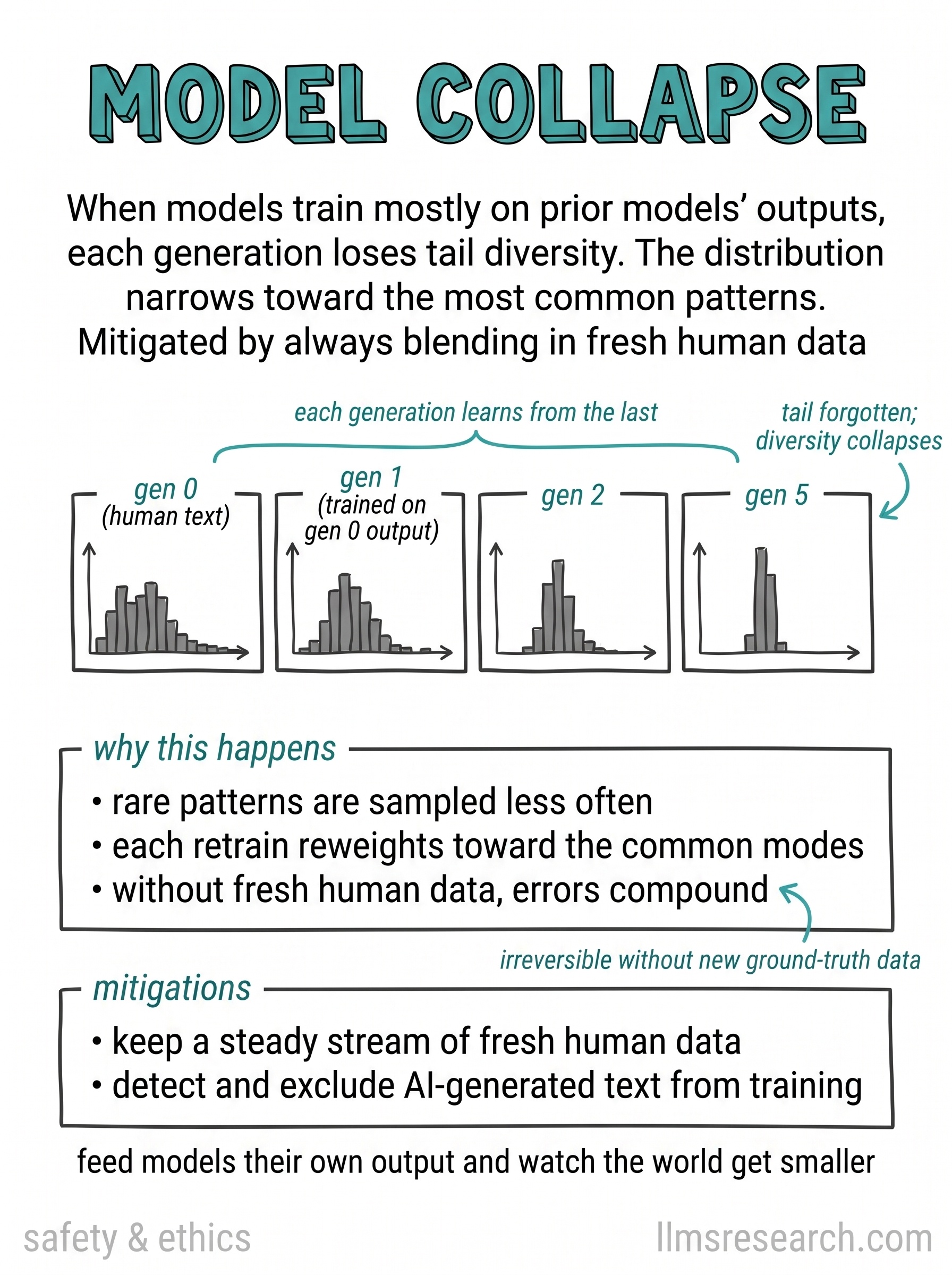
Model collapse is what happens when training data stops looking like the open web and starts looking like last year’s model outputs. The card shows four histograms in a row. Generation zero is human text with a wide, lumpy distribution and a long tail. Each later generation trains on the previous model’s outputs. By generation five the distribution is a single narrow peak. The tail is gone. Diversity collapses.
The mechanism is sampling bias compounded over rounds. Rare patterns appear less often in model-generated corpora than in human text. Retraining reweights toward common modes. Errors and omissions from one generation become the dominant signal for the next. Without fresh ground-truth human data, the process is hard to reverse because each round bakes in the previous round’s shrinkage.
This matters for teams considering synthetic data loops. Generating training text with your own model and feeding it back can cheaply scale data, but it also shifts the corpus toward the model’s existing blind spots. Tail concepts, minority phrasings, and edge cases thin out. Output becomes more uniform even as loss may look stable.
Mitigations are straightforward in principle and hard in practice. Keep a steady stream of fresh human-written data in the mix. Detect and exclude AI-generated text from crawls when building new pretraining sets. Treat collapse risk as a reason to audit synthetic pipelines, not as a reason to avoid them entirely. The card’s tagline states the intuition: feed models their own output long enough and the world in the weights gets smaller.