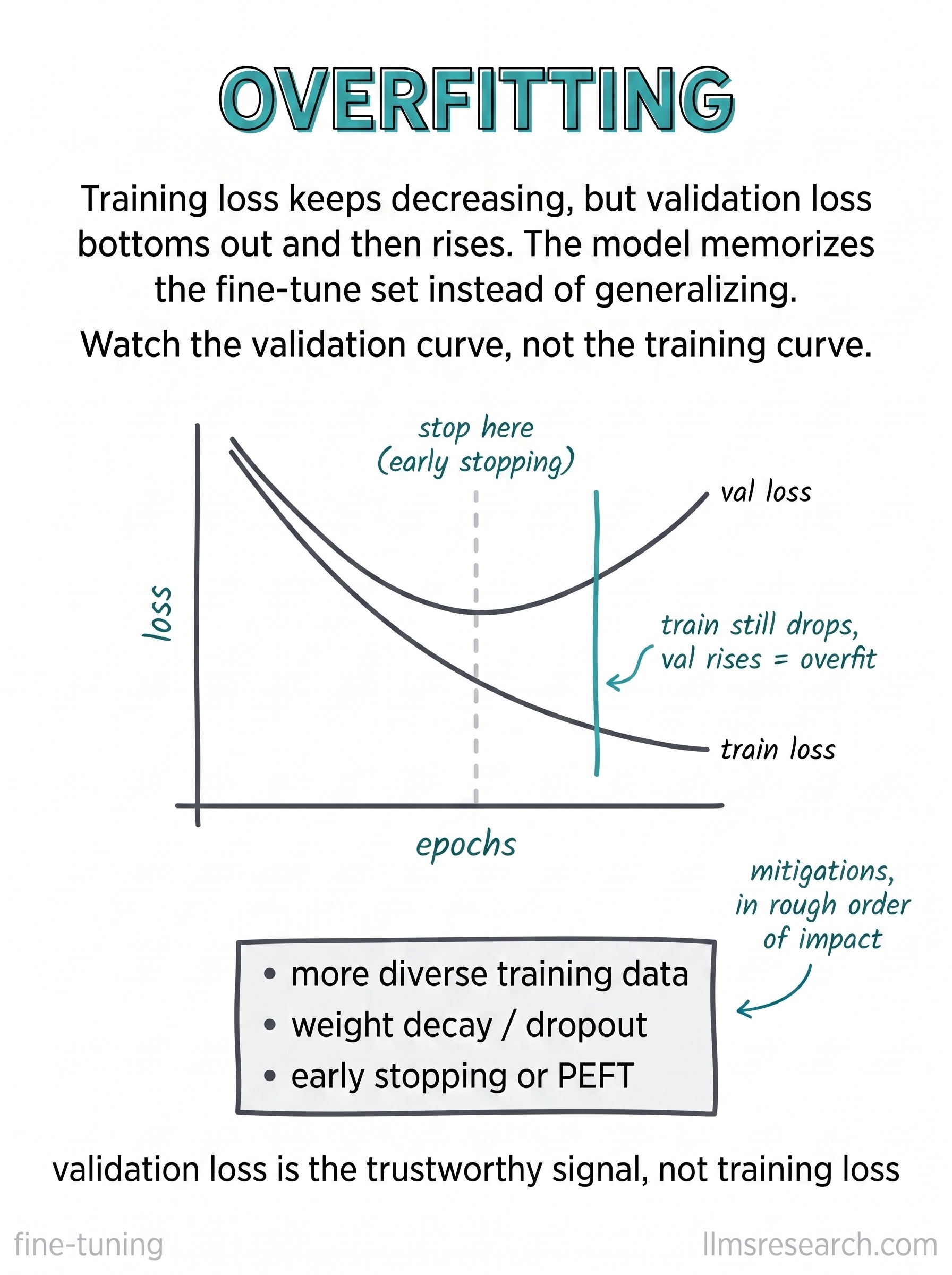
Overfitting is the failure that hides inside a training run that looks like it is going well. The card plots two curves against epochs. The training loss keeps dropping the whole time. The validation loss follows it down at first, reaches a minimum, and then turns back up. The point where they part ways is the moment the model stops learning the task and starts memorizing the specific examples it was trained on.
The reason the two curves diverge is the whole lesson. Training loss measures how well the model fits the data it is being updated on, so it can always be driven lower by memorizing that data more precisely. Validation loss measures performance on held-out examples the model never trains on, which is the thing we actually care about. Once the model begins fitting the noise and idiosyncrasies of the fine-tune set rather than its general structure, it keeps improving on the training set while getting worse on everything else. The card’s annotation names this directly: train still drops, validation rises, that is overfitting. The takeaway line reinforces it, validation loss is the trustworthy signal, not training loss.
Fine-tuning is especially exposed to this because the datasets are small compared to pretraining. A model has enough capacity to memorize a few thousand examples outright, and with limited data it can reach that point in only a few epochs, so the window before overfitting sets in is short. This is the same overfitting risk that made dropout worth reintroducing during fine-tuning even after large-scale pretraining had made it optional.
The card lists three mitigations in rough order of impact. More diverse training data comes first, since giving the model more genuine variation makes memorizing harder and generalizing easier. Weight decay and dropout come next as regularizers that penalize over-precise fits. Early stopping or PEFT comes third: early stopping simply halts training at the validation minimum marked on the plot, and PEFT limits how much the model can memorize by restricting how many parameters can move at all. The next card turns from these fine-tuning failures to a heavier form of adaptation that reruns the pretraining objective itself.