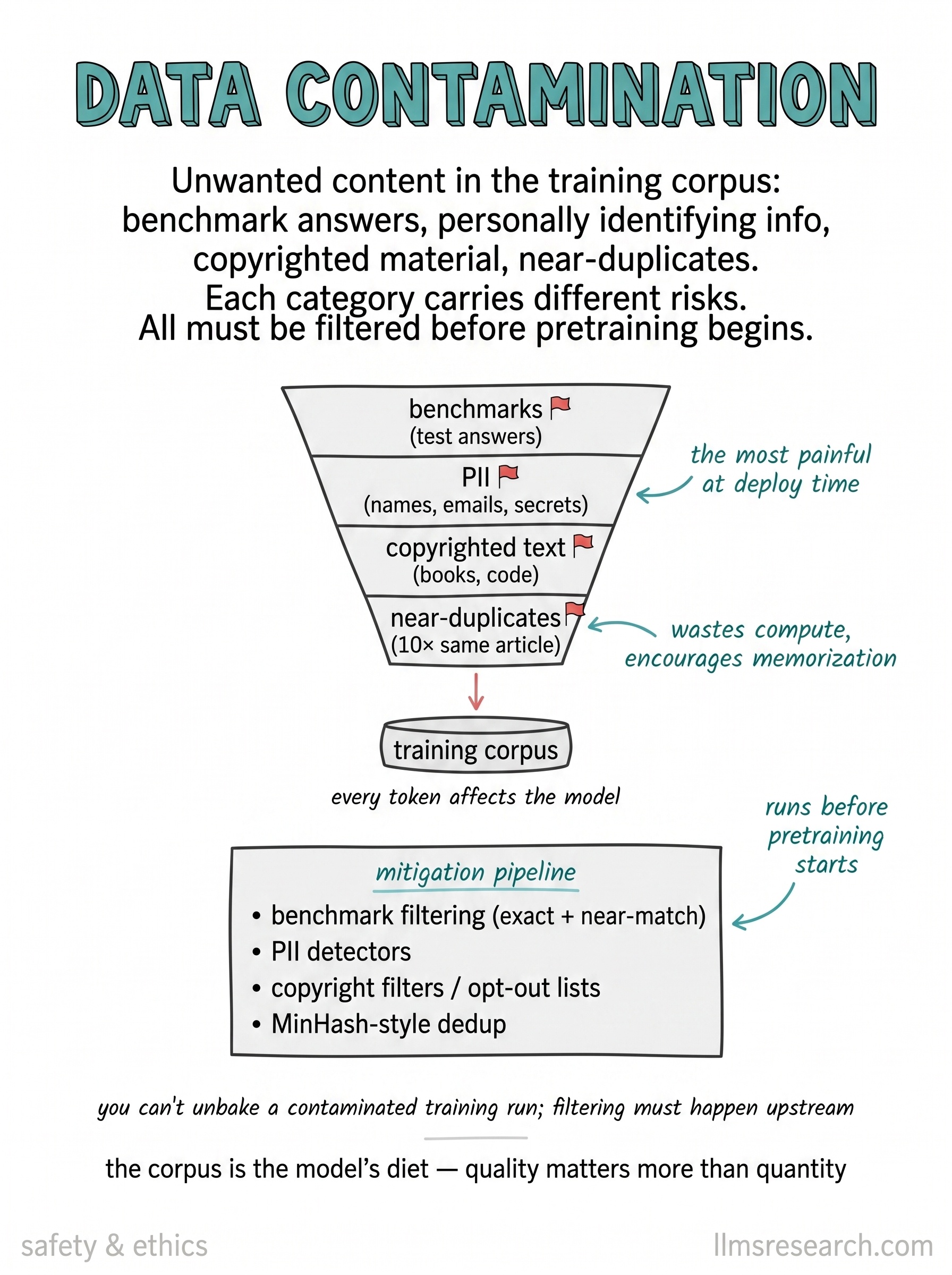
Benchmark contamination is one slice of a larger problem. Data contamination is the umbrella: unwanted content that enters a pretraining corpus and shapes the model in ways you did not intend. The card draws a funnel with four labeled categories. Benchmark test answers inflate eval scores without capability gain. PII such as names, emails, and secrets creates painful deploy-time leaks. Copyrighted books and code create legal exposure. Near-duplicates of the same article waste compute and encourage memorization.
Each category fails differently. PII is annotated as the most painful at deploy time because extraction attacks can surface it in completions. Near-duplicates are annotated as wasteful because they overweight a single source and push the model toward verbatim recall. Benchmark leakage is the eval integrity problem covered on the benchmark contamination card. Copyright sits between legal risk and memorization risk depending on what the model later emits.
The mitigation pipeline runs before pretraining starts. Benchmark filtering with exact and near-match rules. PII detectors on crawled text. Copyright filters and opt-out lists aligned with publisher policies. MinHash-style deduplication to collapse near-identical documents. The annotation stresses timing: you cannot unbake a contaminated training run. Filters belong upstream, not as an afterthought once weights are baked.
The card’s closing line frames the design priority. The corpus is the model’s diet, and quality matters more than quantity. A smaller clean corpus often beats a larger dirty one when the failure modes are leaks, lawsuits, or bogus leaderboard scores. Pair corpus hygiene with post-training probes for memorization and benchmark rephrase tests so contamination risks surface before release, not after users or auditors find them in the wild.