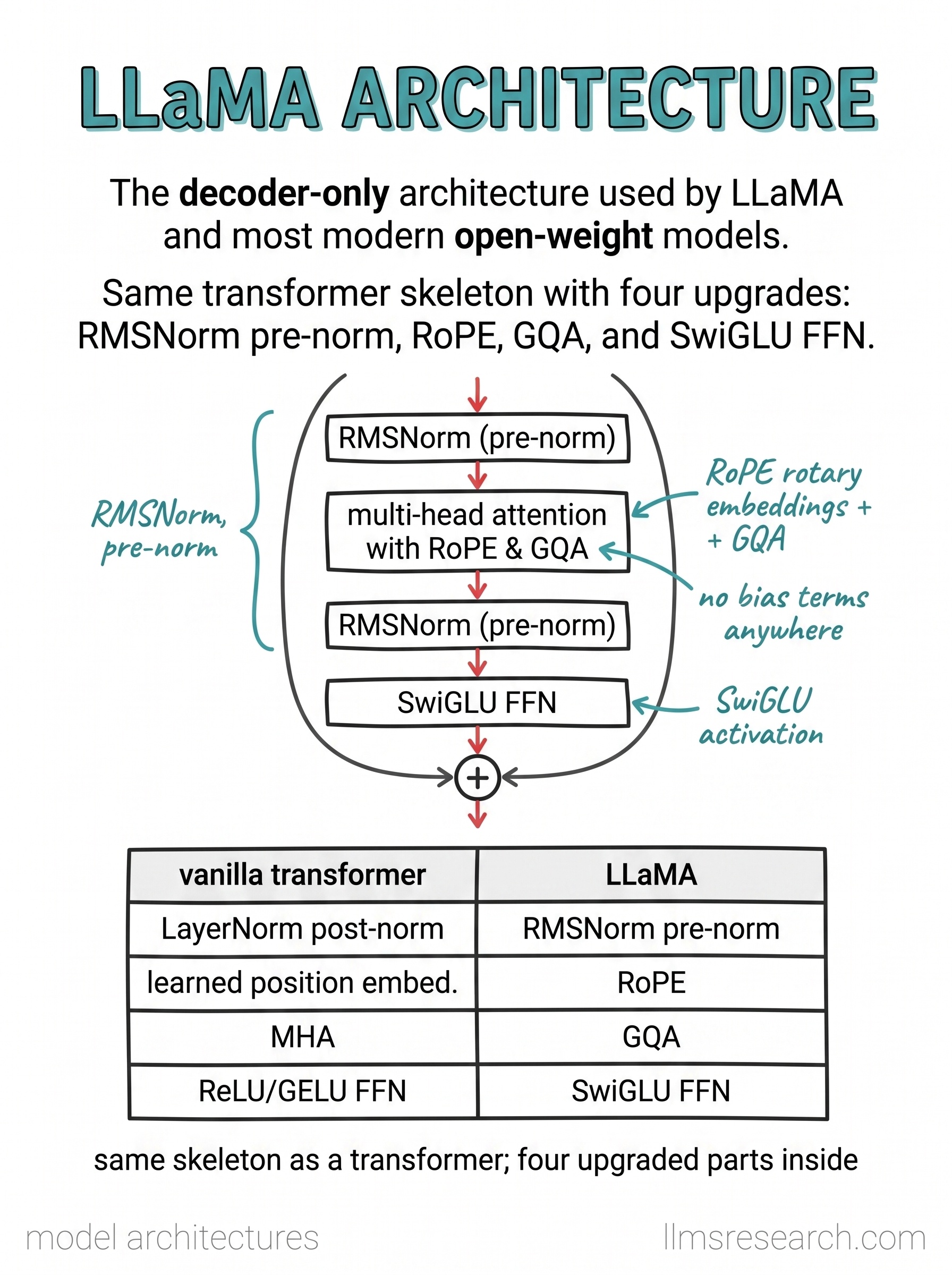
Several earlier cards introduced components as improvements over the original design: RMSNorm, pre-norm placement, RoPE, grouped-query attention, and the SwiGLU feed-forward network. This card is where they come together. LLaMA is not a new architecture so much as the standard decoder-only transformer with each of those swaps applied at once.
The block diagram shows the assembled result. The skeleton is the same as any transformer block: normalize, attend, normalize, feed-forward, with a residual around it. What differs is the specific choice at each slot. Normalization is RMSNorm placed before each sublayer, the pre-norm arrangement. Attention uses RoPE for positions and grouped-query attention to shrink the KV cache. The feed-forward network uses SwiGLU. The annotation adds one detail not covered separately: no bias terms anywhere, a small simplification that modern models adopt because the biases contribute little.
The comparison table is the clearest summary of the deltas. Vanilla transformer against LLaMA, row by row: LayerNorm post-norm becomes RMSNorm pre-norm, learned position embeddings become RoPE, multi-head attention becomes grouped-query attention, and a ReLU or GELU feed-forward network becomes SwiGLU. Each row is a change this course already explained on its own; the table just collects them.
The framing worth keeping is the bottom line: same skeleton as a transformer, four upgraded parts inside. None of these changes alters what a transformer fundamentally does. They are refinements that improve training stability, length handling, memory use, and quality, each validated separately and then combined.
The reason this configuration matters is stated at the top: it is what LLaMA and most modern open-weight models use. When you load a recent open model, this is very likely the block you are running, which makes it the concrete reference point for the rest of the course.