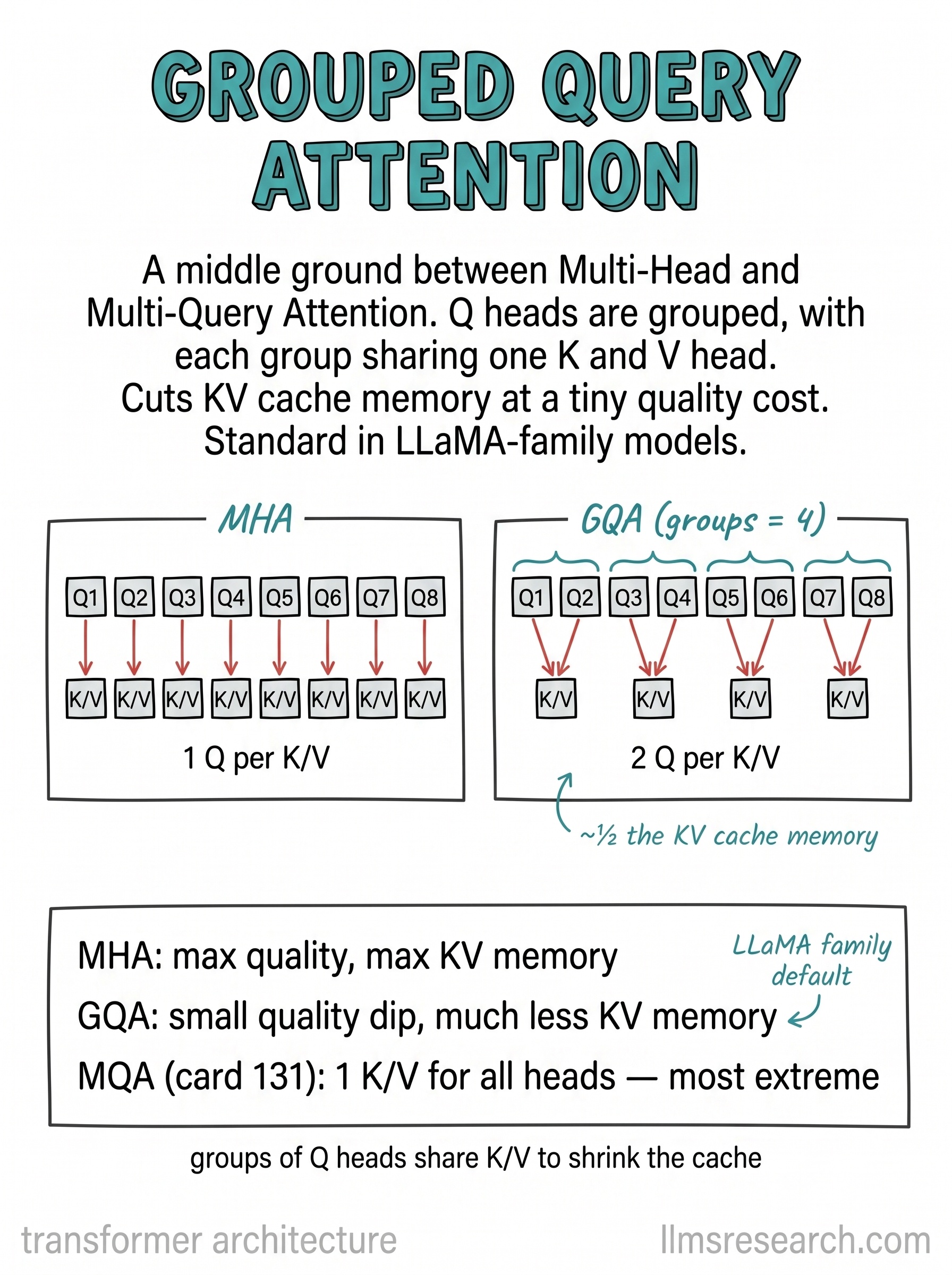
The KV cache grows with the number of attention heads, so one way to shrink it is to use fewer key and value heads than query heads. Grouped-query attention does exactly that, and it has become the default choice for balancing memory against quality.
The two diagrams show the change. On the left, standard multi-head attention gives each of the eight query heads its own key and value head, one Q per K/V. On the right, grouped-query attention with four groups pairs the eight query heads into four groups, and each group shares a single K/V head, so it is two Q per K/V. The queries stay fully independent; only the keys and values are shared within a group. The annotation reports the effect: roughly half the KV cache memory in this four-group example, since there are half as many K/V heads to store.
The reason this works with little damage is that the query heads, which do the actual distinguishing between what different heads look for, remain separate. Sharing keys and values reduces the diversity of what can be matched against, but empirically that loss is small on large models. The summary box frames it as a spectrum: multi-head attention gives max quality at max KV memory, GQA takes a small quality dip for much less memory, and multi-query attention, the next card, pushes to a single K/V head for all query heads as the most extreme point.
The annotation calling GQA the LLaMA-family default is the practical takeaway. When a recent open model reports its attention configuration, it is usually GQA with some number of groups, chosen to fit the KV cache within a memory budget while keeping quality close to full multi-head attention.
The bottom line, groups of query heads share keys and values to shrink the cache, is the whole idea. The next card takes the same axis to its endpoint with multi-query attention.