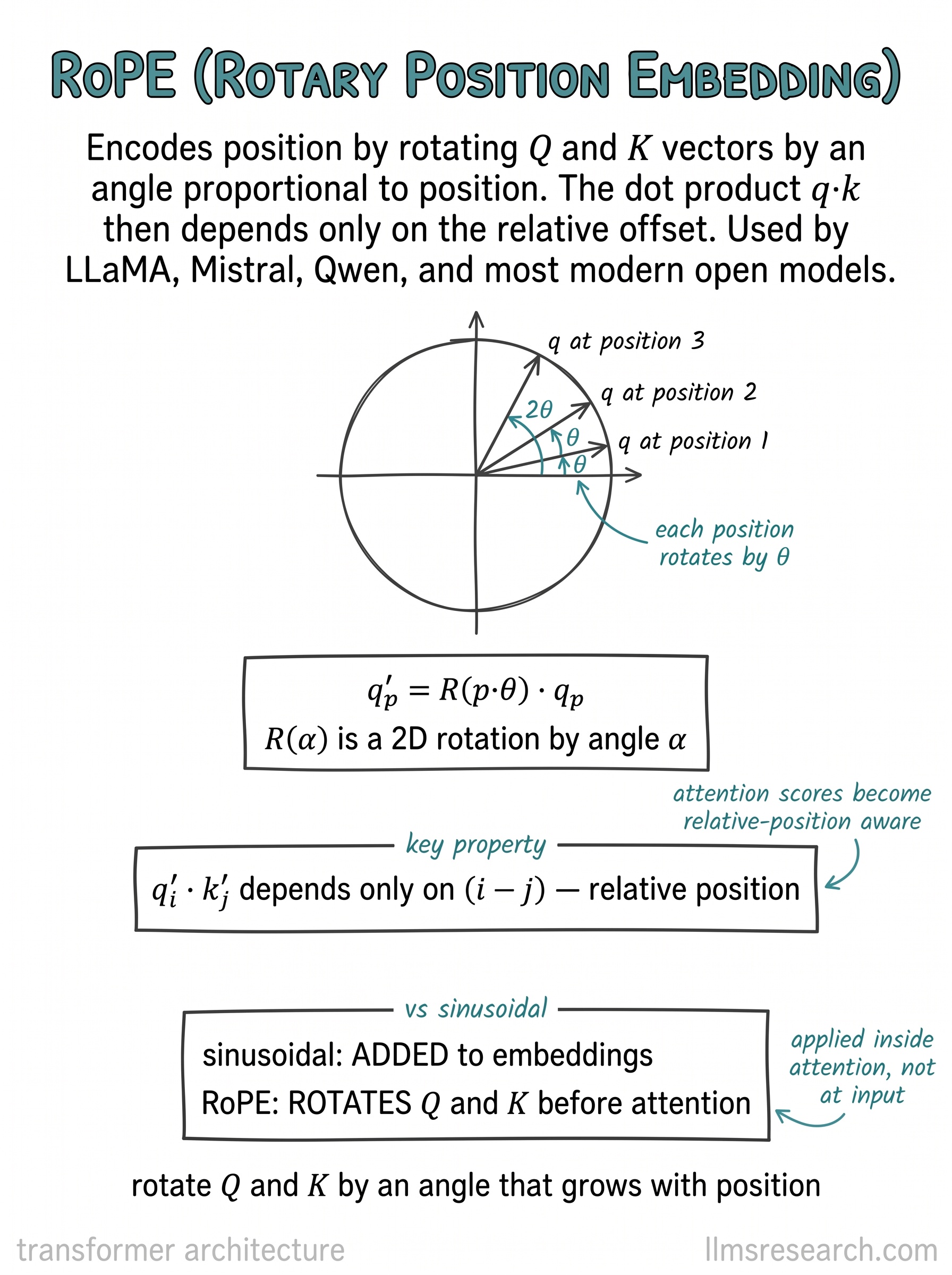
The earlier position methods add a vector at the input and then let attention run. RoPE takes a different route: it leaves the input alone and instead rotates the vectors that attention uses, and this small change is why nearly every modern open model, LLaMA, Mistral, Qwen, uses it.
Attention scores come from the dot product of a query and a key, terms the next cards define. RoPE rotates each query and key by an angle proportional to its position before that dot product is taken. The card shows a query at positions 1, 2, and 3 as the same vector rotated by one, two, and three steps of an angle. The formula states it as multiplying the vector by a rotation of position times theta.
The payoff is the key property on the card. When you take the dot product of a rotated query at position i and a rotated key at position j, the result depends only on the difference i minus j, the relative offset between them, not on where the pair sits in absolute terms. Rotations compose by adding angles, so the absolute rotations cancel and the relative one remains. Attention scores become a function of how far apart two tokens are, which is usually what actually matters.
The comparison at the bottom is the crisp summary. Sinusoidal encoding is added to embeddings at the input; RoPE rotates queries and keys inside attention. Because the position signal lives in the geometry of the dot product rather than in a fixed table, RoPE extrapolates to longer contexts more gracefully than learned embeddings and has become the default.
This is also the first card that leans on the query and key vectors as if they were familiar. They are the subject of the attention cards that follow, so if the mechanism feels thin here, it fills in shortly.