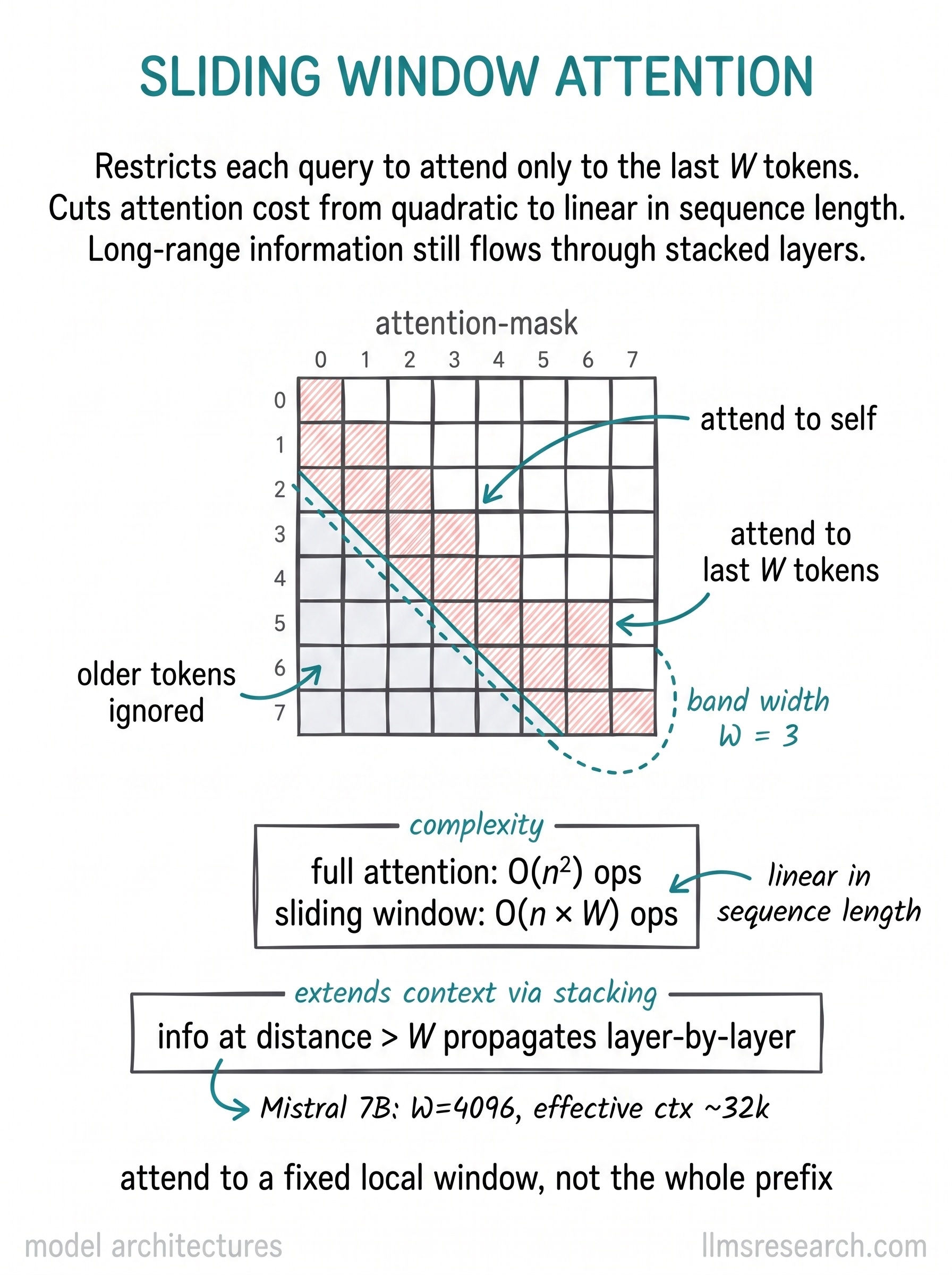
Flash Attention keeps full attention but computes it more efficiently. Sliding-window attention takes a different route: it changes what each token is allowed to see, trading exact global attention for a cost that grows only linearly with length.
The mask on the card shows the rule. With a band width of three, each query attends to itself and the two tokens before it, the shaded band along the diagonal. Older tokens outside that band are ignored entirely. This is a stricter version of the causal mask: causal attention lets a token see all earlier positions, while sliding-window attention sees only the last W of them. The complexity box gives the payoff: full attention is order N squared operations, sliding window is order N times W, which is linear in sequence length once W is fixed.
The obvious worry is that a token then cannot access information from far back. The card’s answer is stacking. Because each layer lets information move up to W positions, a token at one layer can indirectly reach content up to W positions away, and after several layers that reach compounds. Information at a distance greater than W propagates layer by layer rather than in a single hop. The effective context is therefore larger than W, though reaching distant information is indirect and depends on depth.
The concrete example is Mistral 7B with a window of 4096 and an effective context around 32k. That gap between the 4096 window and the 32k effective context is exactly the stacking effect: roughly W times the number of layers of reach, not W alone.
The bottom line, attend to a fixed local window rather than the whole prefix, marks the tradeoff. Unlike Flash Attention this does change the computation and can miss long-range detail that a hop through layers fails to carry, but for many tasks the local window captures most of what matters, and the linear cost is what makes very long sequences affordable.