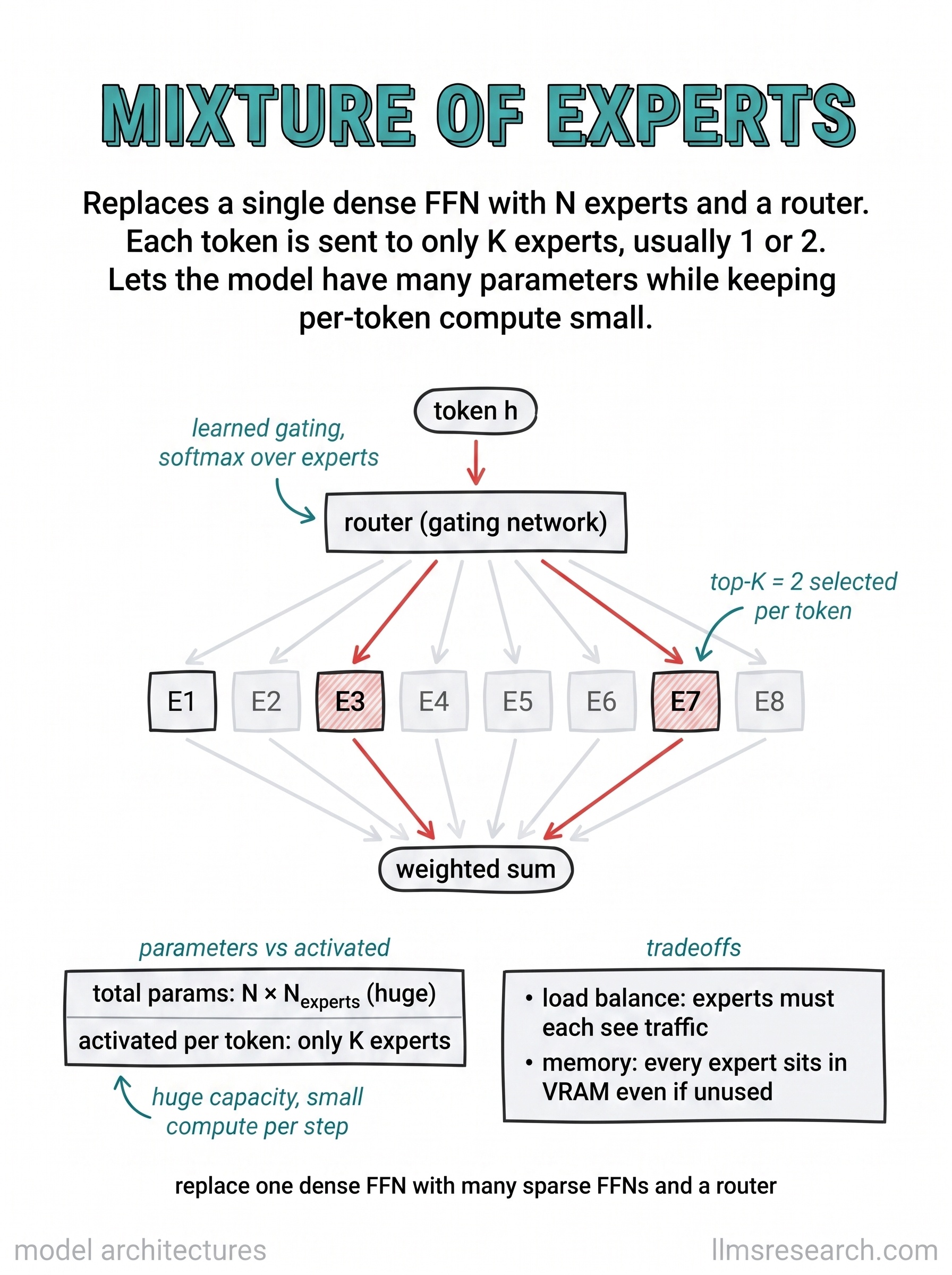
The FFN card noted that the feed-forward network holds most of a transformer’s parameters and most of its compute. Mixture of experts breaks the link between those two by making the parameters large while keeping the compute per token small.
The diagram traces one token through the mechanism. Instead of a single FFN, the block has N experts, here eight, and a router, also called the gating network. The router reads the token and scores the experts, a softmax over experts as the annotation notes, then selects the top K, shown as two: E3 and E7. Only those two experts run. Their outputs are combined into a weighted sum using the router’s scores, and that becomes the block’s output. The other six experts sit idle for this token. A different token may route to a different pair.
The left box is the whole point. Total parameters scale with the number of experts, which can be very large, but the activated parameters per token are only the K experts that fire. A model can therefore hold a large parameter count for capacity while each token pays for just a small slice of it. That is why MoE models advertise two numbers, total and active, that differ by a wide margin.
The tradeoffs on the right are the reasons it is not universal. Load balancing is a real training problem: if the router favors a few experts, the rest never learn, so models add auxiliary losses to spread traffic across experts. Memory is the other cost. Every expert must sit in VRAM whether or not a given token uses it, so the savings are in compute, not in memory footprint. An MoE model needs the memory of its full parameter count even though it computes as if it were much smaller.
The bottom line, replace one dense FFN with many sparse FFNs and a router, is the design in a sentence. It is the main way current frontier models push parameter counts far past what dense scaling alone would allow.