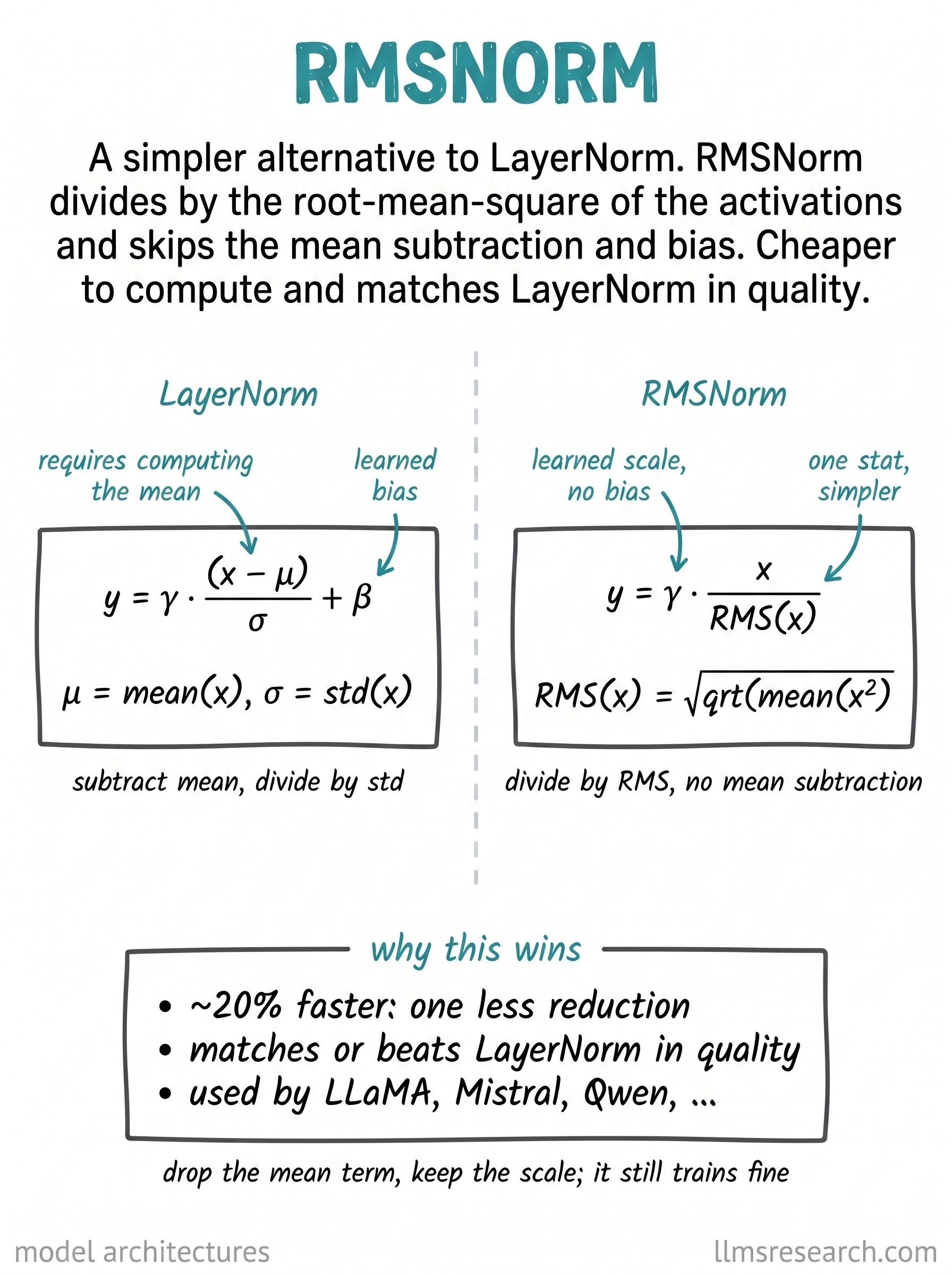
LayerNorm does two things to each token’s vector: it removes the mean and it divides by the standard deviation. RMSNorm asks whether the first of those is worth its cost, and the answer that held up in practice is that it mostly is not.
The two formulas side by side make the difference concrete. LayerNorm subtracts the mean mu, divides by the standard deviation sigma, then applies a learned scale and a learned bias. RMSNorm keeps only the scale. It divides by the root-mean-square of the activations, which is the square root of the mean of the squared entries, and it uses no mean subtraction and no bias term. Computing the mean and then the variance around it is two passes over the vector; the root-mean-square is a single statistic. That is what the card means by one stat, simpler.
The savings look small on paper and they are, per call. The reason it matters is that normalization runs before or after every sublayer in every layer, so a modest constant multiplies across the whole network. The card puts the effect at roughly twenty percent faster from one less reduction, and reports that quality matches or slightly beats LayerNorm. That combination, cheaper with no measured cost, is unusual enough that adoption was quick.
The bottom line is worth taking at face value: drop the mean term, keep the scale, and it still trains fine. There is no deep theoretical guarantee being claimed here. The mean subtraction turned out to contribute little once the model has a learned scale to work with, so removing it is close to free.
The named users are the tell for how settled this is. LLaMA, Mistral, and Qwen all use RMSNorm, which is why it appears here under model architectures rather than as a transformer fundamental. It is the default normalization in the current generation of open models, paired most often with the pre-norm placement discussed next.