Dense retrieval matches meaning. A query about “refund policy” can find a passage that never uses those exact words but describes returns in different terms. Sparse retrieval matches terms. It excels when the query contains specific identifiers, product codes, or rare words that must appear literally in the document. Neither approach covers every query type on its own.
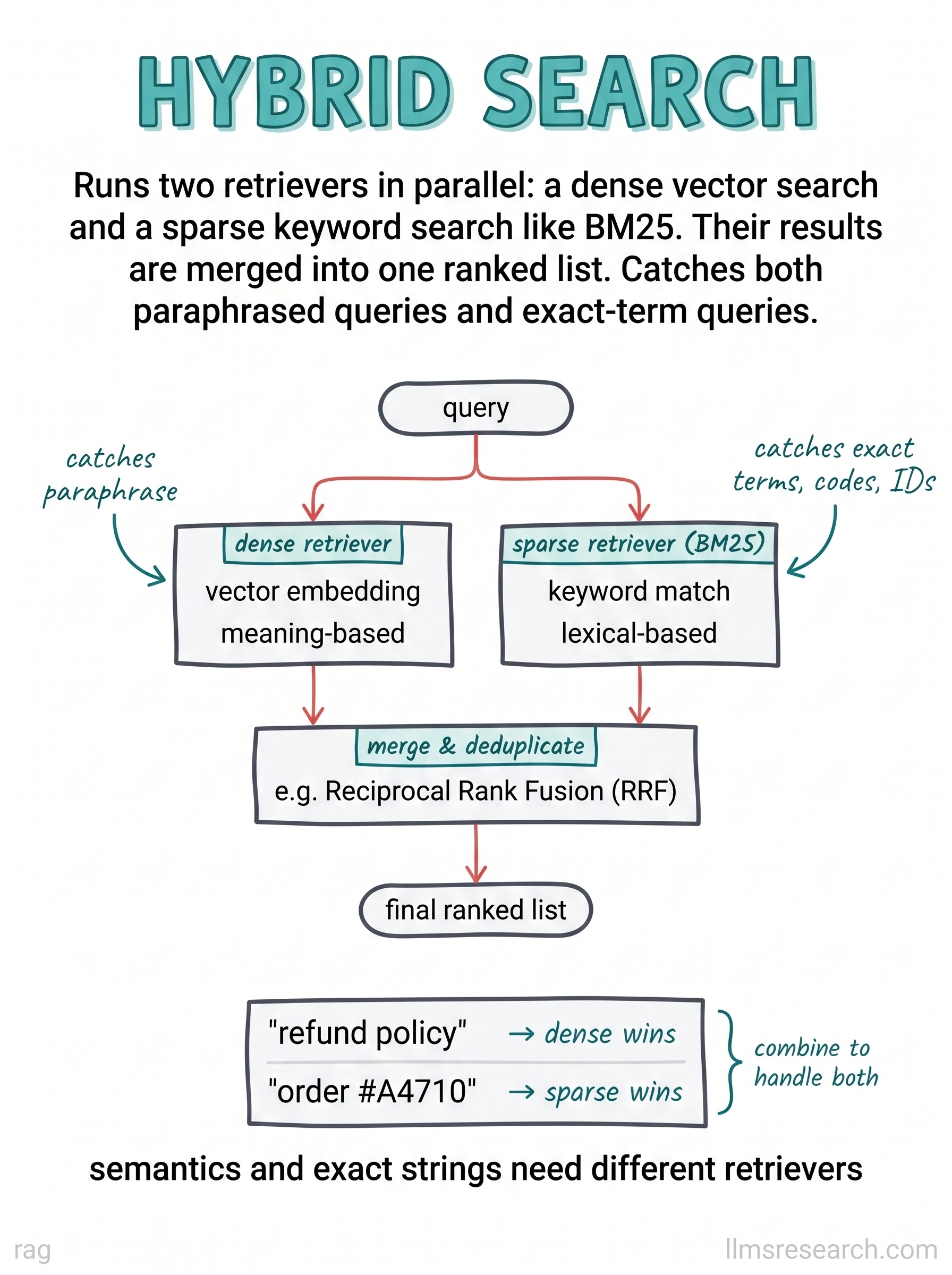
The card draws a Y-shaped fork. A single query splits into two parallel retrievers. The dense branch embeds the query and searches by vector similarity. The sparse branch runs a lexical method like BM25, scoring documents by term overlap with length normalization. Both branches return ranked lists over the same corpus, which are then merged and deduplicated into one final ranking. Reciprocal Rank Fusion is a common merge strategy that combines ranks without requiring scores to be on the same scale.
The examples at the bottom show where each branch wins. A paraphrased question like “refund policy” tends to favor dense search, because the relevant passage might say “returns within thirty days” without sharing keywords. A query like “order #A4710” tends to favor sparse search, because the answer hinges on an exact string match that embedding similarity may miss. Production systems often see both query shapes in the same traffic.
Hybrid search is not about picking one retriever forever. It is about running both and letting the merge step surface candidates that either method alone might rank too low. The added complexity is real: two indexes to maintain, two query paths, and a merge policy to tune. The benefit is higher recall across mixed query types.
The practical takeaway is to consider hybrid retrieval when your corpus contains structured identifiers alongside prose, or when users phrase questions both literally and loosely. Start with dense-only for a semantic FAQ, add sparse when exact-match failures show up in eval, and measure the merged result rather than either branch in isolation.