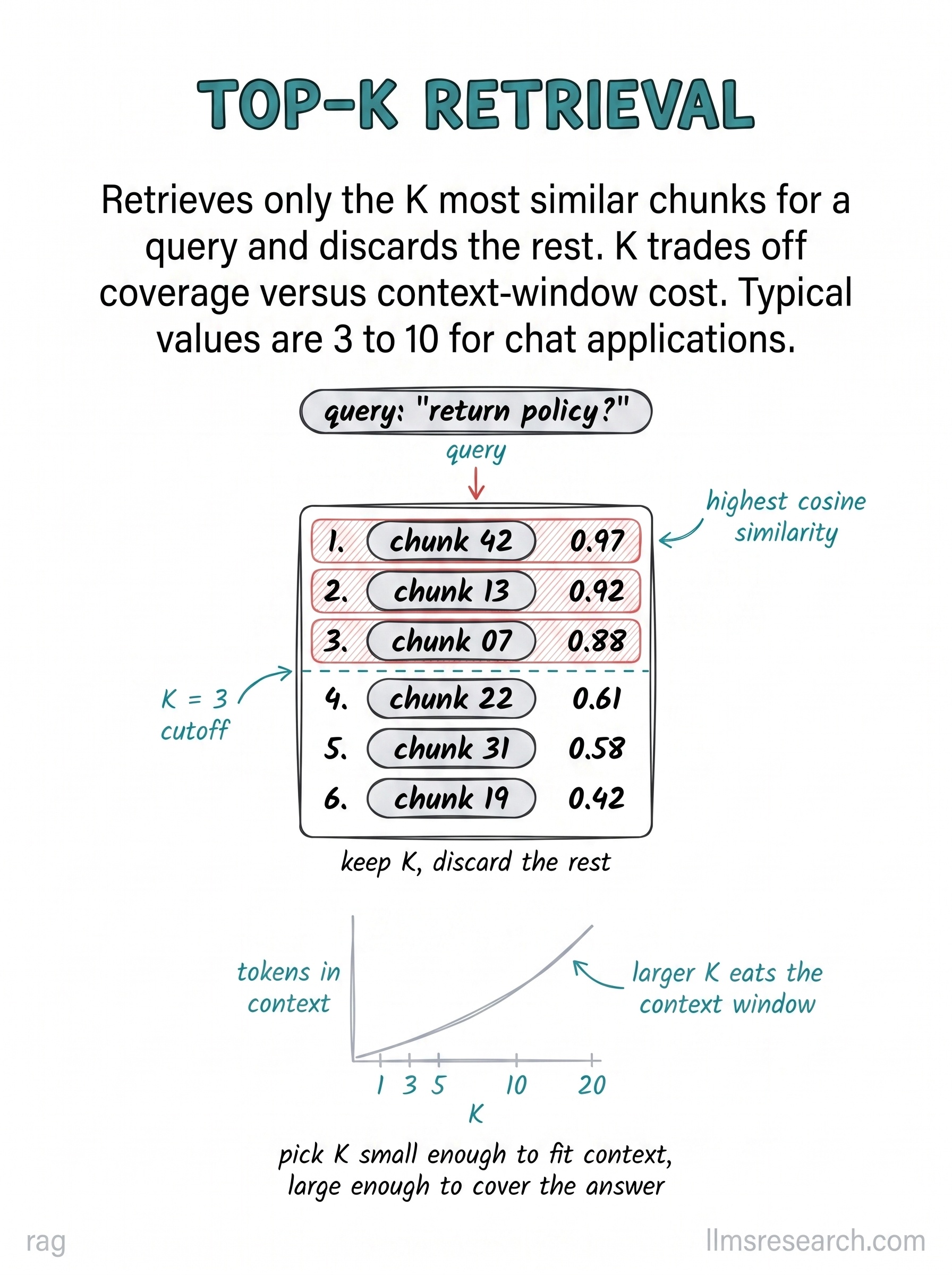
Similarity search returns a ranked list of candidates. Top-K retrieval is the step that decides how many of those candidates actually enter the prompt. K is not a cosmetic setting. It directly controls how much evidence the model sees and how many tokens the context consumes.
The card shows a ranked list of six chunks scored against a query about return policy. Chunk 42 scores highest at 0.97, followed by chunks 13 and 07. A dashed cutoff at K equals three highlights the top three rows and discards the rest. The lower chunks may still be somewhat related, but they are not similar enough to justify the token cost of inclusion. Keeping K tight focuses the model on the best matches.
The line chart below plots K against tokens in context. As K grows, the token count rises roughly linearly because each additional chunk adds its full text to the prompt. Larger K improves the chance that the answer sits somewhere in the retrieved set, but it also eats the context window, increases latency, and can dilute the model’s attention across marginally relevant passages.
There is no single correct K. A narrow FAQ with short chunks may work well at K equals three. A research assistant pulling from long technical documents might need K equals ten or more, especially before reranking narrows the list. Some pipelines retrieve a larger K internally, rerank down to a smaller set, and only then stuff context into the prompt.
The practical takeaway is to pick K small enough to fit your context budget and large enough to cover the answer in eval. Measure on real queries rather than defaulting to an arbitrary number. If the right chunk consistently appears at rank four or five, raise K or improve embeddings before adding generation-side fixes.