A vector database may hold billions of embeddings. Comparing the query against every stored vector on each request is exact but slow, scaling linearly with corpus size. Approximate nearest neighbor search accepts a small accuracy tradeoff in exchange for query times that stay practical at scale.
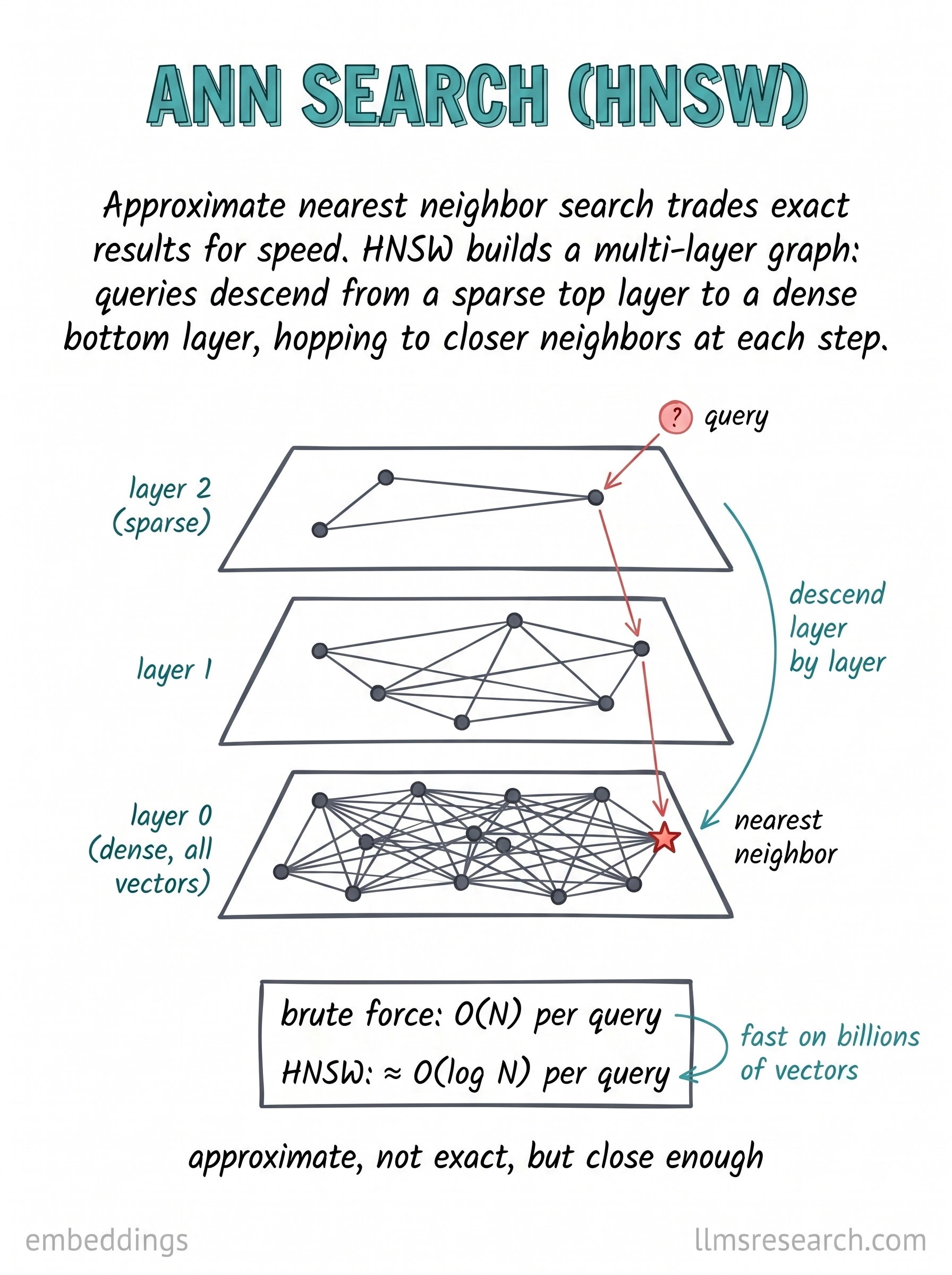
The card shows HNSW, Hierarchical Navigable Small World, one of the most widely used ANN algorithms. Three horizontal layers form a stack. The top layer is sparse, with only a few nodes and long-range links. The bottom layer is dense, with every vector present and many local connections. A query enters at the top, lands on a nearby node, then descends layer by layer, moving to closer neighbors at each step until it reaches the bottom layer and finds an approximate nearest neighbor.
The navigation path is the key idea. Instead of scanning the full corpus, the query hops through a graph structure that was built at index time. Long links at the top layers provide coarse jumps across the space. Short links at the bottom layers refine the position. The result is not guaranteed to be the true nearest neighbor, but it is usually close enough for retrieval, where ranking roughly correct passages matters more than finding the mathematically optimal one.
The complexity comparison at the bottom states the gain plainly. Brute force search costs O(N) per query, one comparison per stored vector. HNSW typically costs around O(log N), with the exact constant depending on graph parameters like how many neighbors each node links to and how many layers the index has. That difference is what makes billion-vector indexes feasible.
The practical takeaway is that your vector database almost certainly uses an ANN algorithm like HNSW under the hood, not exhaustive search. Tune recall versus latency through index parameters, and validate retrieval quality on your own queries rather than assuming exact nearest-neighbor guarantees. For most RAG systems, approximate search is the right default.