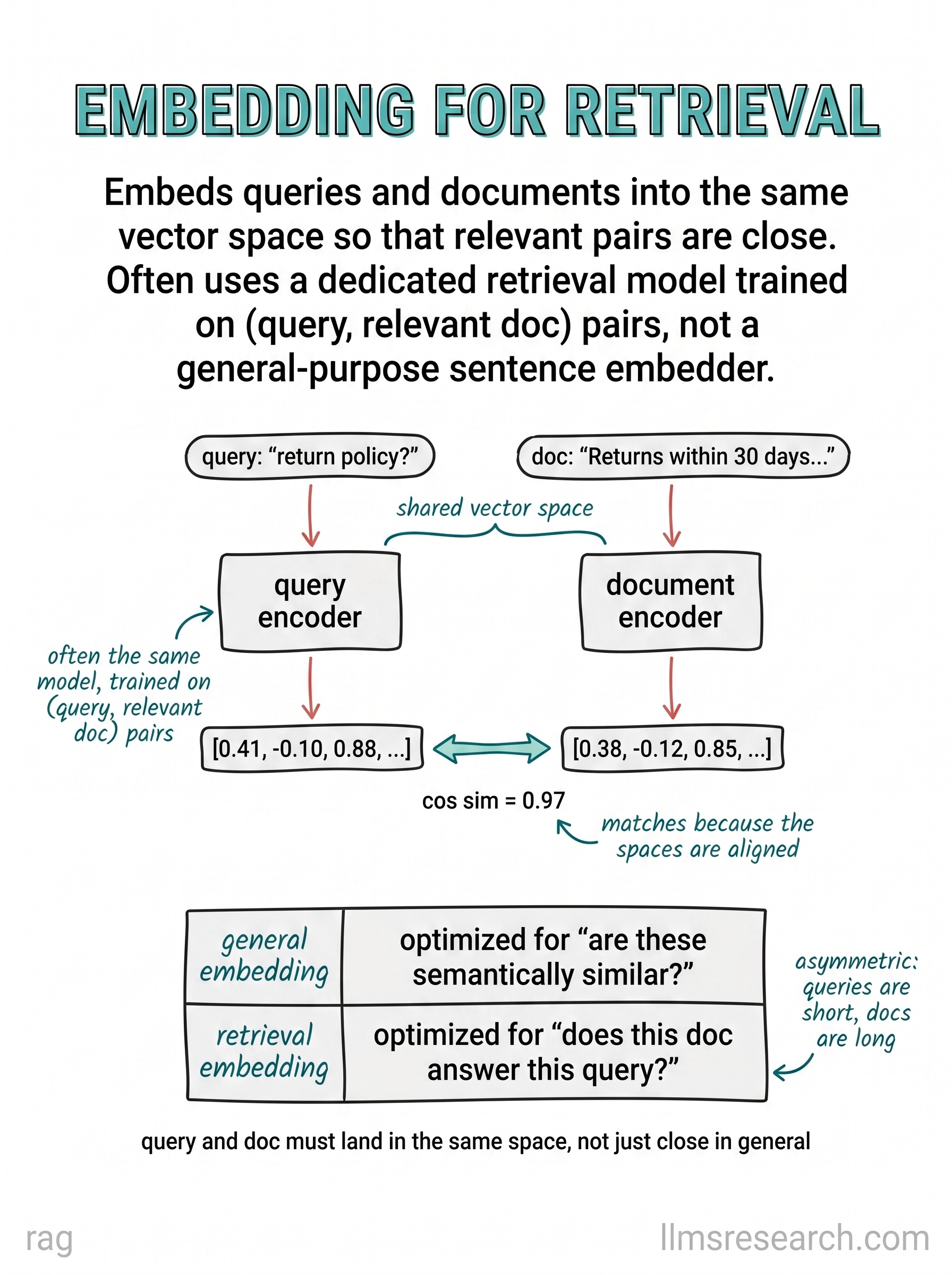
A general sentence embedder asks whether two texts are semantically similar. Retrieval asks a different question: does this document answer this query? Those are related but not identical tasks, and the card shows why the embedding step for search often needs its own design.
The hero is the dual encoder pattern. A query encoder and a document encoder run in parallel, each taking a different input shape. The query side sees a short string like “return policy?” The document side sees a longer passage. Both project into the same vector space, and cosine similarity between the two output vectors scores how well the document matches the query. The card labels this shared space explicitly because alignment between the two encoders is what makes retrieval work.
The comparison table below the diagram states the distinction plainly. A general embedding model is optimized for semantic similarity: are these two things about the same topic? A retrieval embedding model is optimized for relevance: does this passage answer this question? Queries are short and documents are long, so the task is asymmetric. Training on pairs of queries with their relevant documents teaches the model to place answer-bearing passages near the queries that would retrieve them.
Often the two encoders share weights or come from the same base model, but they are fine-tuned on retrieval data rather than on generic similarity benchmarks. Models like E5, BGE, and proprietary retrieval embedders exist specifically for this purpose. Using a general embedder can still work, but relevant documents may rank lower than passages that merely share vocabulary with the query.
The practical takeaway is to treat query and document encoding as a matched pair. Use the same retrieval model for indexing and for querying, and verify that both sides land in the same space. Swapping in a different embedder at query time without re-indexing breaks the alignment the search depends on.