First-pass retrieval has to be fast. Bi-encoder models embed the query and each document separately, then compare vectors with a cheap cosine similarity. That scales to large corpora but only approximates relevance, because the query and document never interact during encoding. Reranking adds a second pass that trades speed for accuracy on a short list of candidates.
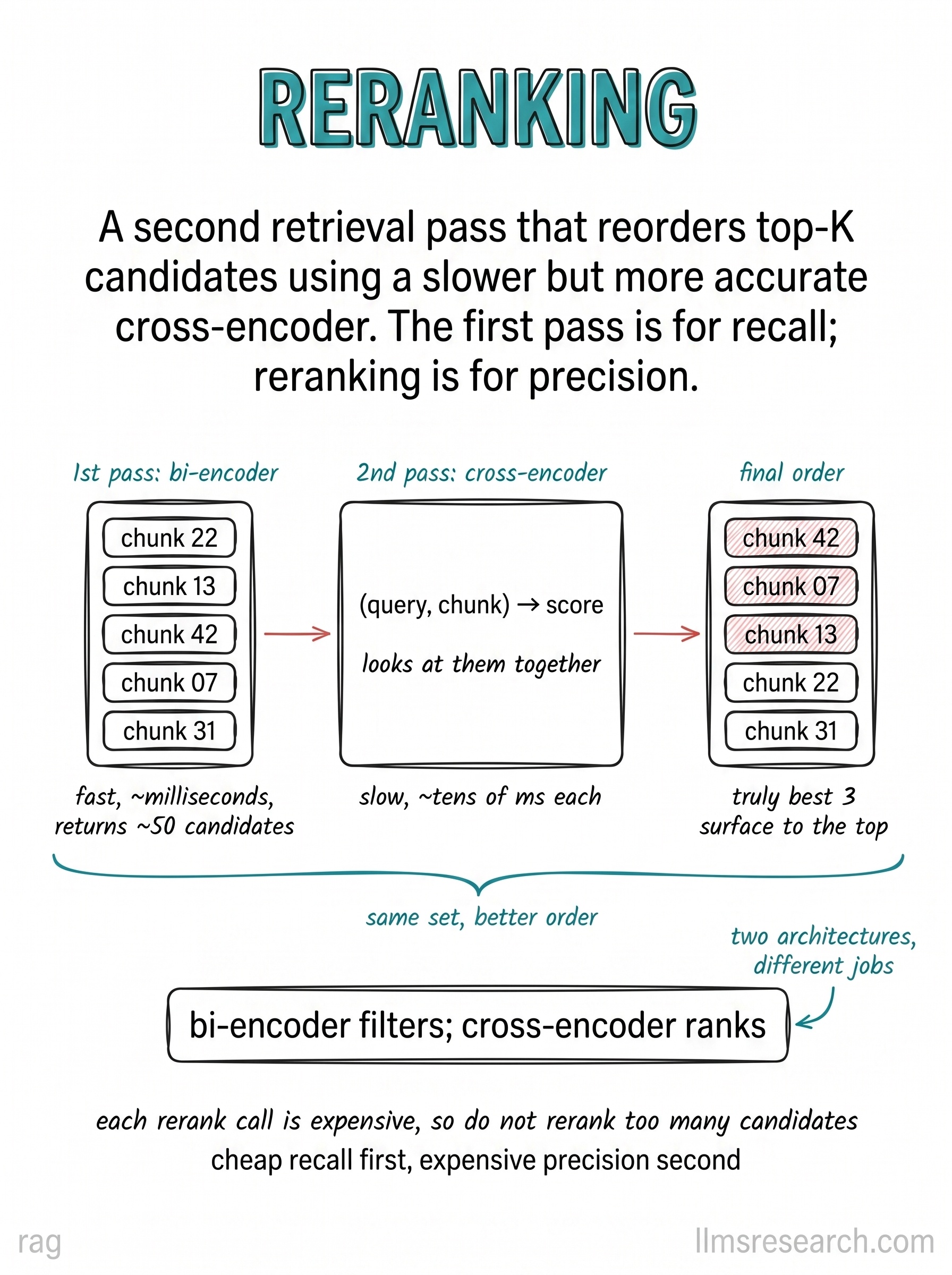
The card shows a three-stage flow. The first pass, labeled bi-encoder, returns roughly fifty candidates in milliseconds. The middle stage is a cross-encoder that scores each query-chunk pair jointly, feeding both texts into one model and producing a relevance score. The final column shows the same chunk ids in a new order, with the truly best passages now at the top. The set of candidates does not change. Only the ranking does.
The architectural difference matters. A bi-encoder produces two independent vectors and compares them at a distance. A cross-encoder attends across query and document tokens together, so it can catch fine-grained signals like negation, entity overlap, and answer completeness. That joint attention is more accurate and more expensive, which is why it runs on tens of candidates, not millions.
The note at the bottom warns against reranking too many items. Each cross-encoder call processes the full query and chunk together, so cost grows with candidate count. The standard pattern is cheap recall first, expensive precision second. Retrieve broadly with a bi-encoder or hybrid search, rerank the top fifty or so, then pass only the top three to five into the generation prompt.
The practical takeaway is to add reranking when first-pass retrieval returns relevant chunks in the candidate set but ranks them poorly. If the right passage never appears in the initial pool, reranking cannot help and the indexing or embedding strategy needs work instead.