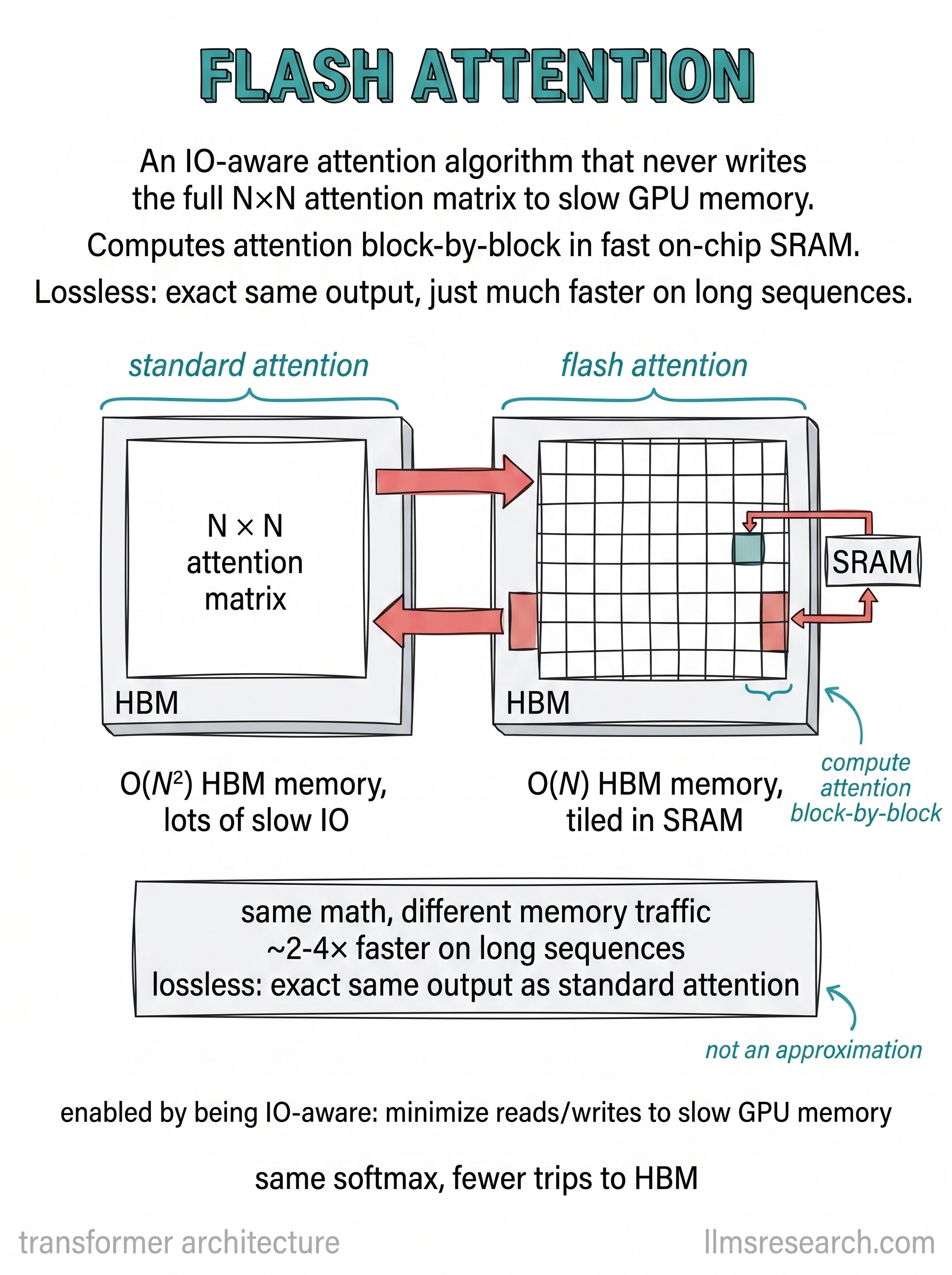
The earlier attention cards described the math. Flash Attention changes nothing about that math; it changes where the intermediate numbers live during the computation. The gain comes entirely from respecting the GPU memory hierarchy.
The two panels show the difference. Standard attention builds the full N by N attention matrix and stores it in HBM, the large but slow GPU memory. That costs memory on the order of N squared and, more importantly, a lot of slow reads and writes moving that matrix in and out. Flash Attention never materializes the full matrix. It processes attention in blocks small enough to fit in SRAM, the fast on-chip memory, computing each block’s contribution and accumulating the result. HBM memory drops to order N, and the traffic to slow memory falls sharply.
The point the card underlines twice is that this is lossless. Same math, different memory traffic, and the label is explicit that it is not an approximation. The output is bit-for-bit the standard attention result, unlike sliding-window attention which genuinely changes what each token can see. Flash Attention only reorganizes the computation, which is why it can be turned on by default with no change to model behavior.
The speedup is reported as roughly two to four times faster on long sequences. The qualifier matters: the benefit grows with sequence length, because that is when the attention matrix is large enough for memory traffic to dominate the cost. On short sequences the difference is small.
The framing to keep is IO-awareness: minimize reads and writes to slow GPU memory, same softmax, fewer trips to HBM. It is a systems optimization rather than a modeling change, and it is one of the main reasons long context became practical to train and serve.