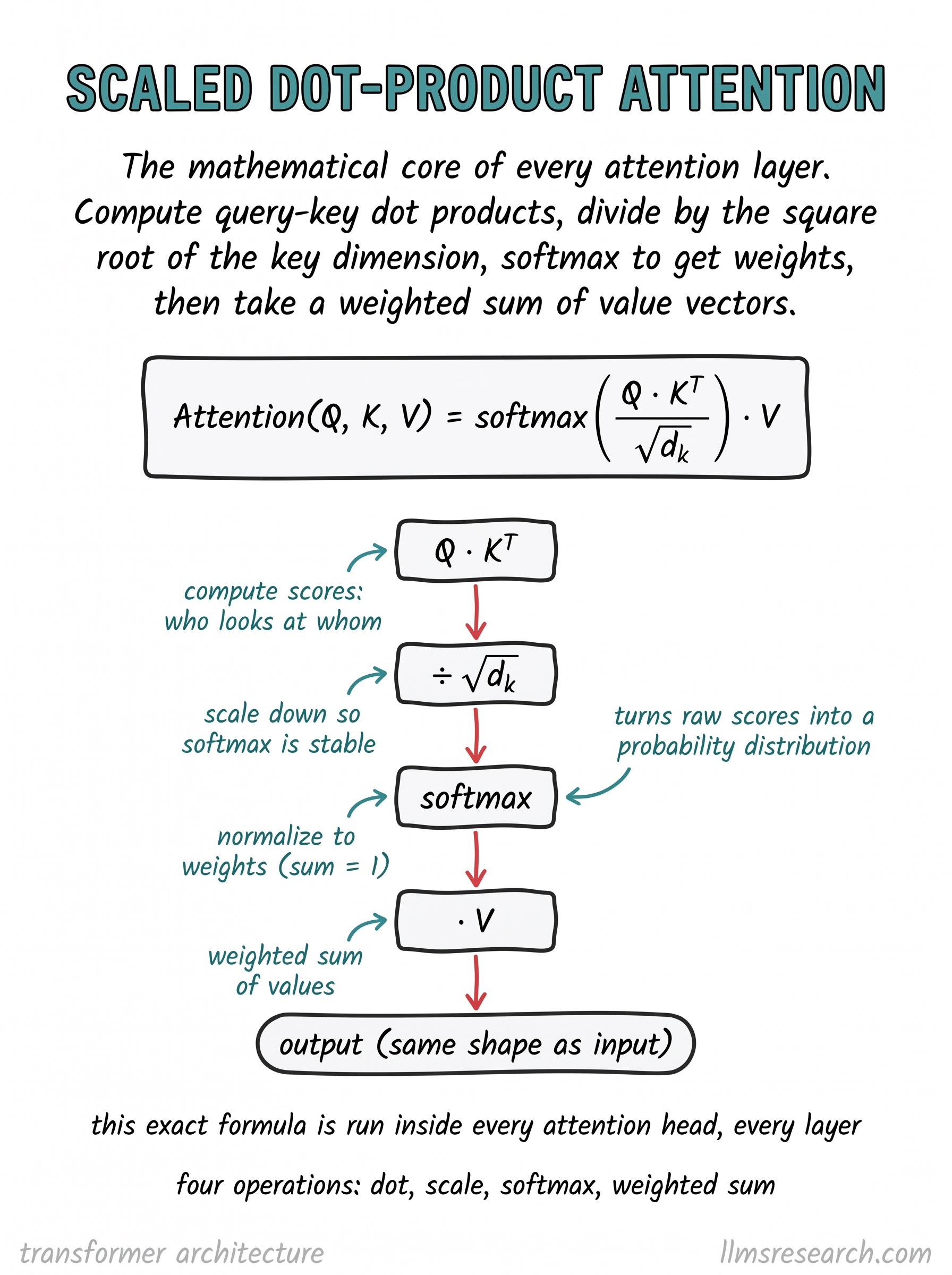
The last two cards described attention in words. This one is the equation, and it is worth reading as four steps rather than one dense line.
The formula is Attention of Q, K, V equals softmax of Q times K transpose over the square root of d_k, all times V. The diagram breaks it into a pipeline. First, Q times K transpose computes the scores, which the card annotates as “who looks at whom”: every query dotted with every key. Second, those scores are divided by the square root of d_k, the key dimension, to keep them in a stable range; the next card is entirely about why. Third, softmax turns the raw scores into a probability distribution, a set of weights that sum to one. Fourth, multiplying by V takes the weighted sum of value vectors. The output has the same shape as the input, so the operation slots cleanly into a stack of identical layers.
Reading it as dot, scale, softmax, weighted sum makes the earlier cards line up. The dot product is the query-key similarity from the QKV card. The softmax produces the weights that the self-attention card summed with. The final multiply by V is that weighted sum. Nothing new is introduced; the formula just names the order precisely.
The note at the bottom is the point to carry forward: this exact formula runs inside every attention head, in every layer. A large model is not doing something more elaborate at each step. It is applying this same four-operation computation many times, with different learned projections each time, which is what the head and multi-head cards cover next.