Grouped-query attention shrinks the KV cache by giving each group of query heads a shared key and value head. Multi-query attention takes that idea as far as it goes: all query heads share a single K and V projection.
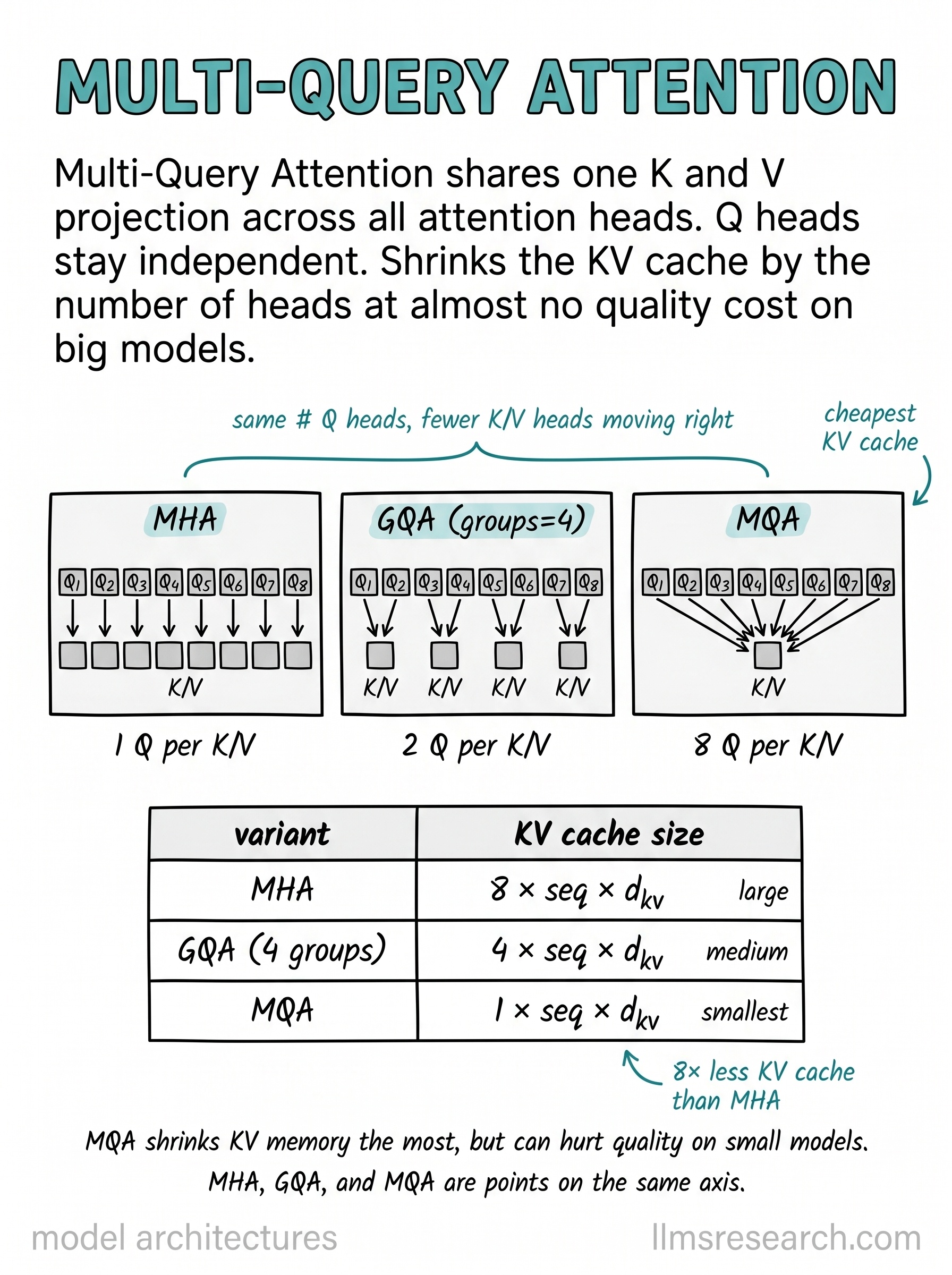
The three panels place the variants on one axis. Multi-head attention has eight K/V heads for eight query heads, one per query. Grouped-query with four groups has four K/V heads, two queries each. Multi-query has a single K/V head that all eight queries attend to, eight Q per K/V. The heading captures the progression: same number of query heads throughout, fewer key and value heads moving to the right, with multi-query giving the cheapest KV cache.
The table quantifies it. KV cache size scales with the number of K/V heads, so multi-head needs eight times sequence length times the per-head dimension, grouped-query with four groups needs four times, and multi-query needs one times, the smallest. The annotation notes multi-query uses eight times less KV cache than multi-head in this eight-head example. Since the KV cache is a major memory consumer during long-context decoding, that reduction directly enables longer sequences and higher throughput.
The tradeoff is stated plainly at the bottom: multi-query shrinks KV memory the most, but can hurt quality on small models. With only one key-value head, every query head must match against the same keys and mix the same values, which limits how differently the heads can behave. Large models have enough capacity elsewhere to absorb this, but smaller ones can lose measurable quality, which is why grouped-query attention became the common compromise.
The closing note, that multi-head, grouped-query, and multi-query are points on the same axis, is the right way to hold all three. The choice is not categorical; it is where on the memory-versus-quality line a given model decides to sit.