Generation happens one token at a time, and a naive implementation redoes an enormous amount of work at every step. The KV cache is the observation that most of that work is identical from step to step, so it need only be done once.
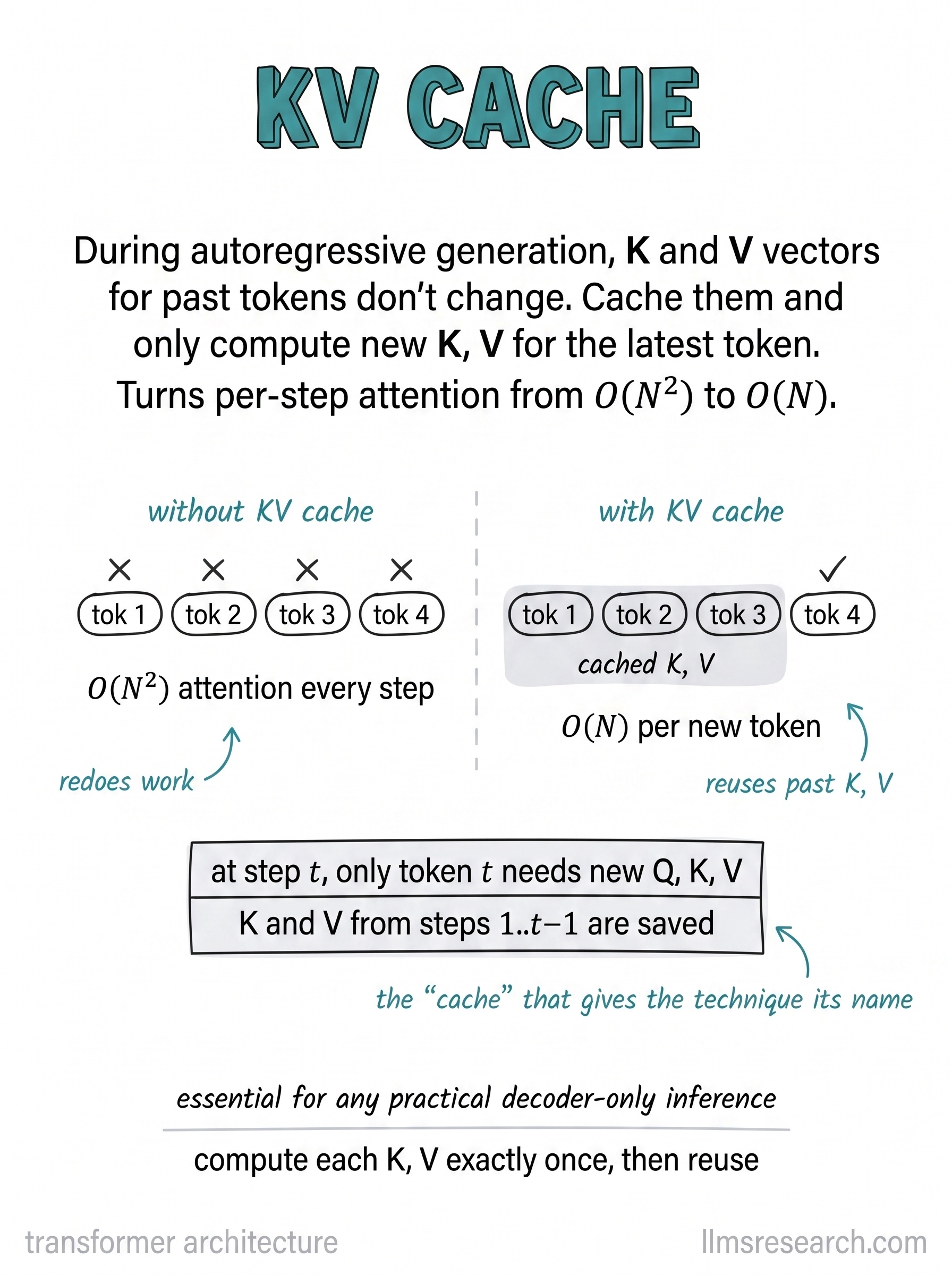
The key fact is at the top: during autoregressive generation, the key and value vectors for past tokens do not change. Token three’s K and V are the same whether the sequence is three tokens long or three hundred. Only the newest token needs fresh K and V computed. The two columns contrast the options. Without the cache, every step recomputes K and V for the whole sequence, so each step costs on the order of N squared and the model redoes work it already did. With the cache, past K and V are stored and only the latest token’s are computed, bringing the per-step cost down to order N.
The lower box states the bookkeeping precisely. At step t, only token t needs a new query, key, and value; the keys and values from steps one through t minus one are saved. That saved store is literally the cache the technique is named for. The query is not cached, because each new token asks its own question of the stored keys and values; only K and V accumulate.
The bottom line is not an overstatement: this is essential for any practical decoder-only inference. Without it, generating a long response would repeat the full attention computation at every token and slow to a crawl. Every serving system keeps a KV cache.
The cache is not free, though. It grows with sequence length and with the number of attention heads, and for long contexts it can dominate memory. That memory pressure is exactly what the next cards address: grouped-query and multi-query attention shrink the cache by sharing keys and values across heads.