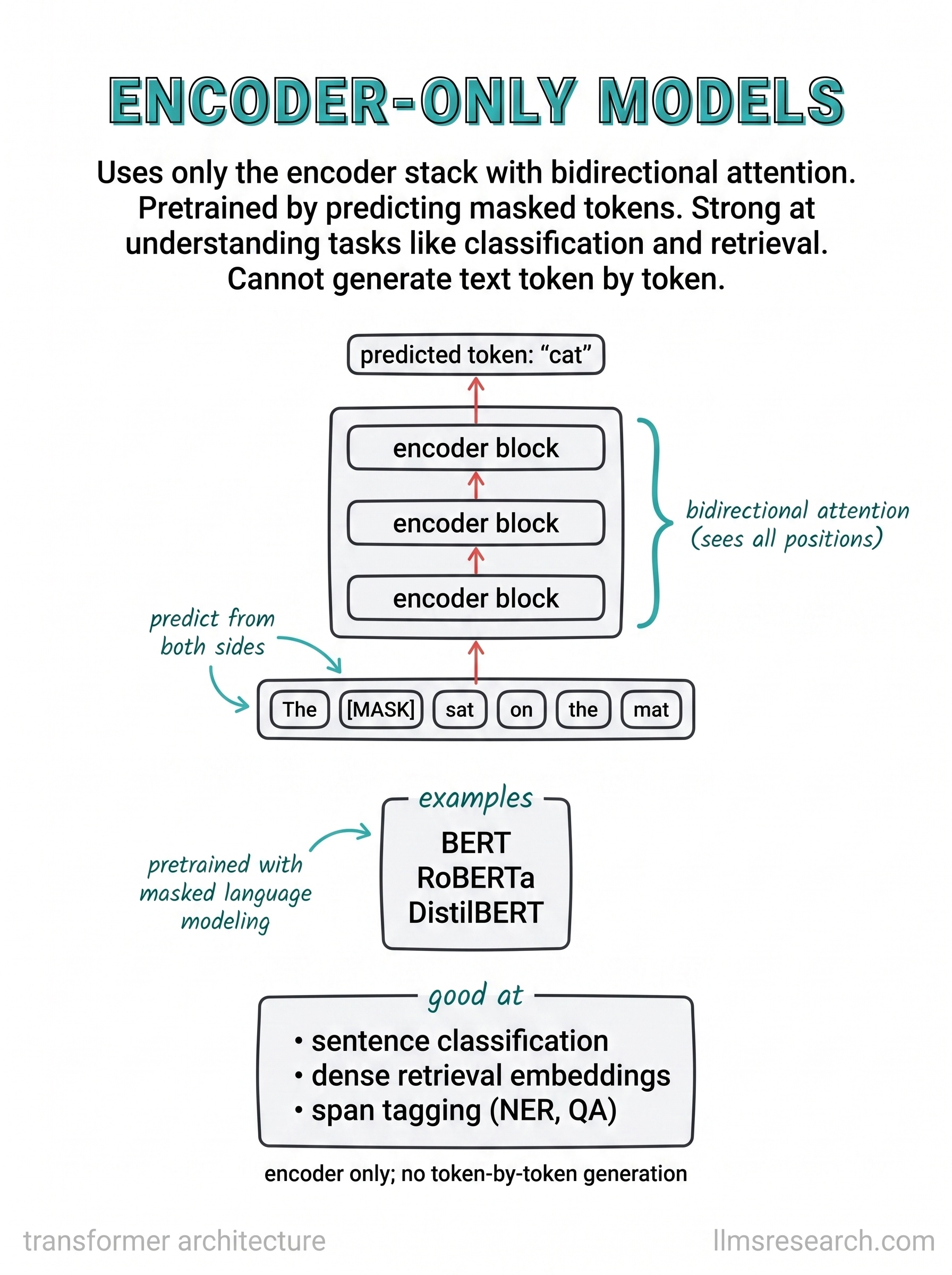
Take the encoder-decoder design and keep only the left half. That is the encoder-only family, and BERT is the model that defined it. The trade it makes is deliberate: give up generation, gain a deep bidirectional read of the input.
The diagram shows a single stack of encoder blocks with no decoder attached. The brace on the right labels the defining property, bidirectional attention that sees all positions. Every token attends to every other token, both left and right, at every layer. The card contrasts this with the causal, past-only attention of the generation models. Seeing the full sentence at once is what makes these models good readers, and it is also exactly why they cannot generate: there is no notion of producing the next token from a prefix when every position already sees the whole input.
The pretraining task is masked language modeling, shown at the bottom of the stack. A token is replaced with a [MASK] placeholder, here the second word, and the model predicts what belonged there, “cat”, using context from both sides. The annotation, predict from both sides, is the point. Because the objective rewards using left and right context together, the learned representations are rich for understanding even though they are useless for left-to-right writing.
The examples and strengths follow from that. BERT, RoBERTa, and DistilBERT are the named models, and the tasks they excel at are sentence classification, dense retrieval embeddings, and span tagging such as named-entity recognition and extractive question answering. These are all cases where you have the complete text and want to label it, embed it, or point to a span within it, not extend it.
The closing line states the boundary plainly: encoder only, no token-by-token generation. That single limitation is what the next card removes by keeping the decoder instead, and the comparison card lays the two families next to the original encoder-decoder.