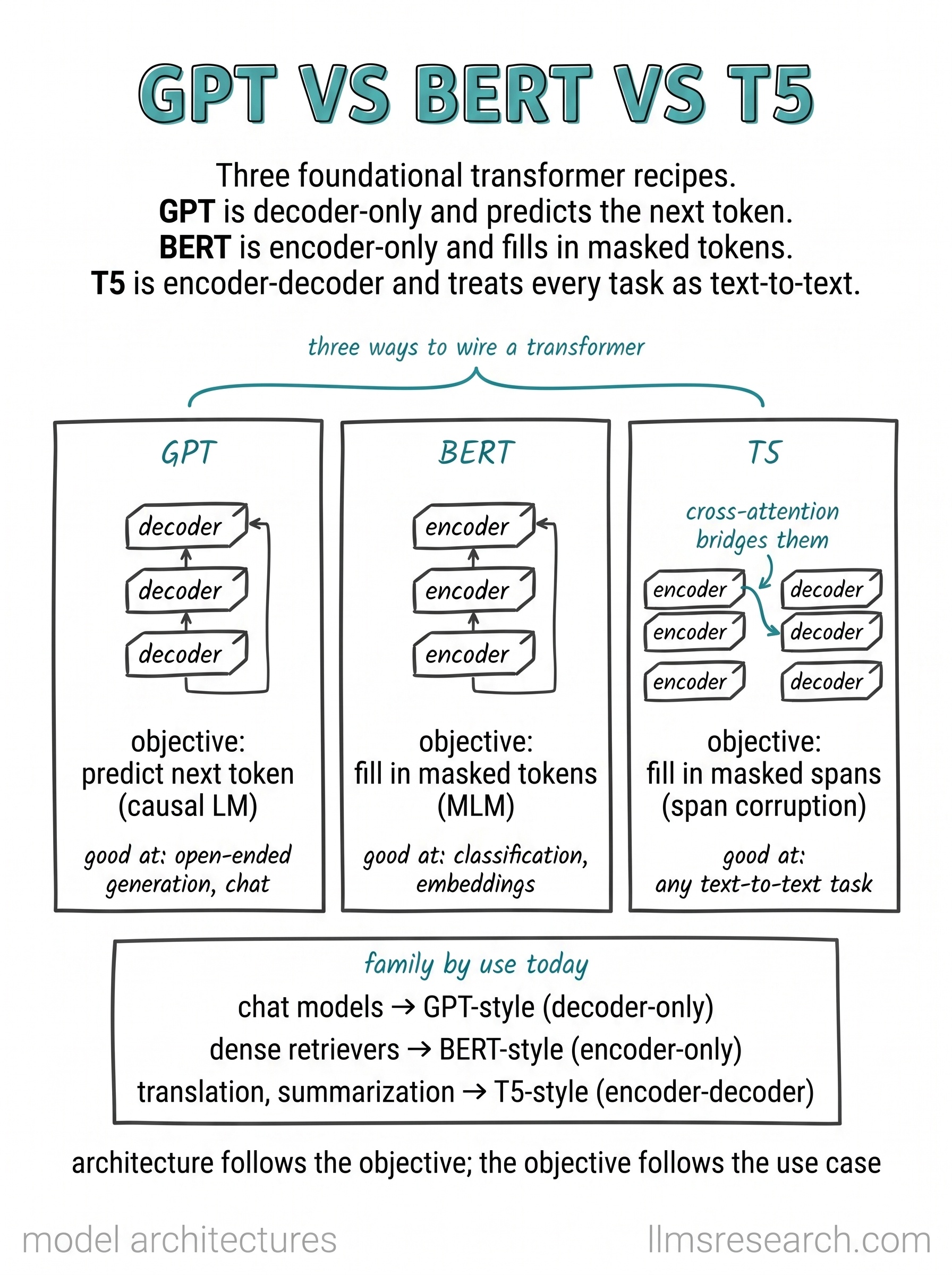
The last three cards each covered one arrangement of transformer blocks. This card places all three together so the pattern behind them is visible: architecture is not chosen for its own sake, it follows from the training objective, which in turn follows from the intended use.
The three columns line up the recipes. GPT is a stack of decoder blocks with causal attention, trained to predict the next token, a causal language model, and it is good at open-ended generation and chat. BERT is a stack of encoder blocks with bidirectional attention, trained to fill in masked tokens through masked language modeling, and it is good at classification and embeddings. T5 keeps both stacks, with cross-attention bridging them as the annotation notes, and is trained to fill in masked spans, called span corruption. Because its input and output are both text, T5 can frame any task as text-to-text.
The distinction worth holding onto is between the objectives. Next-token prediction needs a causal mask, which suits generation. Masked-token prediction wants to see both sides, which suits understanding. Span corruption sits between them, reading a corrupted input and writing the missing spans, which suits transforming one text into another. The architecture in each case is whatever makes its objective learnable.
The family-by-use box reports where each recipe landed in practice: chat models are GPT-style decoder-only, dense retrievers are BERT-style encoder-only, and translation or summarization systems are T5-style encoder-decoder. These are tendencies rather than hard rules. Decoder-only models have grown capable enough that they now handle many tasks once reserved for the other two, which is part of why they dominate today’s frontier systems.
The bottom line is the sentence to carry out of this chapter: architecture follows the objective, and the objective follows the use case. With that, the transformer block and the three ways to wire it into a model are complete, and the next chapter turns to scaling attention itself.