This is the other half of the split, and it is the one that most current large models are built on. Keep only the decoder stack, drop the encoder, and pretrain the whole thing to predict the next token. Simple, and it scaled further than anyone expected.
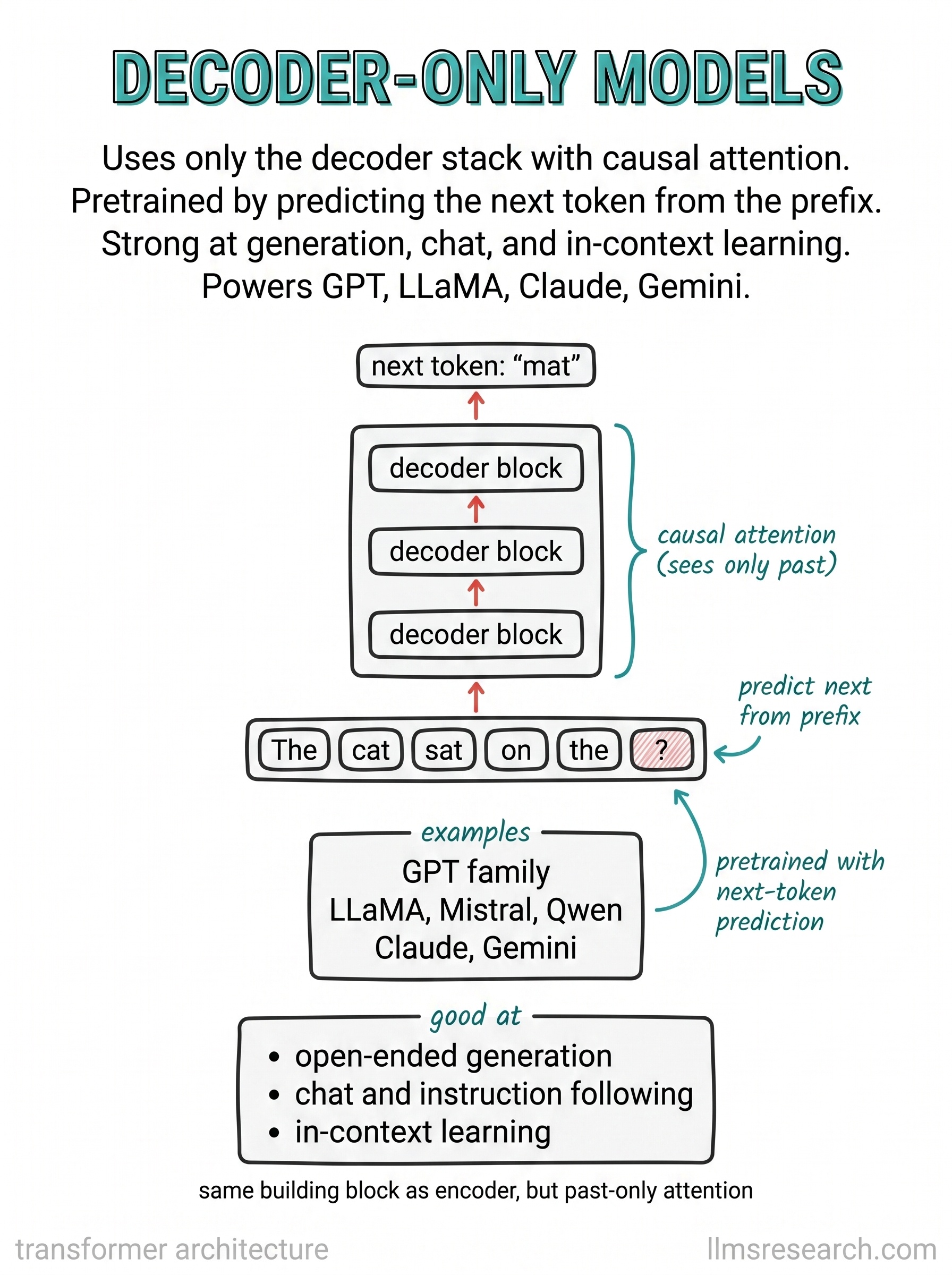
The diagram runs bottom to top. The input “The cat sat on the” ends in a masked position marked with a question mark, the stack of decoder blocks processes it, and the top produces the next token, “mat”. The brace names the defining property, causal attention that sees only the past, which is the causal-mask card in action: each position may attend to earlier positions and itself, never ahead. That constraint is what makes the next-token objective honest. If a position could see the future, the prediction task would be trivial and nothing useful would be learned.
The pretraining setup is annotated on the right, predict next from prefix and pretrained with next-token prediction. There is no masking of interior tokens and no separate reading stack; the model simply reads a prefix and guesses what follows, over enormous amounts of text. The bottom line notes it uses the same building block as the encoder, just with past-only attention. Architecturally the block is nearly identical to BERT’s; the attention mask is the real difference.
The examples box lists the reach: the GPT family, LLaMA, Mistral, Qwen, Claude, and Gemini. The strengths are open-ended generation, chat and instruction following, and in-context learning, the ability to pick up a task from examples in the prompt without weight updates. That last property emerged from scale rather than being designed in, and it is a large part of why this family came to dominate.
Between this card and the encoder-only card, both halves of the 2017 design have been isolated and studied. The next card puts GPT, BERT, and T5 side by side and ties each architecture back to the objective it was built to serve.