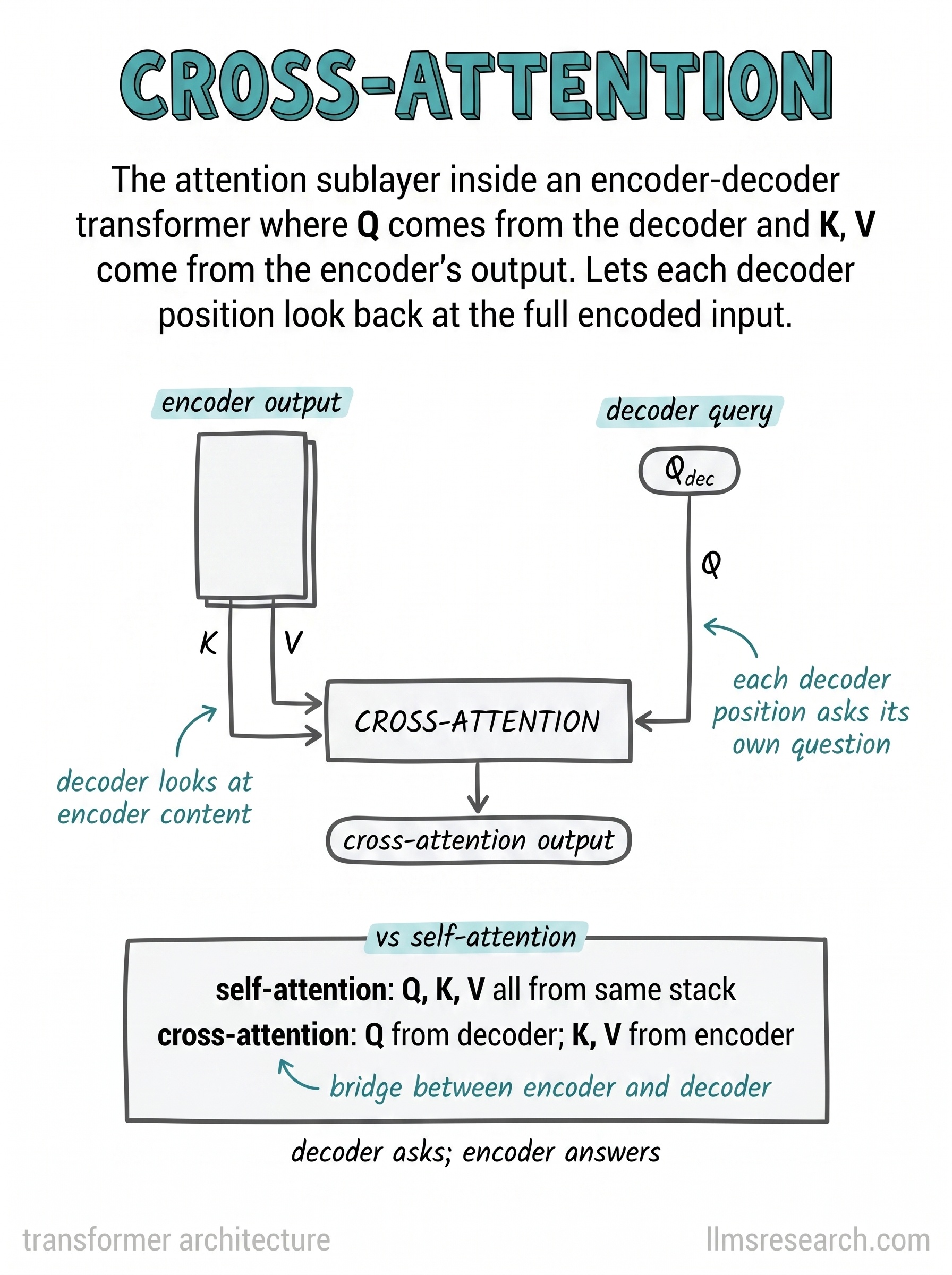
Every attention layer so far drew its queries, keys, and values from one place. Cross-attention breaks that symmetry, and it is the connection that lets an encoder-decoder model use its input at all.
The setup on the card has two stacks. The encoder has already processed the input and produced a set of output vectors. The decoder, generating its own sequence, forms a query at each of its positions. Cross-attention feeds the decoder’s query in as Q, while the keys and values both come from the encoder’s output. So the decoder is asking a question, and the encoder’s representation is what gets searched and summed. The card puts it well: the decoder asks, the encoder answers.
The contrast box makes the one difference precise. In self-attention, Q, K, and V all come from the same stack, so a sequence attends to itself. In cross-attention, Q comes from the decoder and K and V come from the encoder, so one sequence attends to another. Everything else, the dot product, the scaling, the softmax, the weighted sum of values, is identical. Only the source of the vectors changes.
This is why cross-attention is described as the bridge between encoder and decoder. Without it the decoder would generate text with no access to the input it is supposed to be conditioned on, which is fine for a pure language model but useless for translation or summarization where the output must depend on a specific source.
Notice that this whole mechanism presumes there is an encoder to attend to. Decoder-only models, the dominant design for modern chat LLMs, have no separate encoder and therefore no cross-attention. That architectural fork is exactly where the chapter goes next.