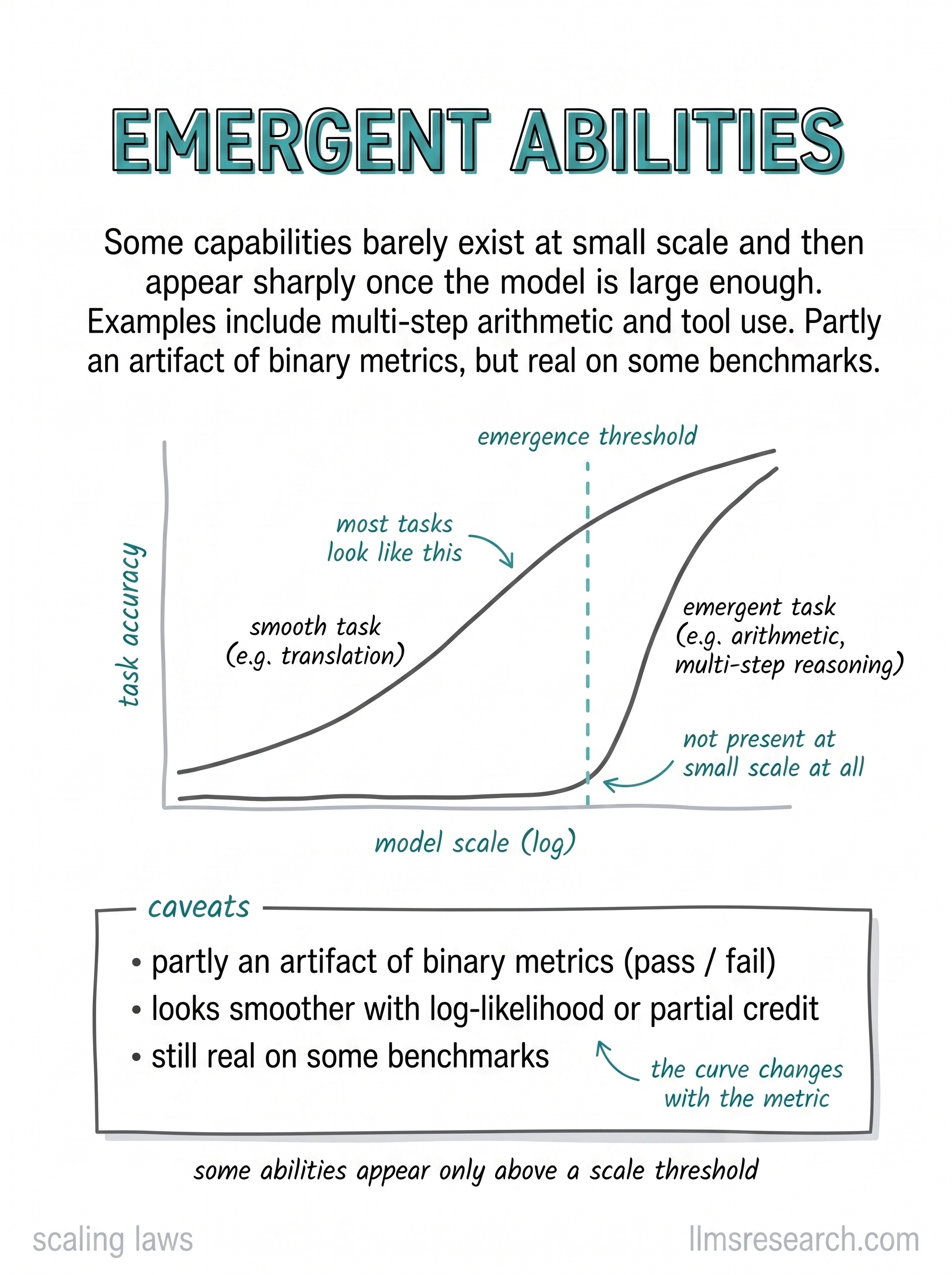
Scaling laws promise that loss falls smoothly with scale, but individual task performance does not always follow that smoothness. The card shows two curves of task accuracy against model scale. One rises gradually from small sizes, the pattern most tasks follow, labeled here as a smooth task like translation. The other stays flat near random accuracy across a wide range of scales and then rises sharply once the model passes a threshold, labeled an emergent task such as multi-step arithmetic or multi-step reasoning. Below the threshold the ability is, as the annotation puts it, not present at small scale at all.
The appeal of the observation is the hockey-stick shape: a capability that seemed absent appears suddenly, which is dramatic and was widely reported. The card is careful not to leave it there. The caveats box is the important half. Much of the sharpness is an artifact of how the task is scored. A binary metric, pass or fail on a whole multi-step problem, gives no credit for a model that has the pieces mostly right, so accuracy stays pinned at zero until the model crosses the point where it can complete the entire chain, at which point it jumps. The underlying competence was improving smoothly the whole time; the metric just could not see it.
The card names the fix directly: measured with log-likelihood or partial credit, the same curves look far smoother. If you score how much probability the model places on the correct answer, or give credit for partial progress, the sudden jump softens into the gradual rise the scaling laws would predict. The annotation sums it up, the curve changes with the metric. This reframing matters because apparent emergence had been read as evidence of unpredictable phase changes in capability, and much of that unpredictability turns out to be a property of the ruler rather than the model.
The last caveat keeps the correction from overreaching: still real on some benchmarks. Not every sharp transition is a scoring artifact, and there are tasks where behavior genuinely shifts qualitatively with scale rather than just becoming measurable. The honest position is between the two extremes. Emergence is a real phenomenon in places, and it is also frequently an illusion created by discontinuous metrics, so a sudden jump on a benchmark is a reason to check how the benchmark is scored before concluding that something new appeared in the model.