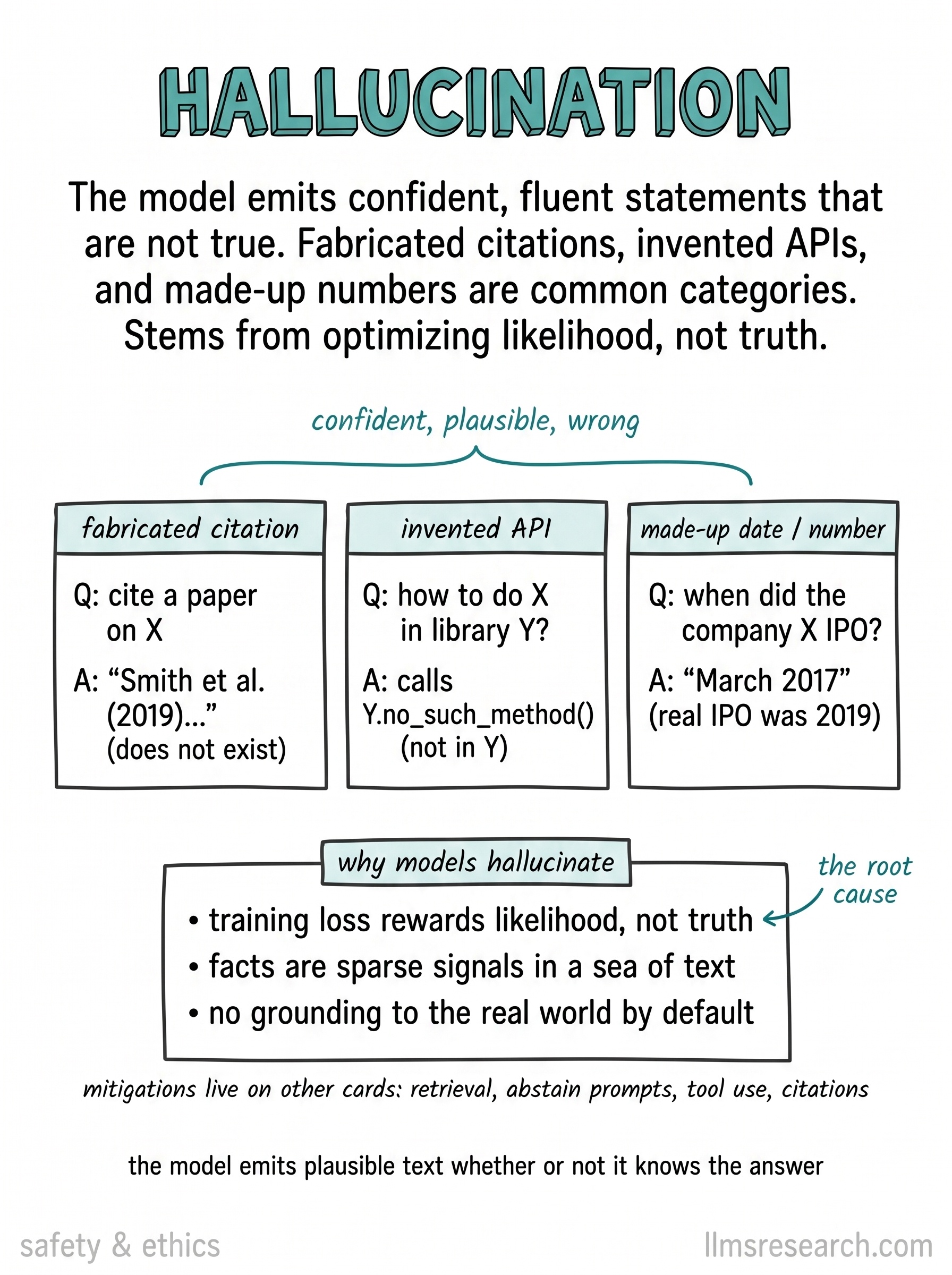
The word makes it sound like a malfunction. It is closer to the opposite. A hallucination is the model doing exactly what it was trained to do, which is produce text that is likely, applied to a case where the likely-sounding answer happens to be false. The three examples on the card are the shapes this takes most often: a citation that reads like a real reference but points to a paper that was never written, a code snippet that calls a method that does not exist in the library, a date stated with full confidence that is simply wrong.
What ties them together is the tone. The output is fluent and plausible in every case. The model does not signal doubt, because nothing in its training gives it a reliable sense of the boundary between what it knows and what it is improvising. It generates the most probable continuation whether or not a true one is available.
The card names three roots, and they build on each other. The training loss rewards likelihood, not truth, so a confident guess that fits the surrounding text is not penalized for being false as long as it is probable. Facts are sparse signals: a specific IPO date appears rarely in the training data next to a great deal of text that merely sounds factual, so the pattern of “sounding factual” is learned far more strongly than any particular fact. And by default the model has no channel to the outside world during generation, no lookup, no ground truth to check against, only its weights.
Seen this way, hallucination is not a bug to be patched out so much as a property of the objective. That is also why the fixes do not touch the base behavior and instead add something around it: retrieving real documents to condition on, prompting the model to abstain when unsure, giving it tools that return real values, asking for citations that can be verified. Those mitigations each get their own card. The point here is diagnostic. The model emits plausible text regardless of whether it knows the answer, and understanding that is the first step to building around it safely.