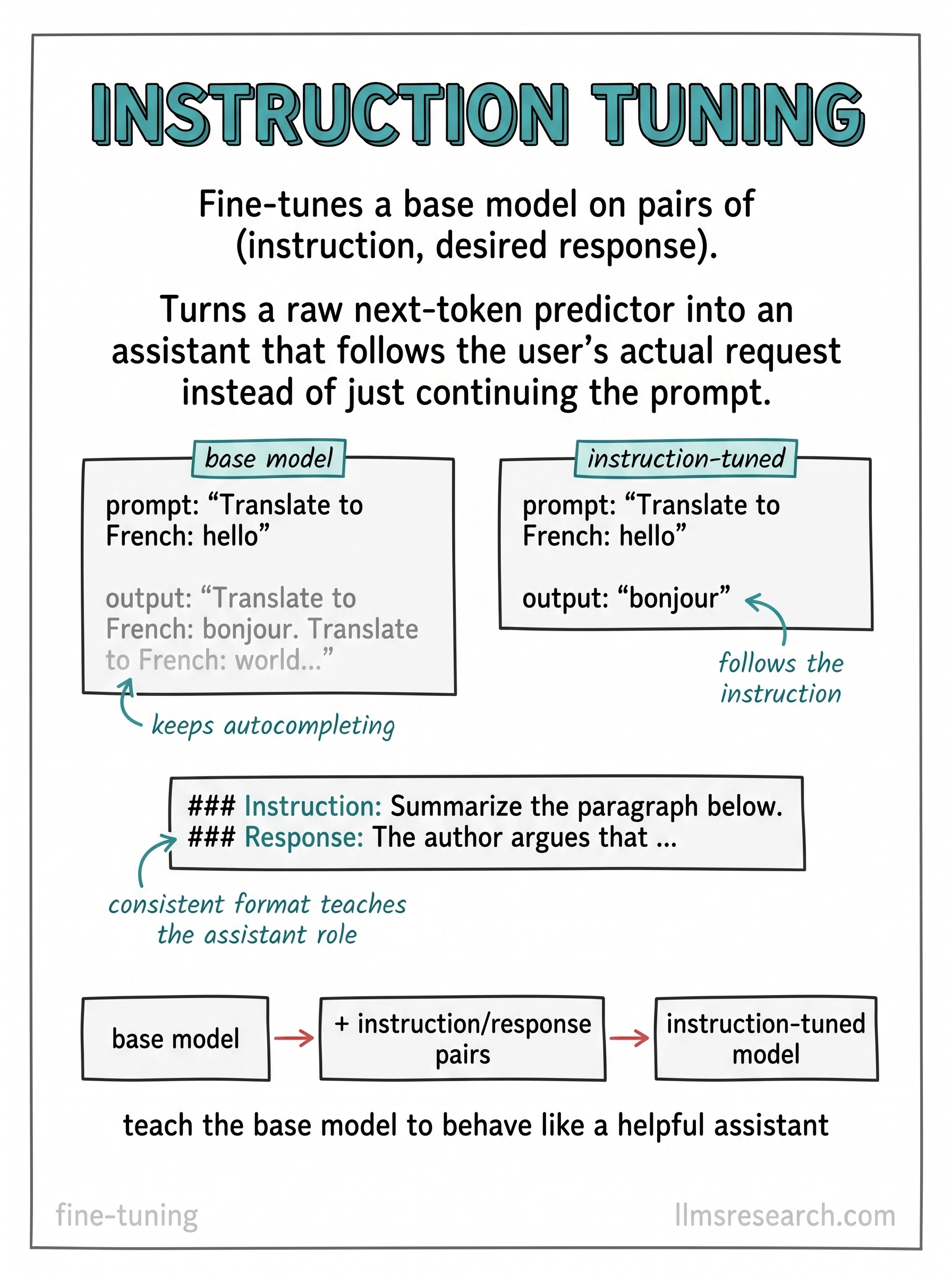
A base model out of pretraining is a next-token predictor and nothing more. Ask it to translate “hello” to French and it may well produce “bonjour”, but it is just as likely to keep going with “Translate to French: world” and another example after that, because the training text it saw was full of lists and templates that continue rather than stop. The card puts the two behaviors next to each other: the base model keeps autocompleting the pattern, while the instruction-tuned model reads the request and returns just the answer.
Instruction tuning is the step that closes that gap. It takes the base model and continues training it, but on a curated set of examples where each one is a pair: an instruction, and the response a helpful assistant would give. The card shows the format that carries this, an ”### Instruction:” segment followed by an ”### Response:” segment. That consistent structure is doing real work. It gives the model a reliable signal for where the request ends and its own turn begins, which is what lets it learn the assistant role rather than absorbing the examples as more generic text to imitate.
Nothing about the underlying objective changes here. The loss is still next-token prediction, the same one used in pretraining. What changes is the data. Instead of scraped web text with no particular shape, the model now sees thousands of demonstrations of the behavior we want, and gradient descent moves it toward producing that behavior by default. The bottom strip of the card frames it as a pipeline: base model, plus instruction and response pairs, gives an instruction-tuned model.
It helps to be precise about what this does and does not add. Instruction tuning does not teach the model new facts in any reliable way, and it is a small run compared to pretraining. What it changes is disposition: the model learns that the expected continuation of a request is a direct, helpful answer. The next card looks at how the loss is actually applied during this step, since the way the instruction and response tokens are treated is not symmetric.