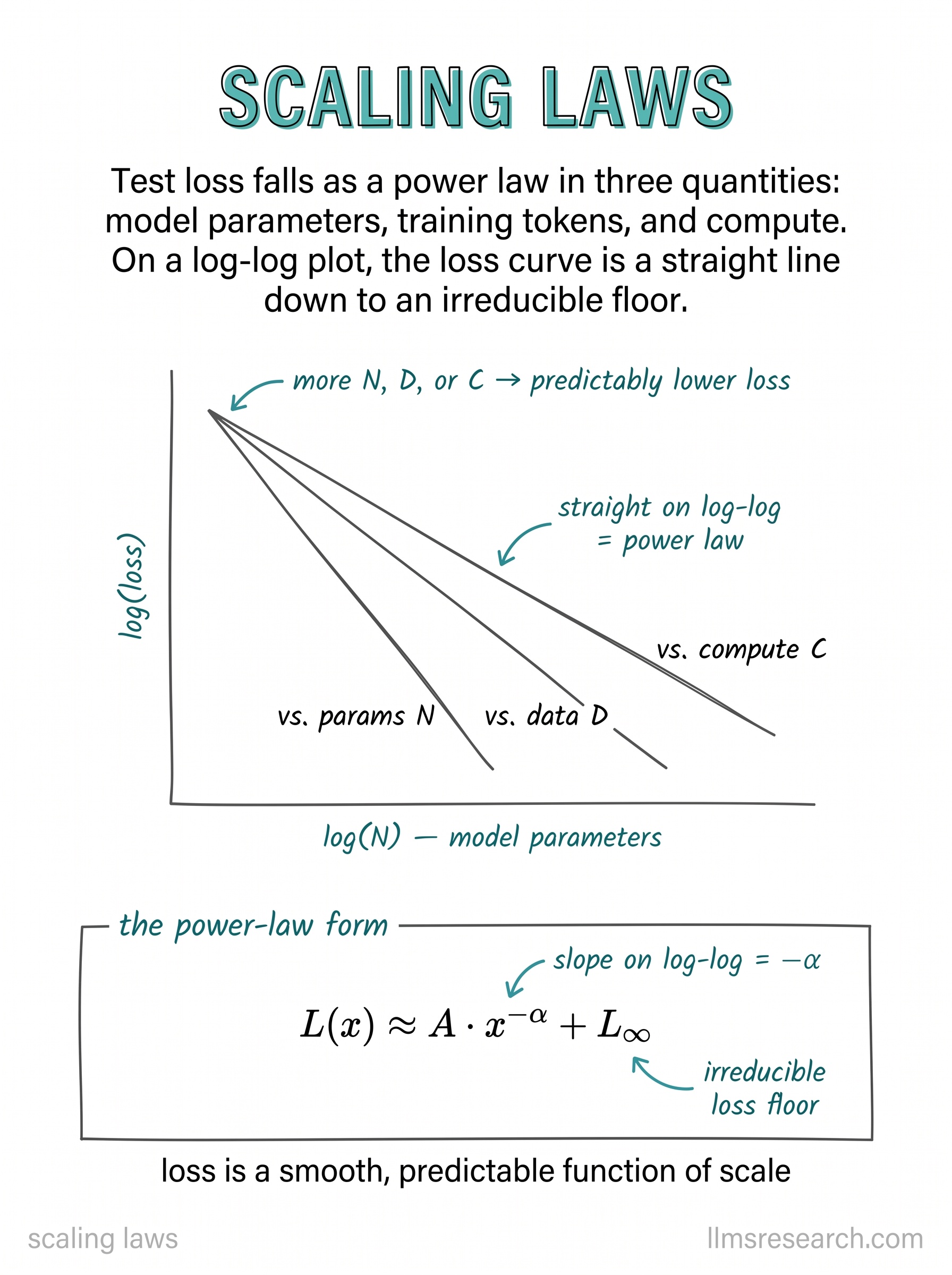
The last two chapters showed how a model is trained and what pretraining produces. Scaling laws answer the question that comes next for anyone spending the compute: if I make it bigger, how much better does it get, and can I know in advance. The finding on the card is that the answer is unusually regular. Test loss falls as a power law in three quantities, the number of model parameters N, the number of training tokens D, and the total compute C.
The plot shows what a power law looks like once the axes are logarithmic: a straight line. Each of the three quantities traces its own descending line, and the caption states the practical reading, more N, D, or C gives predictably lower loss. Straightness on a log-log plot is the signature that a relationship is a power law, which is the subject of the next card. The point here is that the relationship holds across many orders of magnitude, which is what makes it useful for planning rather than just describing.
The formula boxes the shape. Loss as a function of any one of these quantities is approximately a constant A times that quantity raised to a negative exponent, plus a term written L-infinity. The exponent, called alpha, is the slope of the line on the log-log plot, and it sets how fast loss falls as you scale. The L-infinity term is the piece that does not go away: an irreducible floor, the loss you would still have with infinite scale, set by the inherent unpredictability of language itself. Scaling buys you the gap down to that floor, not below it.
What makes this more than a curiosity is that it turns training into something you can forecast. Fit the curve on small, cheap runs, and you can project the loss of a run far too expensive to try more than once, which is exactly how large models are planned before the budget is committed. Two cautions come with it. The laws predict loss, not any particular downstream skill, and the connection between lower loss and better behavior on real tasks is looser than the clean line suggests. And the fitted exponents are empirical, specific to an architecture and data distribution, so they describe the regime they were measured in rather than a law of nature.