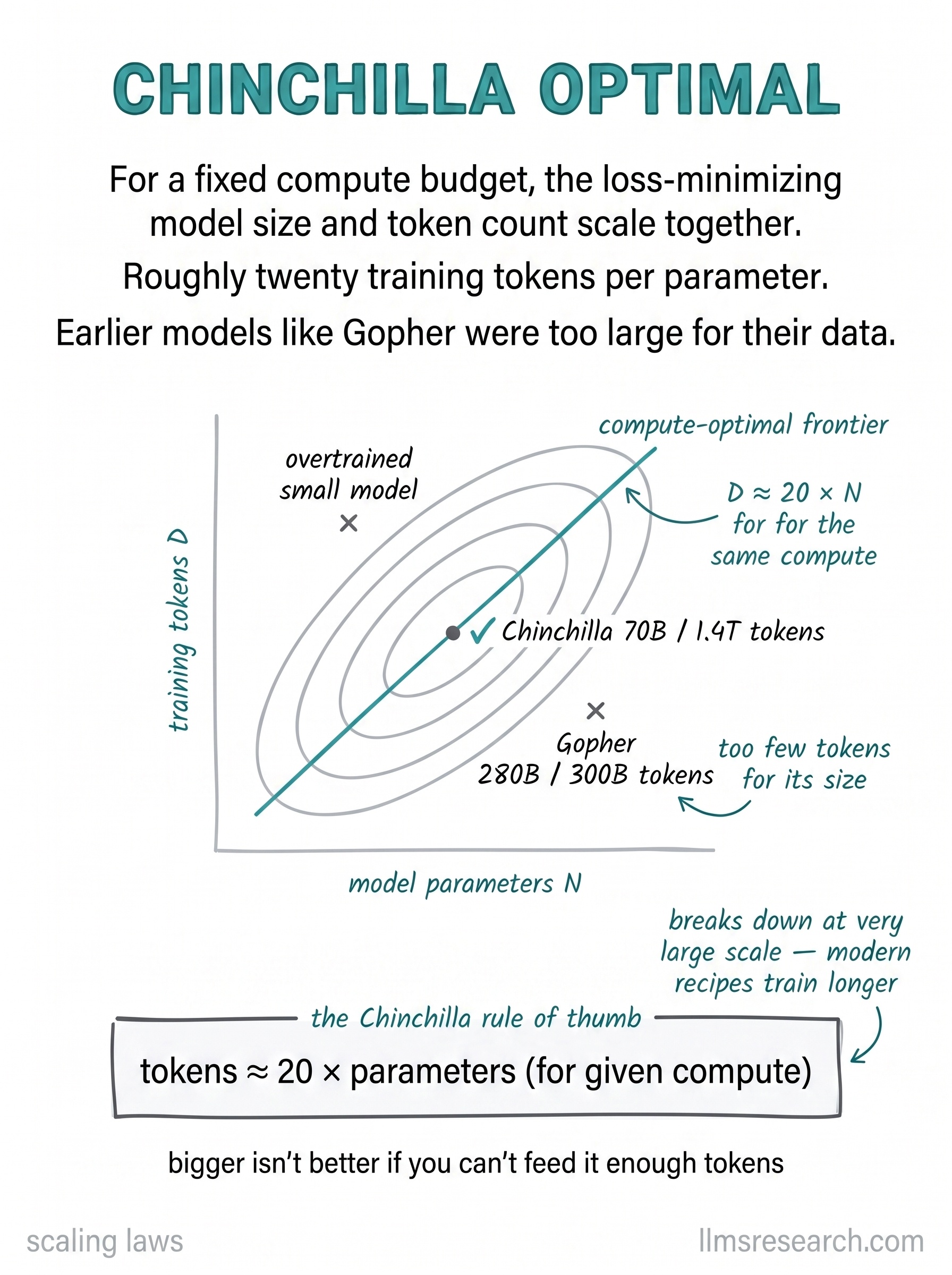
The FLOPs formula says compute is parameters times tokens times six, which leaves a choice: for a fixed budget, you can spend it on a bigger model trained on less data, or a smaller model trained on more. Chinchilla answered which split minimizes loss. The finding on the card is that model size and token count should scale together, at a ratio of roughly twenty training tokens per parameter.
The contour plot shows why there is a right answer. The concentric rings are lines of equal loss over the plane of parameters N against tokens D, and loss is lowest at the center. The compute-optimal frontier, the diagonal line, traces the best point for each compute budget, and it passes through the middle of the rings. The labeled point, Chinchilla at 70 billion parameters and 1.4 trillion tokens, sits on that line. The name comes from the model DeepMind trained to demonstrate the rule: at the same compute as the earlier 280-billion-parameter Gopher, a smaller model fed far more data reached lower loss.
The two crossed-out points make the failure modes concrete. Gopher, at 280 billion parameters on 300 billion tokens, sits below the line, too few tokens for its size, a large model starved of data. The other cross sits above the line, a small model trained on more tokens than its size warrants. Both waste part of the budget relative to a model placed on the frontier. The rule of thumb at the bottom compresses it: tokens should be about twenty times parameters for a given compute budget. The caption states the lesson bluntly, bigger is not better if you cannot feed it enough tokens.
One annotation on the card is important enough to carry forward: the rule breaks down at very large scale, and modern recipes train longer. Chinchilla answers a specific question, how to minimize training loss for a fixed training budget. It says nothing about the cost of running the model afterward, and once inference is in the picture the optimal shifts toward smaller models trained on far more than twenty tokens per parameter. The next two cards take up exactly that tension.