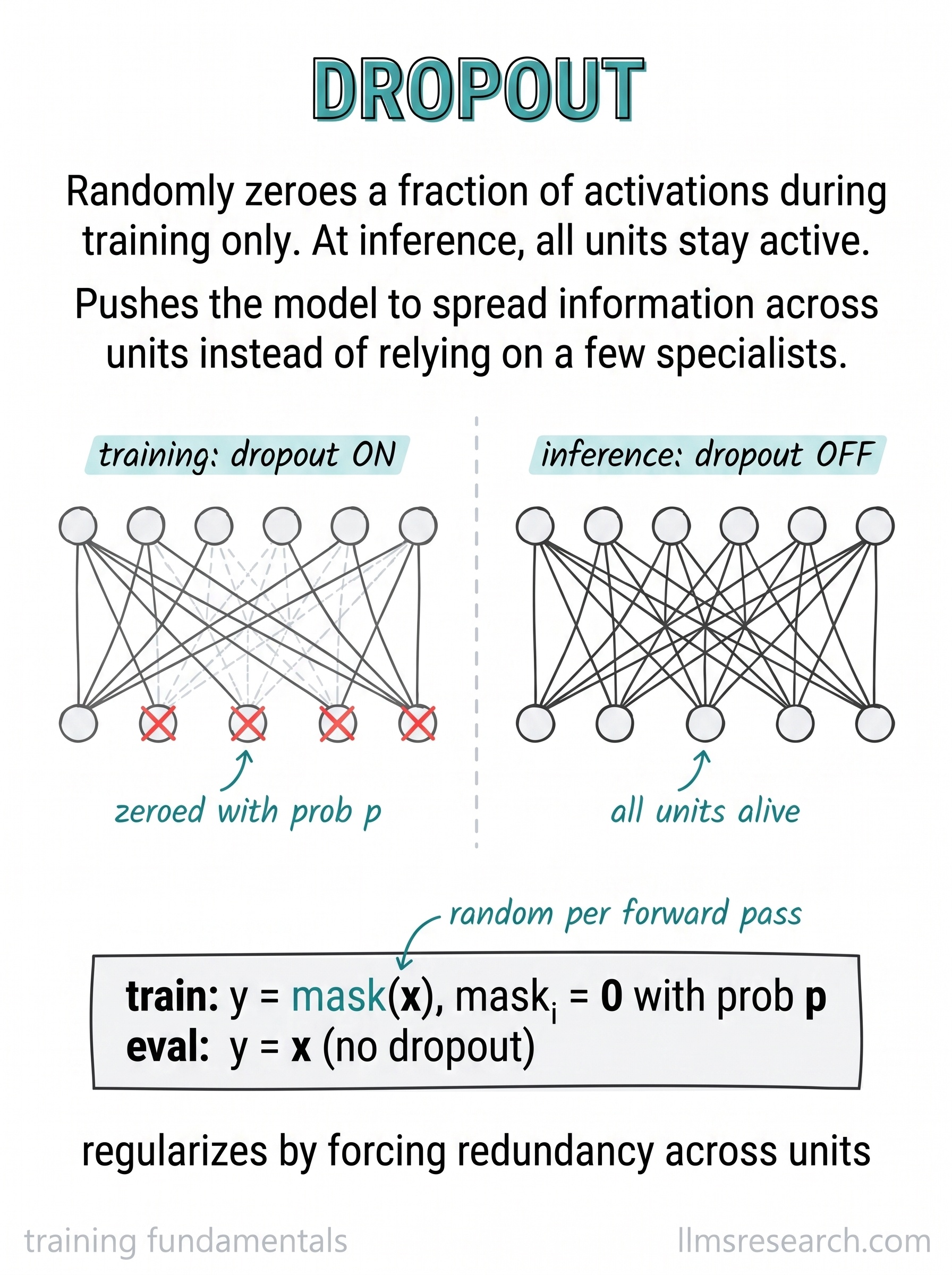
Dropout is a regularizer that works by deliberately damaging the network during training. On each forward pass it picks a random fraction of activations and sets them to zero, and the choice is fresh every pass, so a unit that survives one step may be dropped the next. The card contrasts the two modes side by side. During training some units are crossed out with probability p; at inference the mask is removed and every unit stays active.
The point is what this does to how the model organizes information. If a network could route a prediction through one or two highly specialized units, it would, and it would then be fragile: those units carry too much and the rest carry too little. Dropout makes that strategy fail, because any given unit might be absent when the answer depends on it. The model is pushed to build redundant, distributed representations where several units each hold part of the signal, which is the sense in which the caption says it forces redundancy across units.
The train-versus-eval split shown on the card is not optional bookkeeping. If dropout stayed on at inference the output would be random from one run to the next, and the average activation would be lower than the network was calibrated for, since a fraction of the signal is missing. Frameworks handle the mismatch by scaling, commonly dividing the surviving activations by one minus p during training so the expected total stays constant, then running clean at inference. The mechanism is a single train-time flag, but forgetting to flip it is a classic source of results that look wrong for no obvious reason.
One thing worth noting is how small a role dropout plays in the largest language models. It was central when networks were trained on limited data and could easily memorize it, but a model trained on a near-endless stream of text sees each example rarely and overfits far less, so heavy dropout is often unnecessary and can even hold learning back. Many large pretraining runs set it to zero in the main layers and reintroduce it during fine-tuning, where the dataset is smaller and overfitting returns as a real risk. It remains a standard tool, but the era of scale has moved it from a default to a situational one.