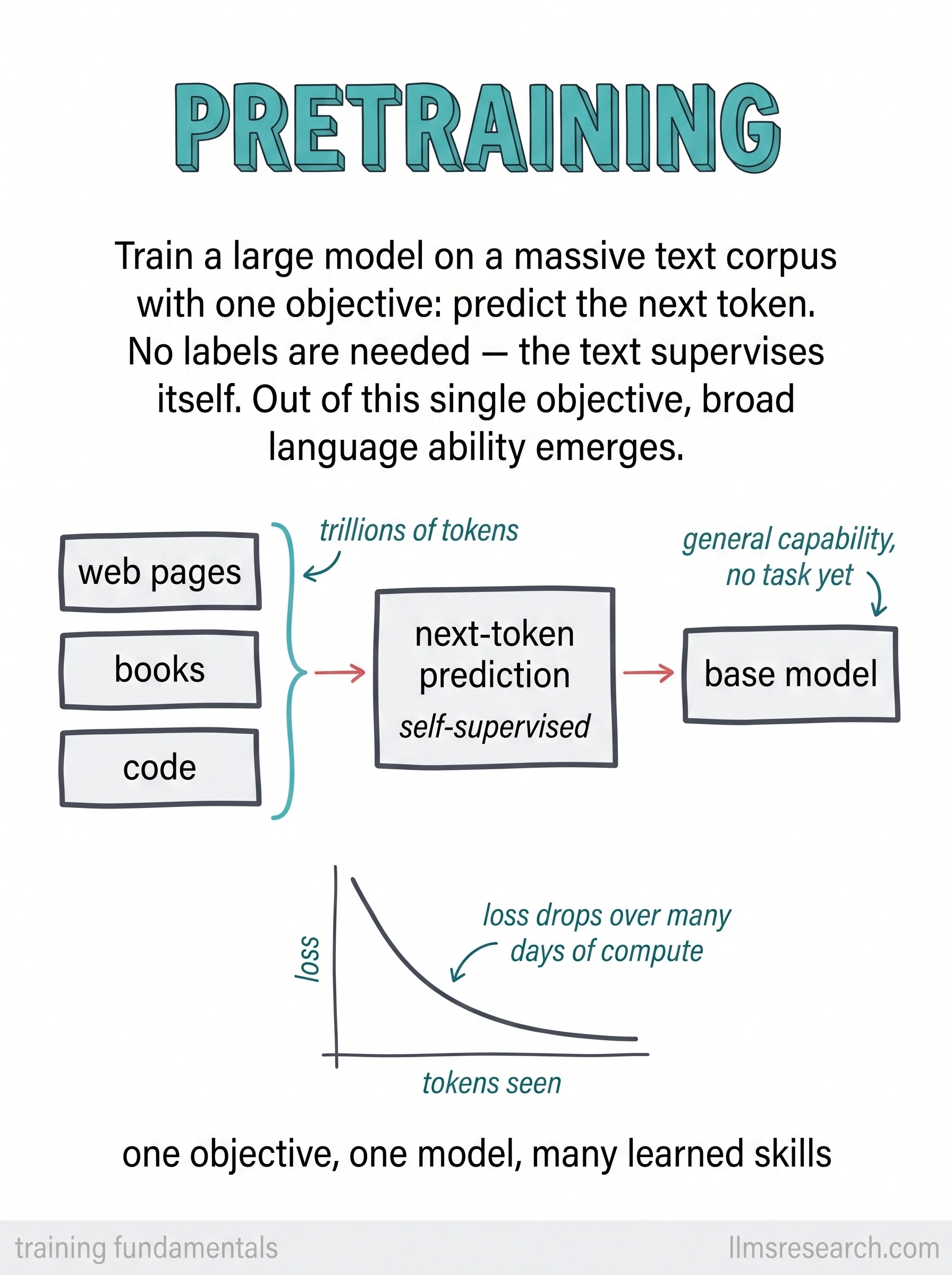
Pretraining is where the objective and the machinery from the previous chapter are run at full scale. The card lays out the whole pipeline in one line: a large corpus flows into next-token prediction, and out comes a base model. Everything about the training signal is the same as the language modeling objective card described. What changes here is the amount, trillions of tokens rather than a worked example, and the consequences of that amount.
The left of the card lists the corpus, web pages, books, and code, bundled as trillions of tokens. The important property is labeled on the middle box: self-supervised. Because the training target is just the next token in text that already exists, no human has to annotate anything. That is what makes the scale possible. Supervised datasets are bounded by how much labeling anyone can afford, while raw text is abundant, so the objective that needs no labels is the one that can absorb a corpus this large.
The loss curve at the bottom is worth reading carefully. It shows loss falling as the model sees more tokens, and the caption notes this happens over many days of compute. The curve is smooth, but the abilities it produces are not evenly distributed along it. As the loss drops, the model moves from producing plausible word fragments to coherent sentences to following the shape of an argument, and some capabilities appear fairly suddenly rather than improving in step with the loss. The single number going down hides a lot of qualitative change.
The label on the output box is the point that sets up the rest of the course: general capability, no task yet. A base model has absorbed grammar, facts, and patterns of reasoning as a side effect of prediction, but it has not been shaped to do anything in particular. Prompt it and it will continue your text rather than answer your question, because continuation is all it was trained for. Turning that raw competence into something that follows instructions and stays within bounds is the job of the adaptation stages ahead. Pretraining builds the capability; it does not aim it.