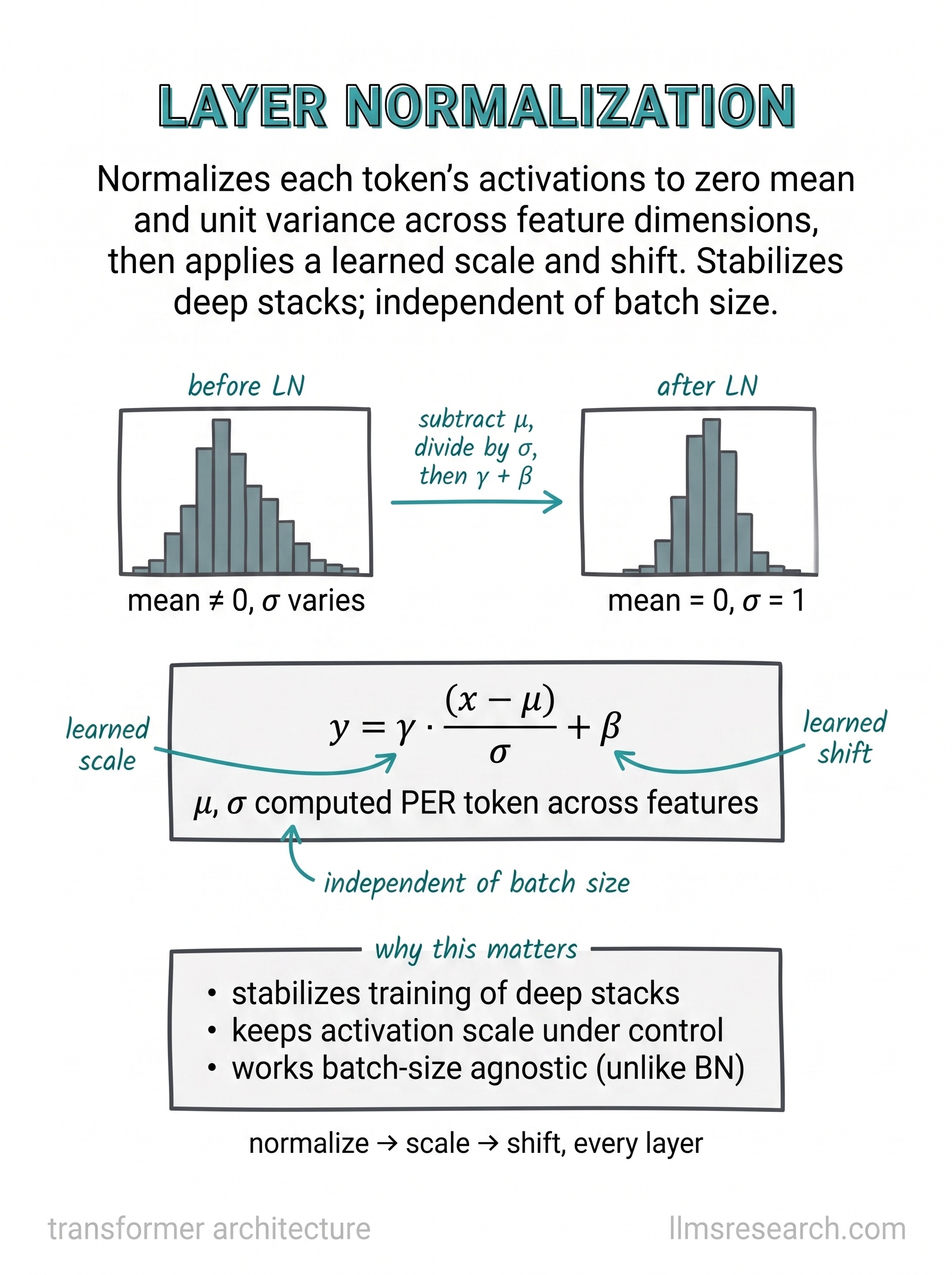
Attention and the feed-forward network do the work of a transformer block, but they only stay trainable when something keeps their outputs from drifting to extreme scales as the stack gets deep. That is the job of normalization, and LayerNorm is the original version.
The two histograms show what it does in practice. Before the operation, a token’s activations have some arbitrary mean and a spread that varies from token to token. After it, the same values have been recentered to zero mean and squeezed to unit variance. The formula in the middle box states the mechanism exactly: subtract the mean, divide by the standard deviation, then multiply by a learned scale gamma and add a learned shift beta. The normalization is fixed arithmetic; gamma and beta are parameters the model trains, so it can undo or reshape the normalization when that helps.
The detail that separates LayerNorm from its predecessor is in the annotation: mean and standard deviation are computed per token across features. Each token’s vector is normalized using only its own entries. Nothing is shared across the tokens in a sequence or across examples in a batch. That is why the card stresses it works batch-size agnostic, unlike batch normalization. Batch norm pools statistics over the batch dimension, which makes it sensitive to batch size and awkward for variable-length sequences. LayerNorm sidesteps that entirely, which is one reason transformers adopted it.
The three payoffs at the bottom follow from this. Stabilizing training of deep stacks and keeping activation scale under control are the same point stated two ways: without a per-layer reset, small scale differences compound through dozens of layers and either blow up or collapse. Being batch-size agnostic is what makes the method practical for the ragged batches that language data produces.
Where the normalization sits relative to the sublayer is a separate design choice, covered in the pre-norm versus post-norm card. And LayerNorm itself has a cheaper successor, RMSNorm, which most current open models use in its place.