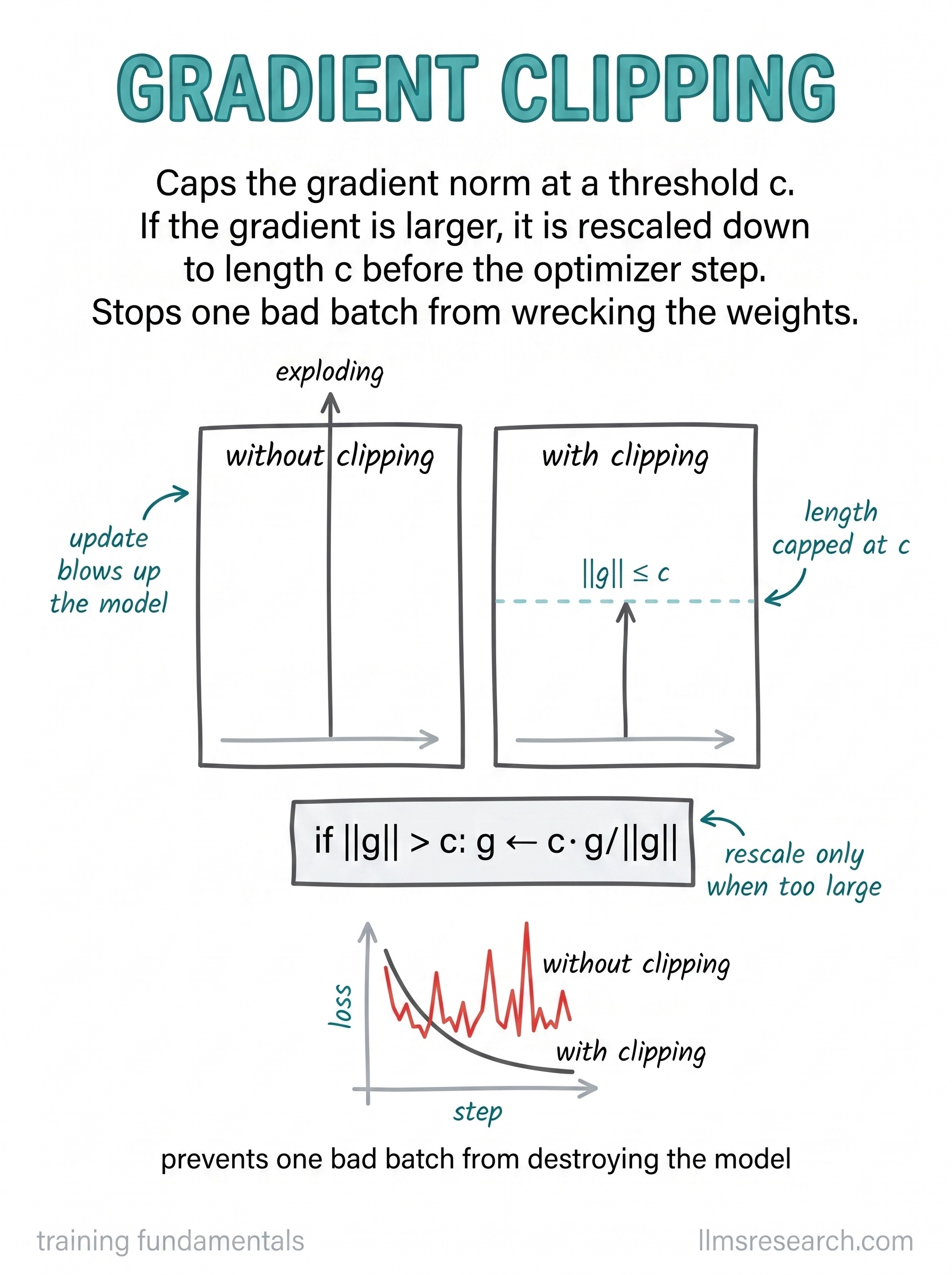
Most training steps are well behaved, but occasionally a batch produces a gradient far larger than usual, and a single oversized update can push the weights into a region the model never recovers from. The card’s left panel is that failure: an exploding gradient sends one update off the top of the chart, and the model blows up. Gradient clipping is the guardrail against it.
The mechanism is a cap on the gradient’s overall length. The formula on the card measures the norm of the full gradient, written as the length of the vector g, and compares it to a threshold c. If the norm is at or below c, nothing happens. If it exceeds c, the whole gradient is rescaled by c divided by its norm, which shrinks it back to exactly length c while keeping its direction unchanged. That last point matters: clipping does not alter which way the step points, only how far it goes. The right panel shows the capped case, the gradient held at the dashed line marked norm less than or equal to c.
The reason to clip the norm rather than each component separately is that the direction carries the information. Clamping individual entries would bend the update toward a different direction than the gradient actually indicated, whereas rescaling the whole vector preserves the direction the loss said to move and only tempers the magnitude. The loss curves at the bottom illustrate the payoff. Without clipping the loss is jagged, spiking whenever a large gradient lands. With clipping it descends smoothly, because the rare huge steps are cut down to size.
Clipping only acts when a gradient is anomalously large, so on a stable run it does almost nothing, which is exactly what you want from a safety mechanism. It pairs closely with the two previous cards. In a mixed-precision setup an overflow can produce a spuriously enormous gradient, and with gradient accumulation the clip applies to the summed gradient of the full effective batch rather than to any single micro-batch. The threshold c is a hyperparameter, and setting it too low throttles learning by clipping normal steps, while setting it too high lets the occasional damaging update through.