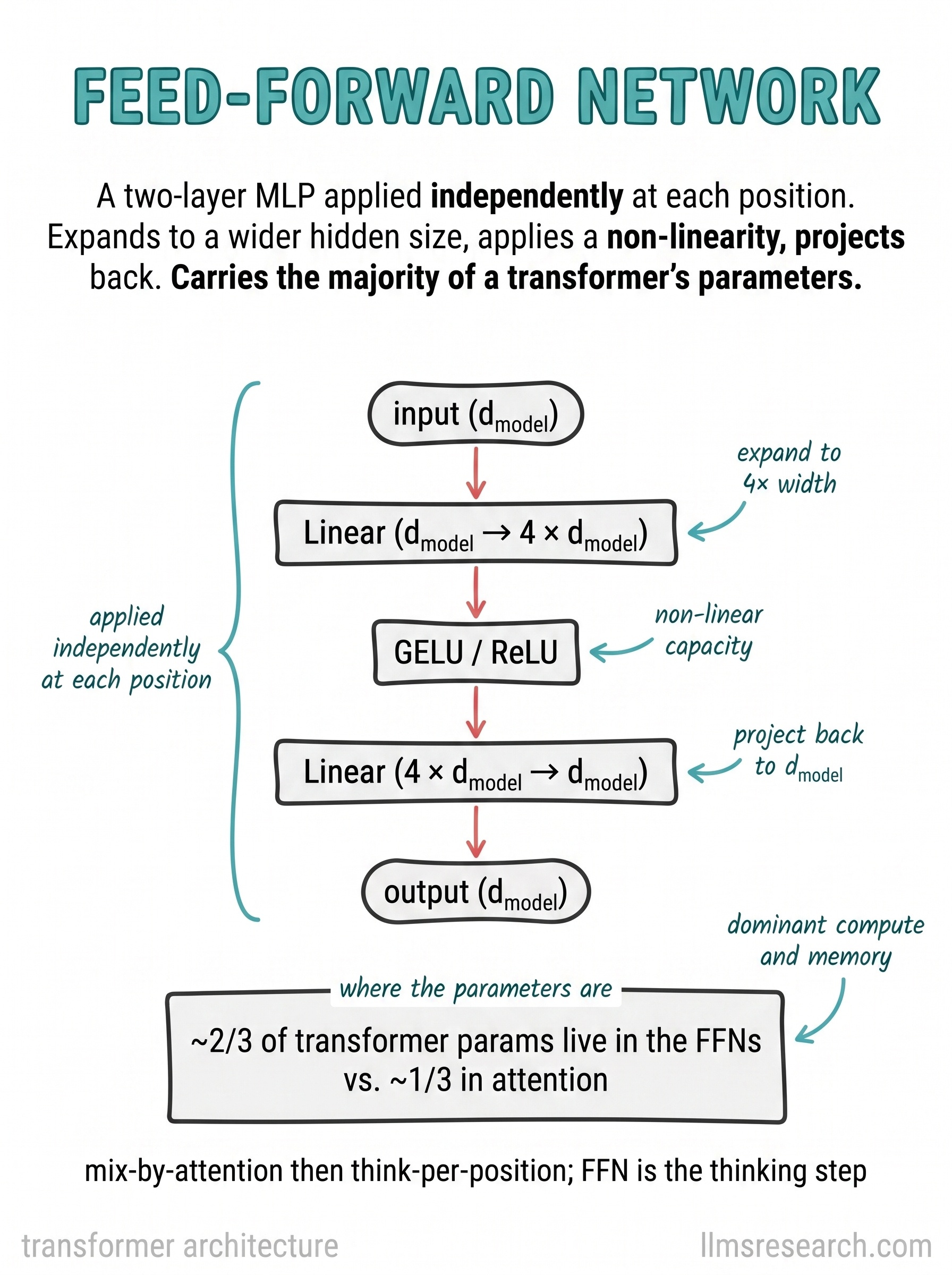
A transformer block is attention followed by a feed-forward network. The attention cards covered the first half; this card is the second, and despite being simpler it holds the bulk of the model’s parameters.
The FFN is a two-layer MLP with a clear shape. A linear layer expands the vector from d_model to four times that width, a non-linearity such as GELU or ReLU is applied, and a second linear layer projects back down to d_model. Input and output have the same width, so the block stacks cleanly. The one property to hold onto is in the annotation: it is applied independently at each position. Attention is where tokens exchange information; the FFN never looks sideways, it transforms each position’s vector on its own.
That division of labor is the mental model the bottom line offers: mix by attention, then think per position, with the FFN as the thinking step. Attention gathers context into each token’s vector, and the FFN then does nonlinear processing on that enriched vector, one position at a time.
The parameter fact is the reason this modest layer matters so much. The card notes roughly two thirds of a transformer’s parameters live in the FFNs versus about one third in attention, and it is the dominant consumer of compute and memory. The 4x expansion is why: those two wide matrices are large. When people discuss shrinking or speeding up models, the FFN is often the first target precisely because that is where the weight sits.
The FFN also became a place to innovate. The next card, SwiGLU, replaces the plain expand-activate-project design with a gated variant that most modern open models now use.