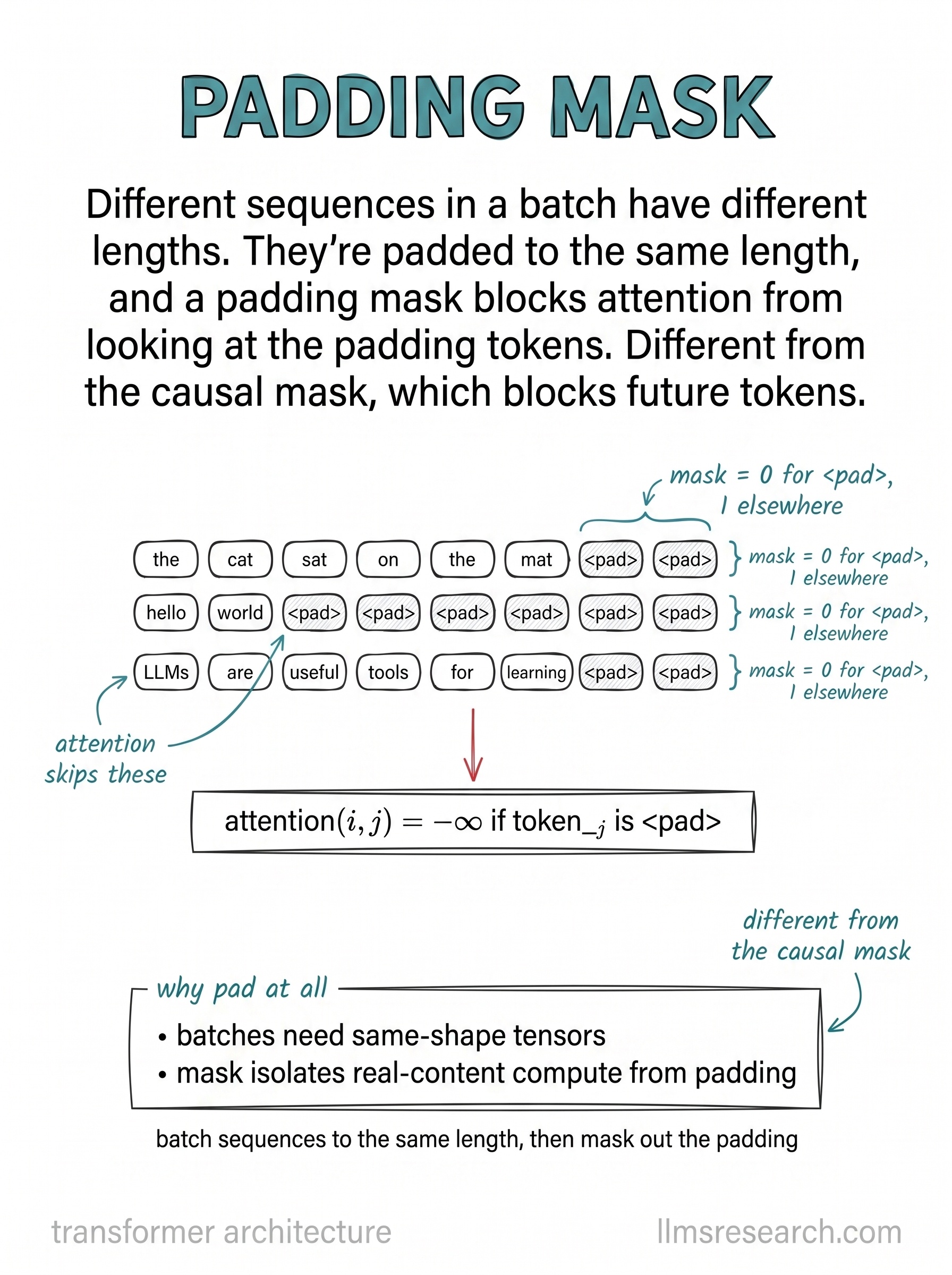
Hardware wants batches of uniform shape, but real sentences are not uniform. The padding mask is the small bookkeeping that lets ragged sequences share a batch without contaminating each other.
The problem is on the card. Three sequences of different lengths are stacked
together: “the cat sat on the mat” fills six slots, “hello world” only two, and
so on. To make one rectangular tensor, the short ones are extended with a filler
token, drawn as <pad>. Those pad tokens carry no meaning, so attention must not
treat them as content. The padding mask marks each pad position and adds negative
infinity to any attention score that would land on it, exactly the same negative
infinity trick the causal mask uses, so softmax drives those weights to zero. The
formula reads attention of i, j equals negative infinity if token j is a pad.
The lower box answers why pad at all. Batches need same-shape tensors to run efficiently, and the mask is what isolates the real-content computation from the padding so the filler never leaks into a token’s representation.
The card is careful to distinguish this from the causal mask, and the distinction is worth keeping. The causal mask depends on position: it blocks the future regardless of what tokens are there. The padding mask depends on content: it blocks specific tokens, the pads, regardless of where they sit. A decoder training on batched data applies both at once, a lower-triangular causal mask plus a per-sequence padding mask, and they compose by simply adding their negative infinities together.
With masking covered, the last attention variant in this chapter is cross-attention, where the queries and the keys come from different places entirely.