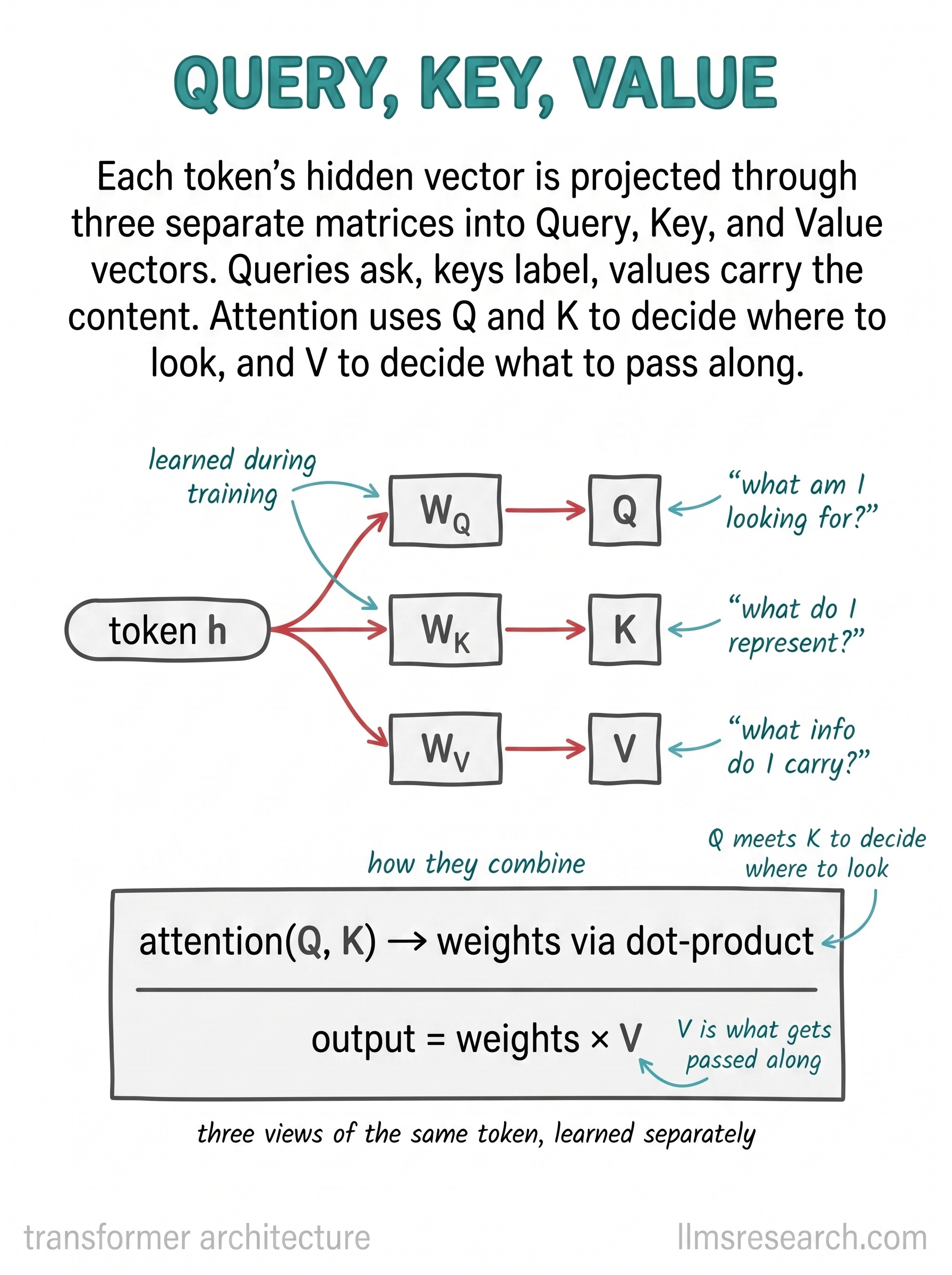
The previous card leaned on “learned similarity” and “value vectors” without saying where they come from. This card is that source. Every token’s hidden vector is turned into three separate vectors, and the three roles are the whole trick behind attention.
The token’s hidden vector, written h on the card, is multiplied by three learned matrices, W_Q, W_K, and W_V, producing a query Q, a key K, and a value V. These matrices are trained; the model discovers during training what each projection should extract. The card gives each vector a plain-language role. The query asks “what am I looking for?” The key answers “what do I represent?” The value carries “what info do I carry?”
The way they combine is the part worth holding onto. A token’s query is compared against every token’s key by a dot product, and that comparison produces the attention weights, the same weights the self-attention card summed with. Then those weights are applied to the value vectors, and the weighted sum of values is the output. The card states it compactly: attention of Q and K gives weights via dot-product, and output equals weights times V.
Splitting a token into three views is what lets attention separate two questions that would otherwise be tangled. Where should I look is answered by queries and keys. What should I take from the places I look is answered by values. A token can be a strong match to look at, through its key, while carrying different content to pass on, through its value.
These three vectors feed straight into the exact formula on the next card, which puts the dot product, the scaling, the softmax, and the weighted sum together in one line.