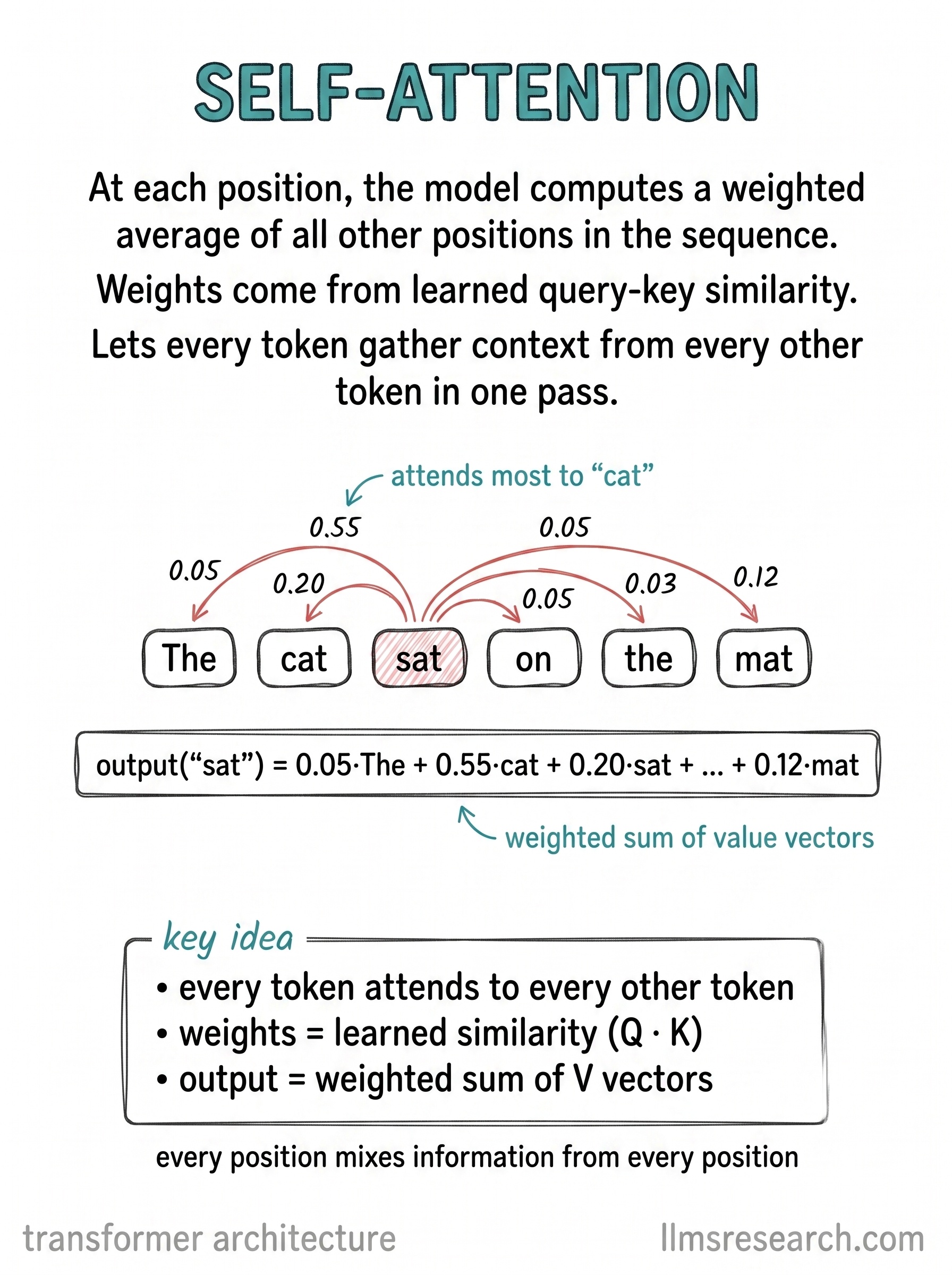
The position cards handled where tokens sit. This card is the operation that actually reads the sequence, and it is the heart of the transformer.
Self-attention works one position at a time, but each position looks everywhere. For a given token, the model produces a set of weights over all tokens in the sequence and then takes a weighted average of their vectors. The card walks through the word “sat”: it attends most to “cat” with weight 0.55, gives 0.20 to itself, and spreads the rest thinly across “the”, “on”, and “mat”. The output for “sat” is written out explicitly as 0.05 times The plus 0.55 times cat and so on, a weighted sum where the weights add to one.
Two details matter. The weights are not fixed; they come from learned query-key similarity, which the next card unpacks. And the vectors being summed are the value vectors, again defined next card, not the raw embeddings. For now the shape of the idea is enough: similarity decides how much attention each token gets, and the value vectors are what get mixed.
The phrase at the bottom captures why this matters, every position mixes information from every position. In a single pass, each token pulls in context from the whole sequence, so the representation of “sat” can come to encode that its subject is “cat”. Nothing is processed left to right one step at a time the way older recurrent models worked; the mixing happens for all positions at once.
That all-to-all mixing is expressive and also expensive, since every token compares against every other. That cost is what a later chapter on scaling attention works to reduce. The next three cards stay on the mechanism, starting with the query, key, and value vectors the weights are built from.