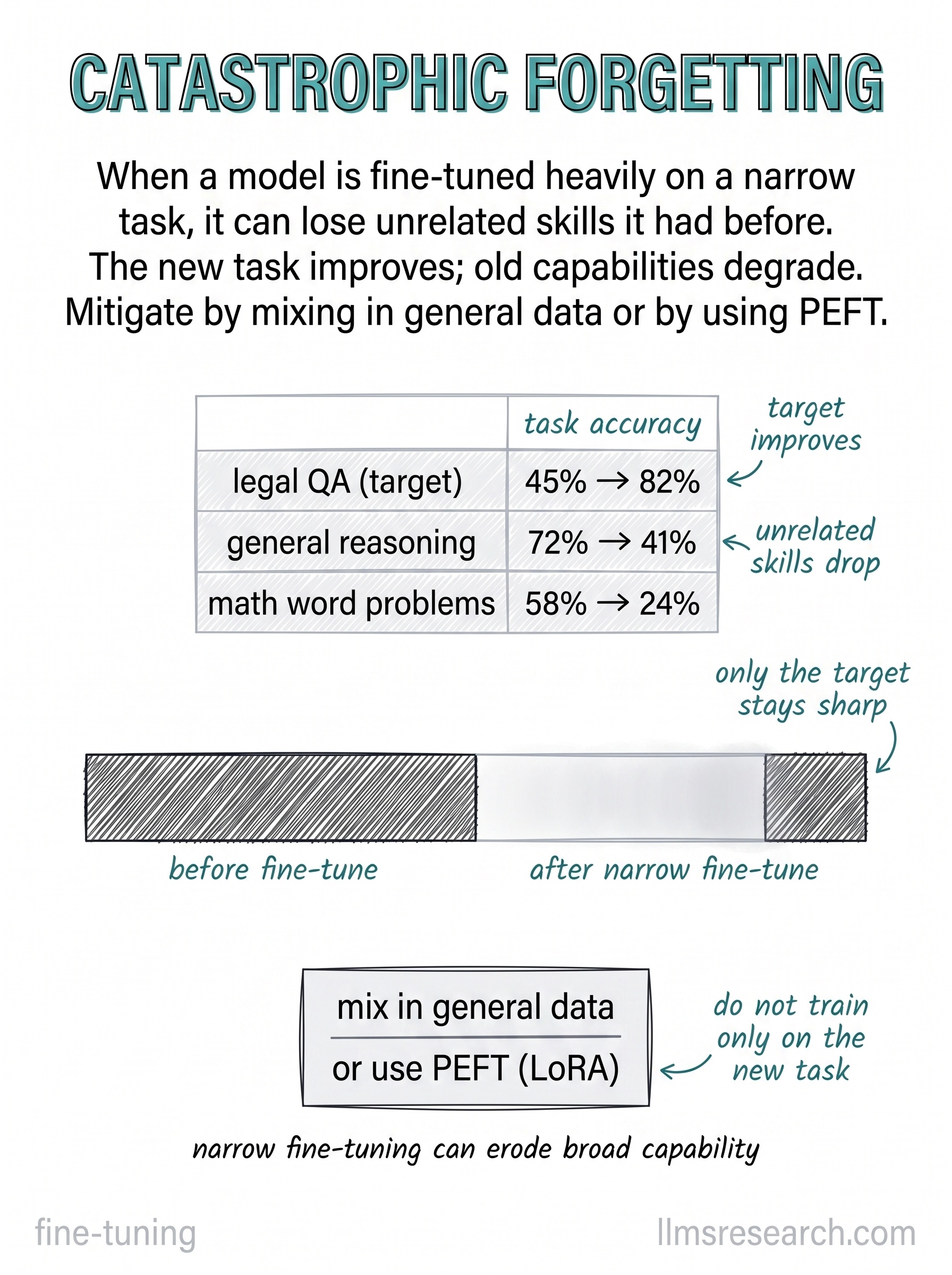
Catastrophic forgetting is the cost of fine-tuning too narrowly. When a model is trained hard on one task, gradient descent moves its weights toward that task, and there is nothing forcing it to preserve abilities that the fine-tune data does not exercise. Those abilities quietly degrade. The card makes the effect concrete with a table: after fine-tuning on legal question answering, target accuracy climbs from 45 to 82 percent, but general reasoning falls from 72 to 41 and math word problems from 58 to 24.
The mechanism is worth stating plainly, because the name makes it sound like a glitch when it is really the expected behavior of unconstrained optimization. The model has a fixed set of weights that encode all of its skills together. Training signal that only rewards the new task pulls those shared weights toward it, and skills that depended on the old configuration of the weights lose the arrangement they relied on. The bar on the card captures this visually: a model that was broadly capable before fine-tuning ends up sharp only on the target region, with the rest of its competence faded out.
The card lists two mitigations, and they map onto ideas from earlier cards. The first is to mix general data into the fine-tuning set, so the training signal keeps rewarding the broad skills alongside the new one and the weights are not pulled entirely toward the narrow task. The second is to use PEFT such as LoRA: because the base weights stay frozen and only a small adapter changes, the original capabilities are structurally protected rather than being overwritten. The closing note is a rule of thumb, do not train only on the new task.
The tradeoff to weigh is between adaptation and preservation. Full fine-tuning on narrow data gives the strongest gain on the target but the largest collateral loss, while data mixing and PEFT trade some peak target performance for keeping the model broadly useful. Which side to favor depends on whether the deployed model needs to do only the one task or remain a generalist. The next card looks at a related but distinct failure, where the model degrades even on held-out examples of the target task itself.