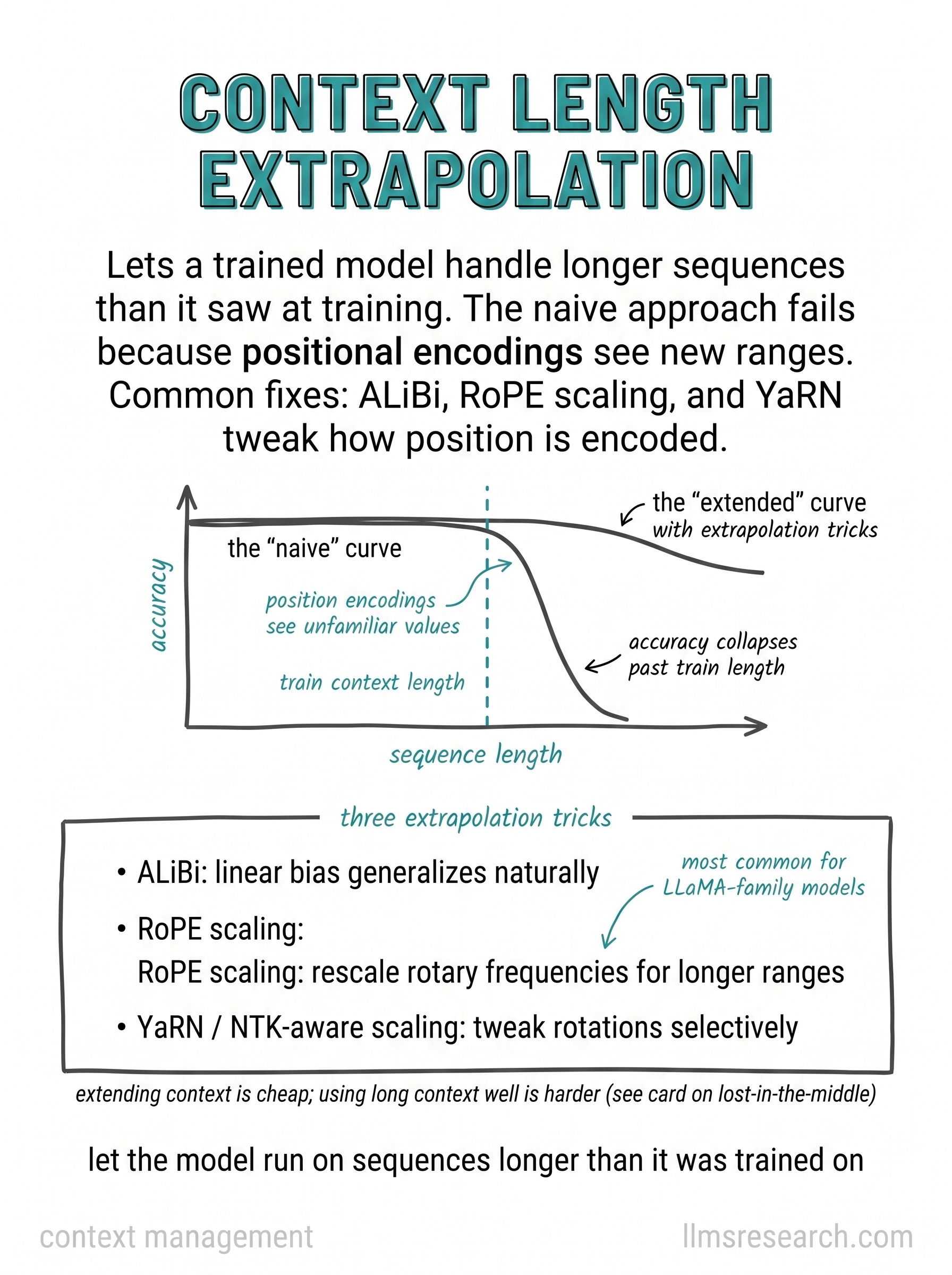
The card plots accuracy versus sequence length. A naive curve stays flat until the training context length, then drops sharply. An extended curve remains higher well past that point before tapering. A vertical dashed line marks the training-time maximum, with a note that positional encodings encounter unseen ranges beyond it. A box lists extension methods: ALiBi chosen at train time, RoPE scaling applied post-training, and YaRN-style selective frequency tweaks.
Position information governs how tokens relate across distance. If the model only trained up to eight thousand tokens, raw absolute positions at eighty thousand are out of distribution. Attention may still run, but quality degrades. Extrapolation techniques rescale or reparameterize positions so distant tokens remain meaningful. ALiBi biases attention slopes for length generalization during training. RoPE scaling and YaRN adjust rotary frequencies after training for LLaMA-family checkpoints.
Extending the window is not the same as using it well. Long inputs still face recall bias in the middle, higher KV cache cost, and slower prefill. The card links outward to lost-in-the-middle for that reason. Ship long context only with retrieval ordering, compression, and benchmarks at your target lengths.
For practitioners, check whether your provider applied a known scaling recipe or merely increased a advertised limit. Downloaded weights may need a matching config change to match claimed context. The caption on the card states the goal: run on sequences longer than training saw, which is an encoding fix first and a prompting problem second.