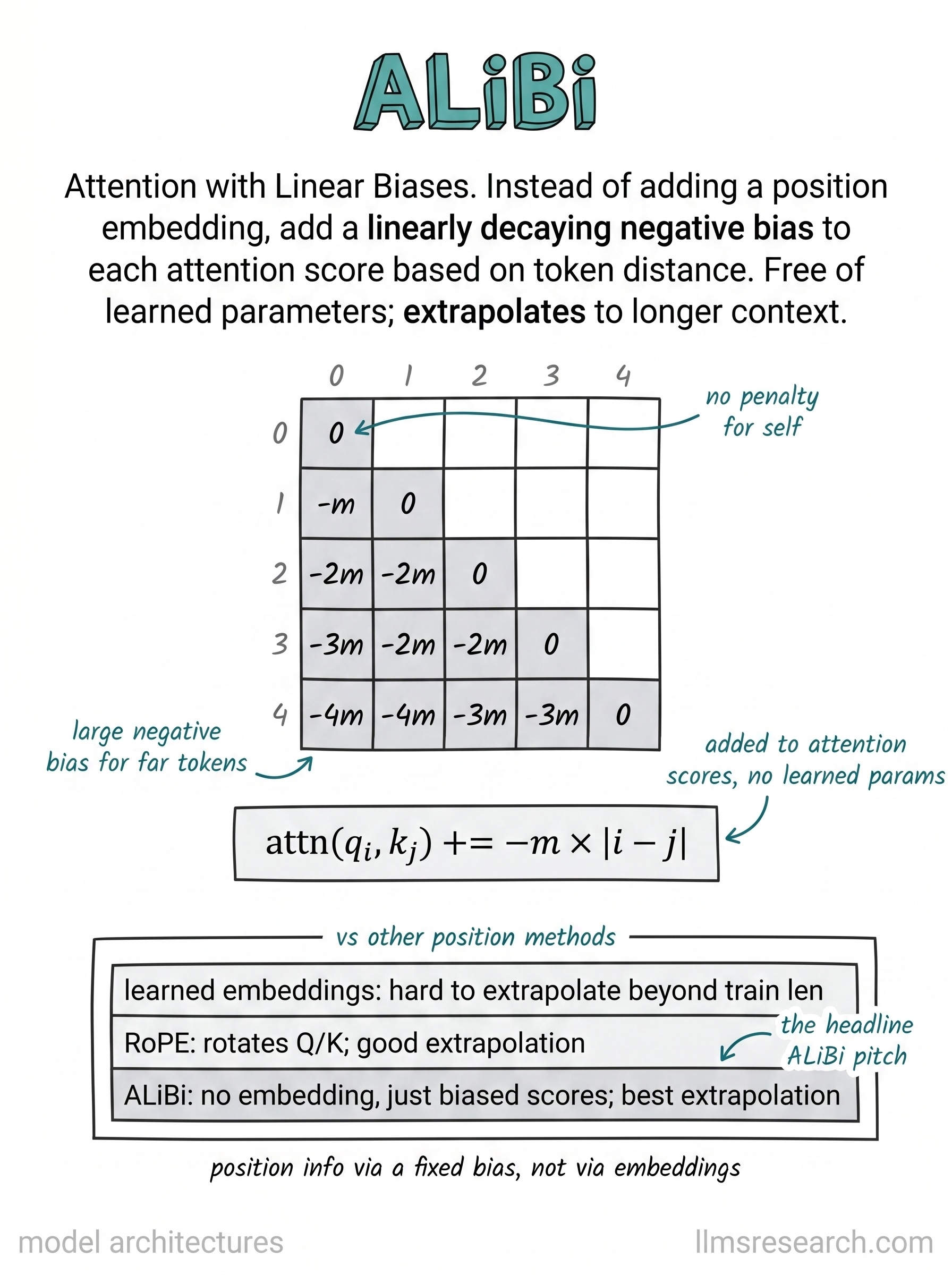
ALiBi, short for Attention with Linear Biases, is the most stripped-down way to tell a model about position. It adds no vectors and learns no parameters. It just penalizes attention for reaching far.
The mechanism is the formula on the card: to the attention score between a query at position i and a key at position j, add a negative bias equal to minus m times the distance between them. The grid shows the resulting pattern. A token attending to itself gets no penalty. A token one step back gets a small penalty, two steps back twice that, and so on, growing linearly with distance. The slope m is a fixed constant, set per attention head rather than trained. The effect is a gentle, built-in preference for nearby tokens, applied directly to the scores.
What makes this appealing is what it avoids. There is no position embedding added at the input and no table with a fixed number of rows. Position enters only as a distance-based bias on scores, so there is nothing that caps the sequence length. The card’s headline claim is extrapolation: because the bias is just a function of distance, a model trained on short sequences keeps behaving sensibly on much longer ones, which is exactly where learned embeddings break.
The comparison box places the three approaches on one axis. Learned embeddings are hard to push past the training length. RoPE rotates queries and keys and extrapolates well. ALiBi uses no embedding at all, only biased scores, and the card credits it with the best extrapolation of the three. That framing is ALiBi’s own pitch, so treat it as the design’s claim rather than a settled ranking; in practice RoPE is the more common default.
With position handled, the chapter turns to the mechanism all of this has been feeding, attention itself.