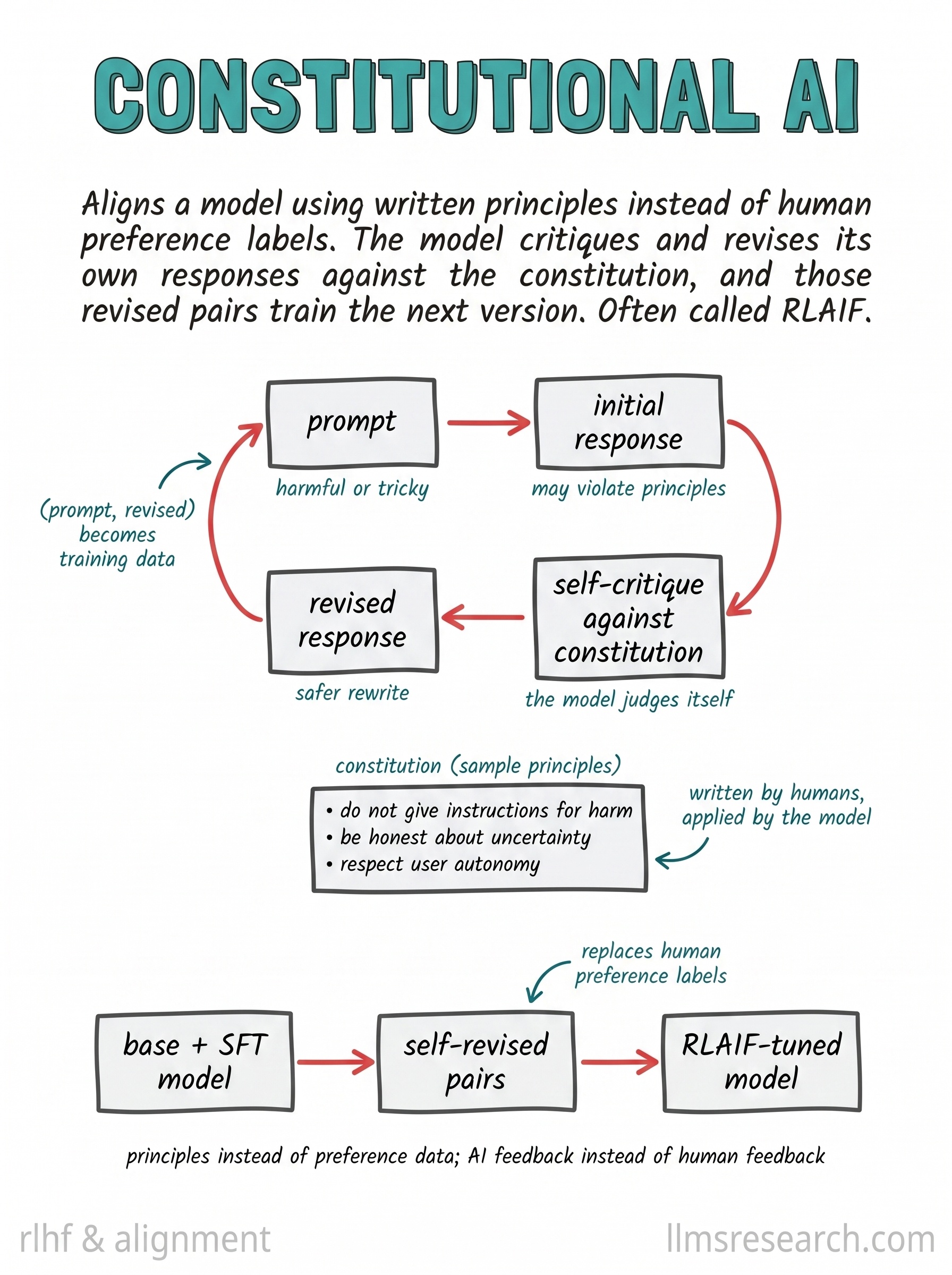
Constitutional AI attacks the cost that sits underneath everything else in this chapter: human preference labels are slow and expensive to collect. The card shows the alternative as a loop the model runs on itself. A prompt comes in, often a harmful or tricky one. The model produces an initial response that may violate the principles we care about. The model then critiques that response against a written constitution and rewrites it into a safer version. The pair of prompt and revised response becomes training data, and the loop feeds the next round.
The move that matters is who does the judging. In standard RLHF a person compares two responses and the reward model learns their taste. Here the model critiques itself against explicit written rules, so the judgment step needs no human in the loop. The card’s sample constitution lists the kind of principles used: do not give instructions for harm, be honest about uncertainty, respect user autonomy. These are written by people, but they are applied by the model, which is the division the card draws. Humans specify the values once, in words, rather than labeling thousands of individual comparisons.
The self-critique step is doing real work and deserves scrutiny. It relies on a capability gap that turns out to hold in practice: a model is often better at recognizing that a response violates a principle than at avoiding the violation while generating in the first place. Asking it to check its own draft against a rule and revise surfaces problems the first pass missed. The revised responses are cleaner than the originals precisely because critique is an easier task than flawless generation, and stacking many such revisions produces training data that pulls the model toward the constitution.
The bottom row shows where this fits the pipeline. A base plus SFT model generates self-revised pairs, and those pairs train an RLAIF-tuned model, replacing the human preference labels that would otherwise sit in that slot. The name reinforcement learning from AI feedback captures the swap: an AI grader stands in for the human annotators. The gain is scale, since the model can critique far more examples than a labeling team could ever review. The catch, which the card leaves implicit, is that the alignment is only as good as the written constitution and the model’s honesty in applying it, so a blind spot in the principles or a weakness in self-critique propagates straight into the tuned model.