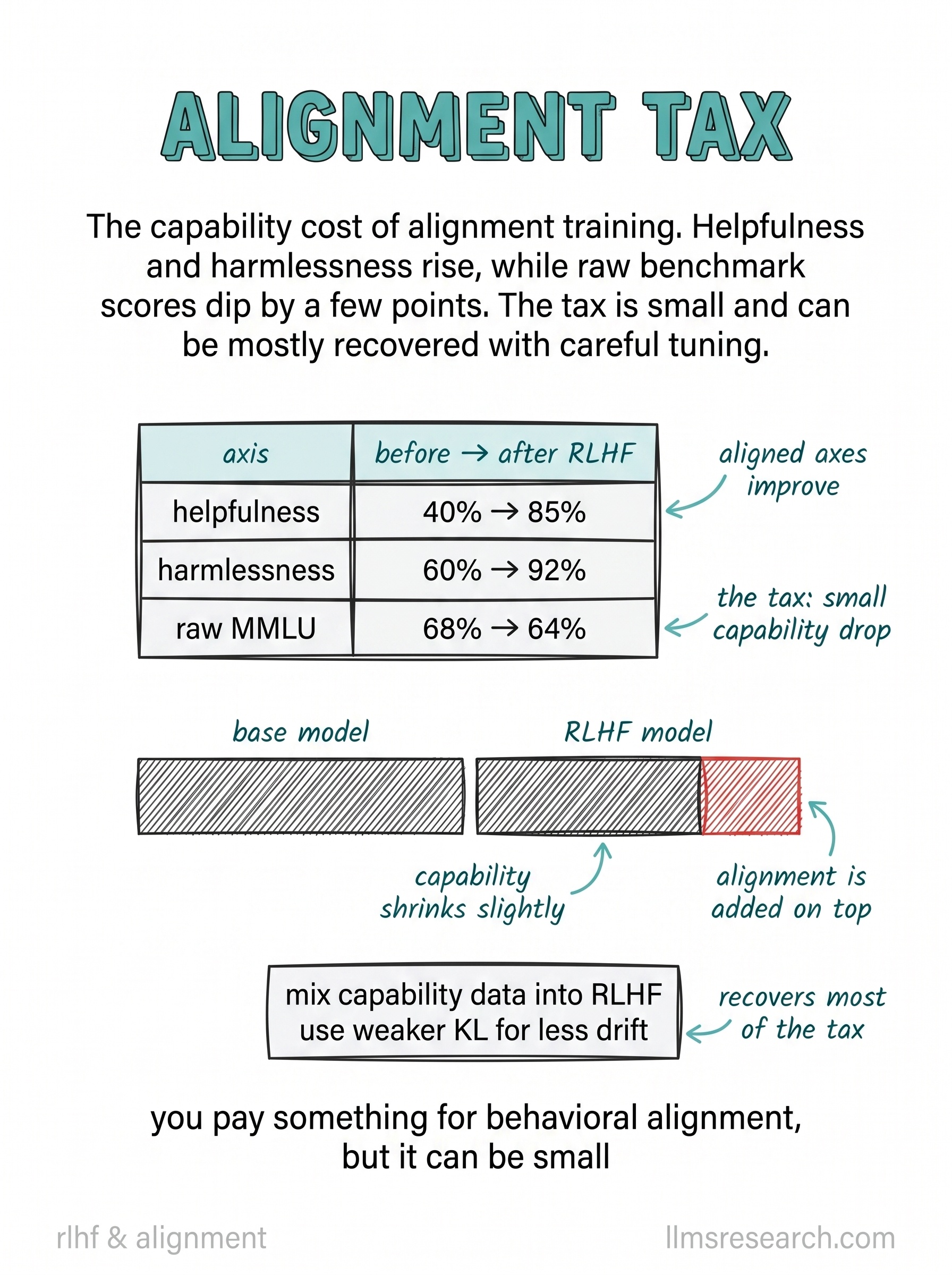
The alignment tax is the price a model pays for being aligned. The card’s table makes it concrete with before-and-after numbers across three axes. Helpfulness climbs from 40 to 85 percent, harmlessness from 60 to 92, and these are exactly the behaviors RLHF was meant to improve. But raw MMLU, a broad knowledge and reasoning benchmark, slips from 68 to 64. The aligned axes go up and a capability axis goes down, and that small drop on the thing alignment was not targeting is the tax.
The bar diagram gives the intuition for why this happens. The base model has some amount of raw capability. The RLHF model keeps most of it but shrinks slightly, and alignment behavior is added on top. The picture is not that alignment destroys ability; it is that pushing the model’s outputs toward a preferred style and a refusal boundary pulls its weights away from the configuration that maximized raw benchmark performance. This is the same mechanism as catastrophic forgetting from the fine-tuning chapter, narrowed to the case where the new objective is human preference rather than a single domain.
The reason the tax stays small rather than large connects back to the KL penalty. The policy is anchored to the SFT model, so it cannot drift far enough to lose its general competence even while it shifts toward preferred behavior. A weaker anchor would let alignment improve faster but would cost more capability; a stronger one protects capability but slows alignment. The tax is one visible symptom of exactly the tradeoff that beta controls.
The card’s mitigations are the standard levers. Mixing capability data into the RLHF stage keeps the model rehearsing the skills it might otherwise shed, and using a weaker KL constraint carefully lets it improve without drifting, though that has to be balanced against the reward-hacking risk. The annotation that this recovers most of the tax is the measured claim. You still pay something for behavioral alignment, as the caption says, but with attention to the data mix and the anchor strength the cost can be kept to a few points rather than a serious regression.