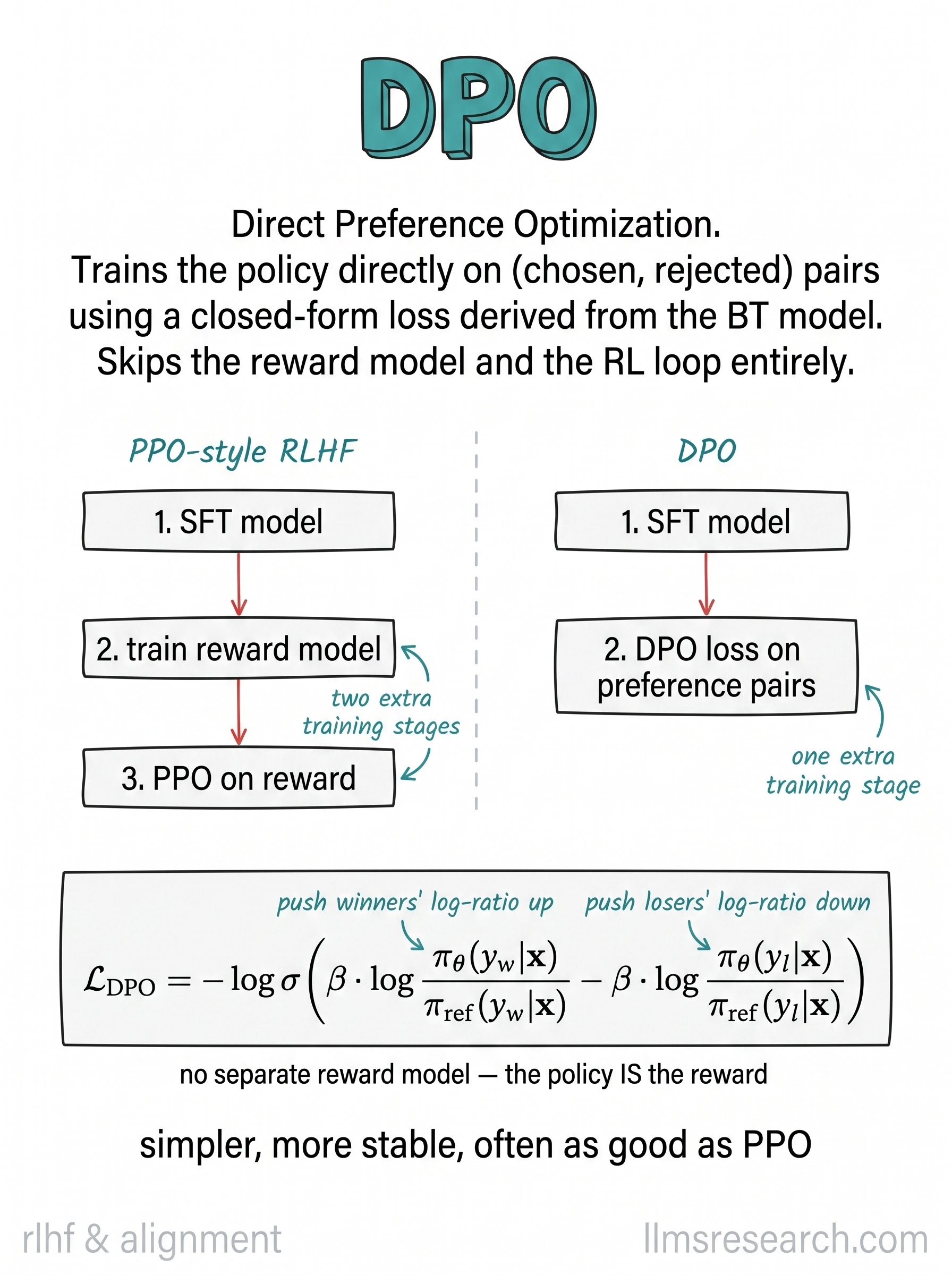
DPO is the answer to a natural question about the PPO pipeline: if the reward model is only a proxy fitted to preference pairs, and the policy is what we actually want, can we train the policy on the pairs directly and drop the machinery in between? DPO shows that you can. The card puts the two recipes side by side. PPO-style RLHF is three stages: an SFT model, a trained reward model, then PPO optimizing against that reward. DPO is two: an SFT model, then a single loss applied straight to the preference pairs. The reward model and the reinforcement learning loop both disappear.
The loss on the card is what makes the shortcut work. It is the negative log sigmoid of a difference of two terms. The first term is beta times the log-ratio of the policy’s probability of the chosen response to the reference’s probability of it; the second is the same log-ratio for the rejected response. Training pushes the chosen response’s ratio up and the rejected response’s ratio down, which the annotations label directly. The shape is the Bradley-Terry likelihood again, the same form the reward model used, but the score being fit is no longer a separate network’s output. It is the policy’s own log-probability relative to the reference.
That substitution is the insight the caption states: there is no separate reward model because the policy is the reward. The derivation behind DPO shows that the optimal RLHF policy can be written in closed form in terms of the reward, and that relationship can be inverted so the reward is expressed through the policy. Plugging that into the Bradley-Terry objective yields a loss over policy probabilities alone, with the reference model held frozen the same way PPO froze it. The KL constraint has not vanished; it is folded into the log-ratios and controlled by beta, so DPO still keeps the policy anchored to the SFT baseline, just without a separate penalty term.
The practical result is fewer moving parts. One extra training stage instead of two, no reward model to train and store, no four-model RL loop to stabilize, and a supervised-style loss that behaves more predictably than PPO’s noisy updates. The card’s closing line, simpler and more stable and often as good as PPO, is the measured claim the evidence supports. DPO is not universally better; PPO can still edge ahead when a high-quality reward model generalizes past the fixed preference set. But for many alignment jobs DPO reaches comparable quality at a fraction of the engineering cost, which is why it spread quickly once it appeared.