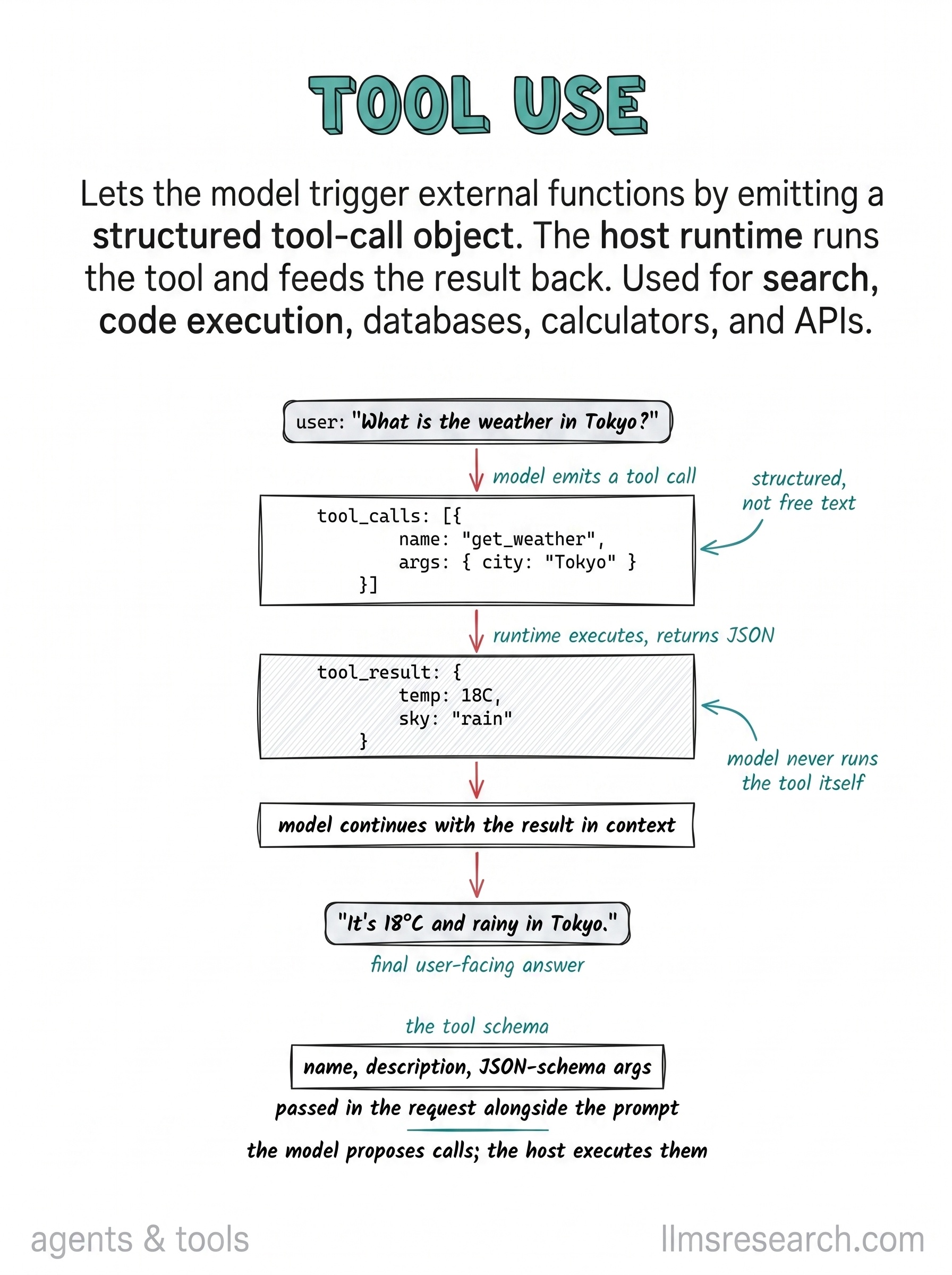
The card shows a request/response flow in three beats. First, the model receives a prompt that includes a list of available tools, each with a name, parameter schema, and short description. Second, instead of answering in plain text, the model emits a structured call: which tool to invoke and what arguments to pass. Third, the runtime runs that tool, appends the result to the conversation, and calls the model again so it can continue with real data in context.
Mechanically, function calling is a convention layered on top of ordinary text generation. During training or fine-tuning, the model learns to output JSON or another structured format when a tool is appropriate. The API parses that output, validates it against the declared schema, executes the matching function, and injects the return value as a new message before the next generation pass. From the model’s perspective, the tool result is just more text in the thread, but it arrived from a real external source rather than from the model’s weights.
This matters because a language model on its own has no reliable access to current facts, private data, or side effects in the world. Tool use is one of the main ways systems work around hallucination for factual queries: instead of guessing a stock price or a database row, the model asks a tool that returns the actual value. The same pattern extends to actions, sending an email, creating a calendar event, or running a query, as long as you expose those capabilities with clear schemas.
The design burden sits mostly on the integrator. Tool descriptions need to be precise enough that the model picks the right one and fills arguments correctly. Results need to be formatted so the model can interpret them without confusion. And every tool call is a trust boundary: the model is deciding to invoke code you wrote, so permissions, validation, and error handling belong in the runtime, not in the hope that the model will be careful. In an agent loop, tool use is the step where the model’s judgment turns into real-world effect.