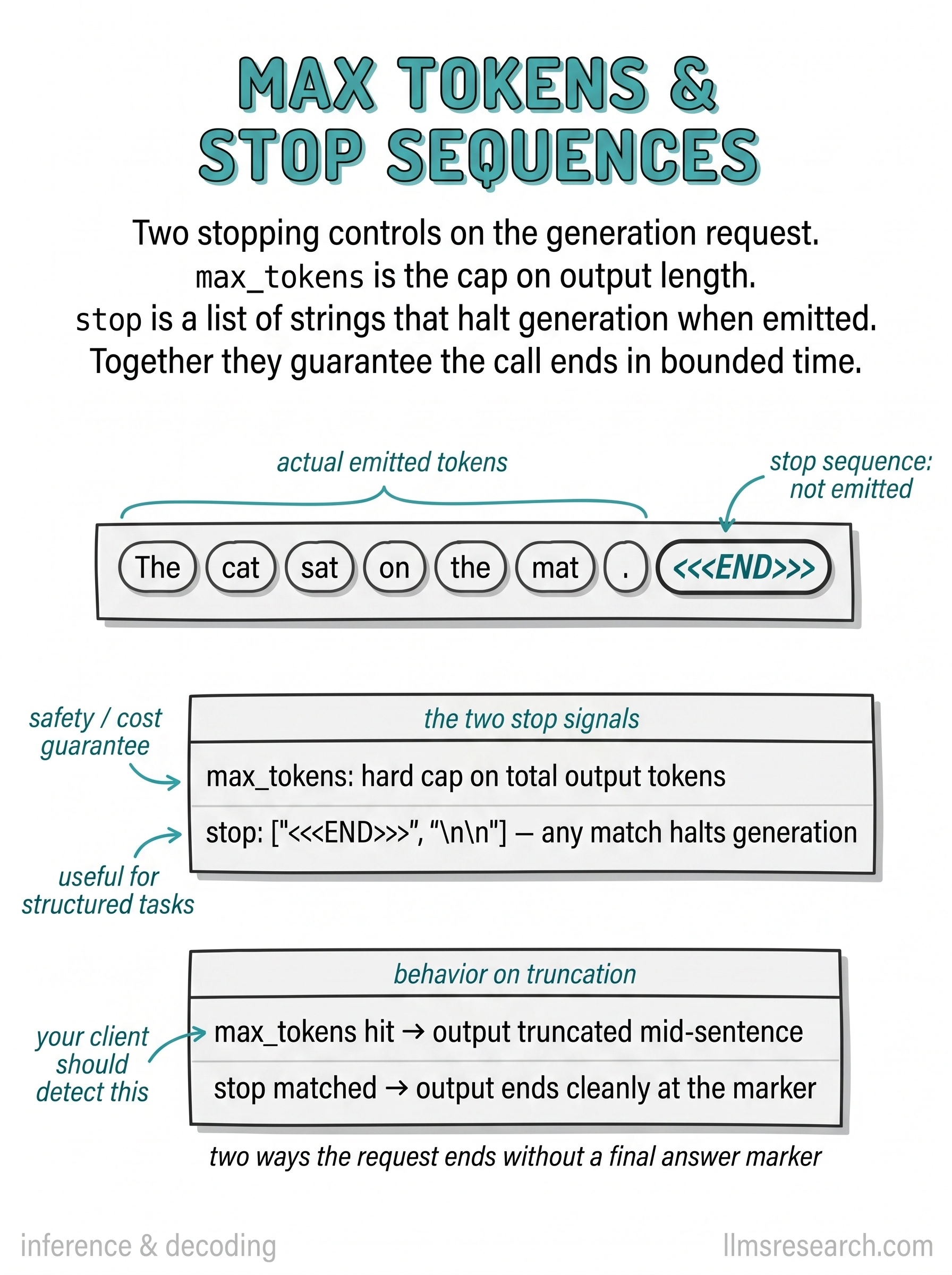
Generation would keep stepping forward until something tells it to stop. The API usually gives you two controls for that: a hard token cap and one or more stop strings.
max_tokens is the blunt one. It sets the maximum number of output tokens the
model may emit for this request. The reason to use it is practical: bounded cost,
bounded latency, and protection against a response that runs on longer than the
client can accept. If the cap is reached, the output may end mid-sentence. That is
not a model judgment that the answer is finished; it is truncation, and the client
should treat it as such.
A stop sequence is a string that halts generation when it appears. The card shows
<<<END>>> as the marker. The model may generate that text internally, but the
marker itself is not returned as part of the final output. This is useful when the
task has a known boundary: one JSON object, one answer before a delimiter, or one
section in a larger protocol.
The difference is clean endings versus guaranteed endings. max_tokens guarantees
the call stops, but it may cut the answer off. A stop sequence lets the answer end
at a deliberate marker, but only if the model produces that marker. In practice you
usually set both, so the request has a clean stop path and a hard fallback.