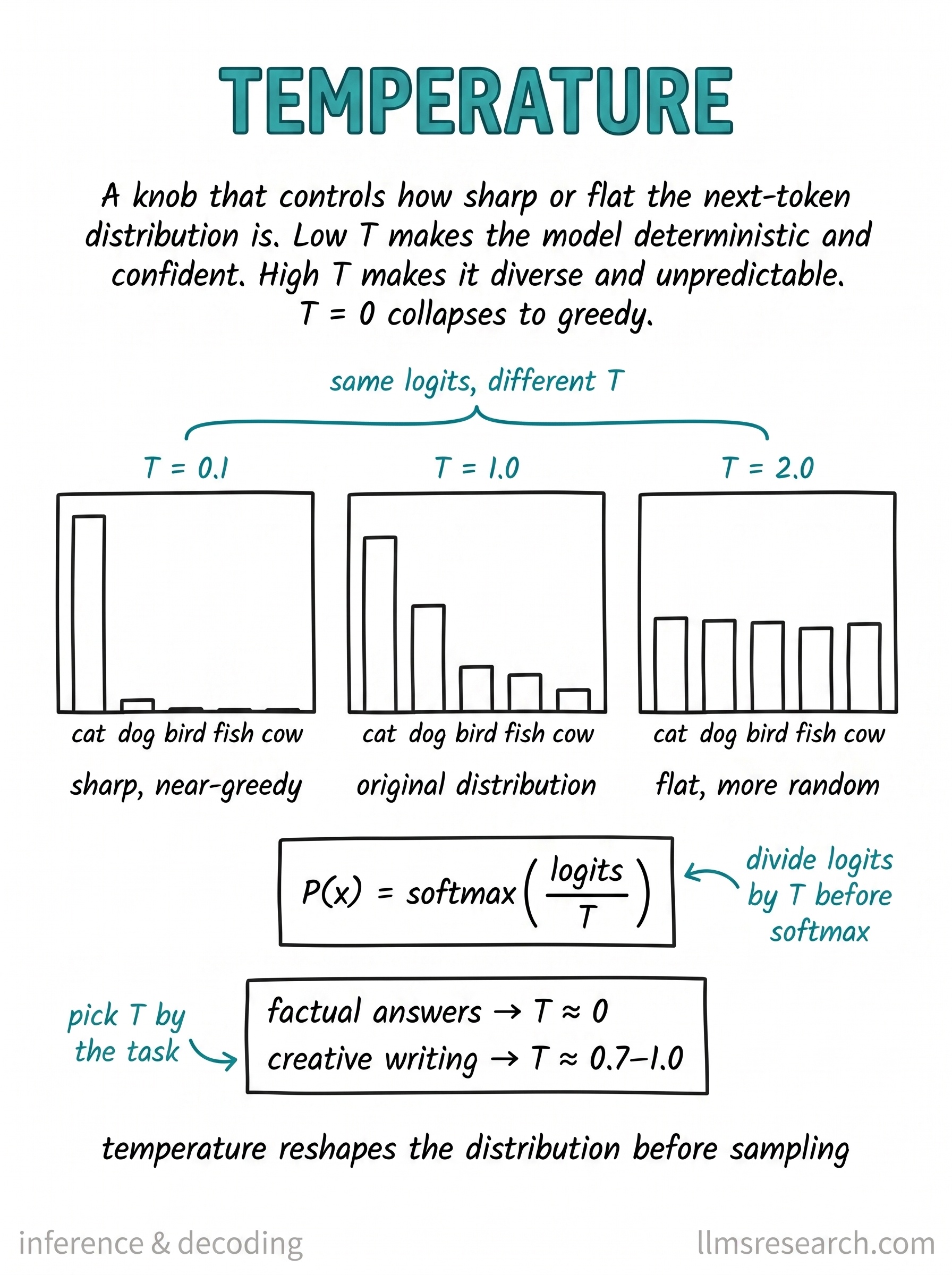
Temperature is the simplest decoding knob because it changes the shape of the next-token distribution without changing the model. The logits are the same. The only extra step is to divide them by T before softmax.
The three charts show the effect on one set of candidate tokens. At T near zero, the largest logit becomes dominant and the distribution is sharp, close to greedy decoding. At T equal to one, the distribution is left in its original softmax shape. At a higher value such as T equals two, the differences between logits are compressed and the bars flatten, giving lower-probability tokens more room to be sampled.
That is why the same prompt can feel factual or loose depending on this one number. A low temperature is useful when the task has a narrow answer, such as extracting a field, classifying an item, or following a strict format. A higher temperature is useful when variety matters more than repeatability, as in brainstorming or open-ended drafting. The card’s guidance box puts that into the usual ranges: close to zero for factual answers, around 0.7 to 1.0 for more creative writing.
Temperature does not decide which tokens are allowed. It only changes their relative probabilities before sampling. The truncation methods on the next cards do the other kind of work: they remove part of the distribution before the draw is made.