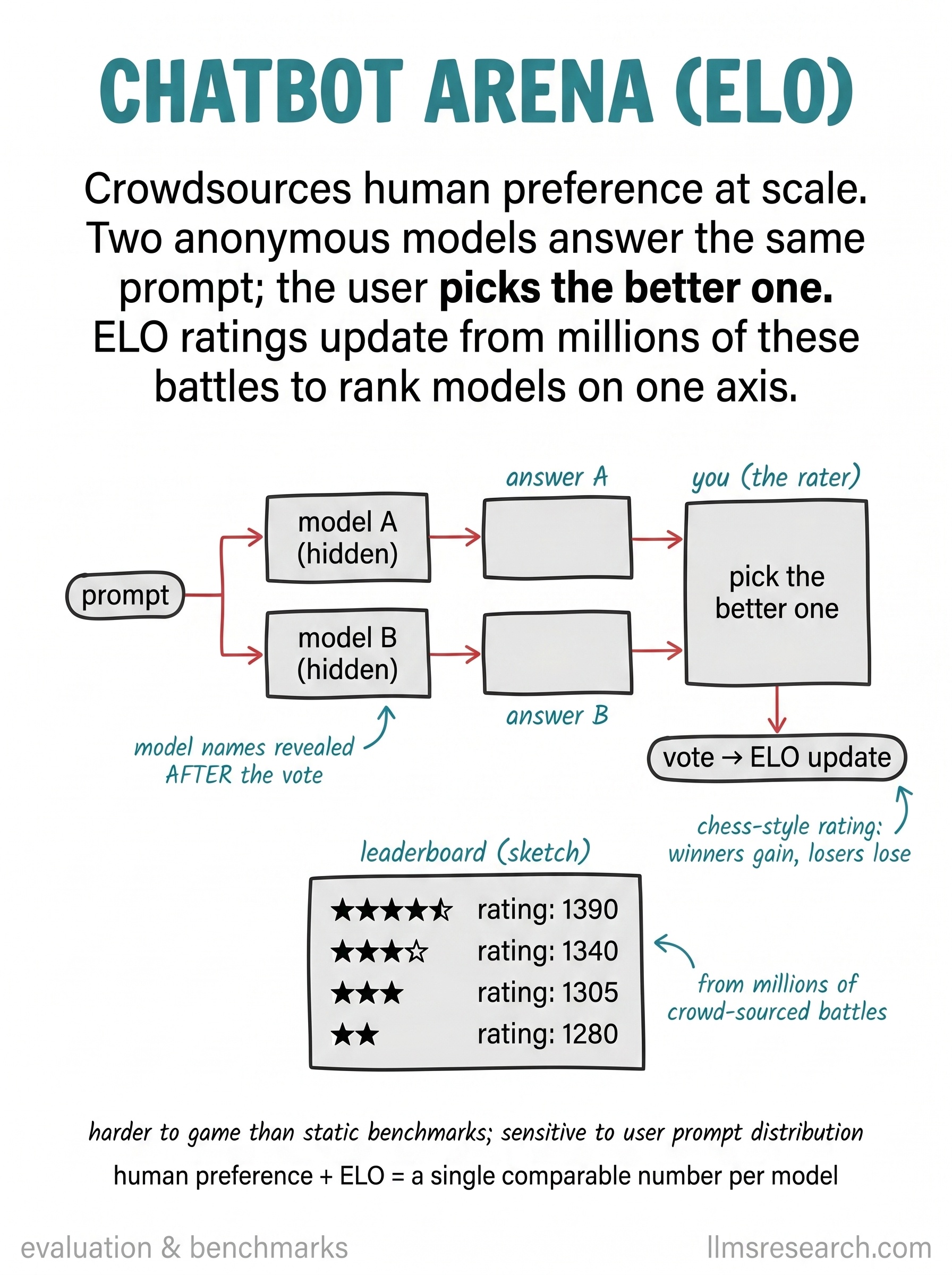
Static benchmarks can be gamed and may not match real chat usage. Chatbot Arena turns human preference into a public leaderboard. The card traces one battle. A prompt goes to two hidden models. The user sees both answers without knowing which model produced which, picks the better one, and the vote feeds an ELO update. Model names are revealed only after the vote so brand recognition does not sway the choice.
ELO is the aggregation mechanism. Each model carries a rating. When A beats B, A gains points and B loses points in proportion to the upset margin, the same logic as chess rankings. Millions of such pairwise outcomes compress into one number per model, which makes cross-model comparison simple even when not every pair has met directly. The sketched leaderboard in the middle shows how those ratings sort models into an ordered list.
The design choices matter for interpretation. Crowdsourcing scales beyond what any lab can run internally, but the prompt distribution follows whatever users submit, not a fixed academic suite. That makes Arena scores a measure of open-ended chat preference under real traffic, not a substitute for MMLU or HumanEval. Arena is also harder to game than static sets because prompts rotate and models stay anonymous during voting, though contamination and prompt leakage remain concerns elsewhere.
The card’s caption states the trade clearly: human preference plus ELO yields one comparable number per model. Use Arena to understand how models rank in interactive use, especially alongside static benchmarks that test knowledge and reasoning under controlled conditions. Bradley-Terry and related pairwise models share the same mathematical roots as the ELO update, which is why preference learning and Arena rankings speak a common language.