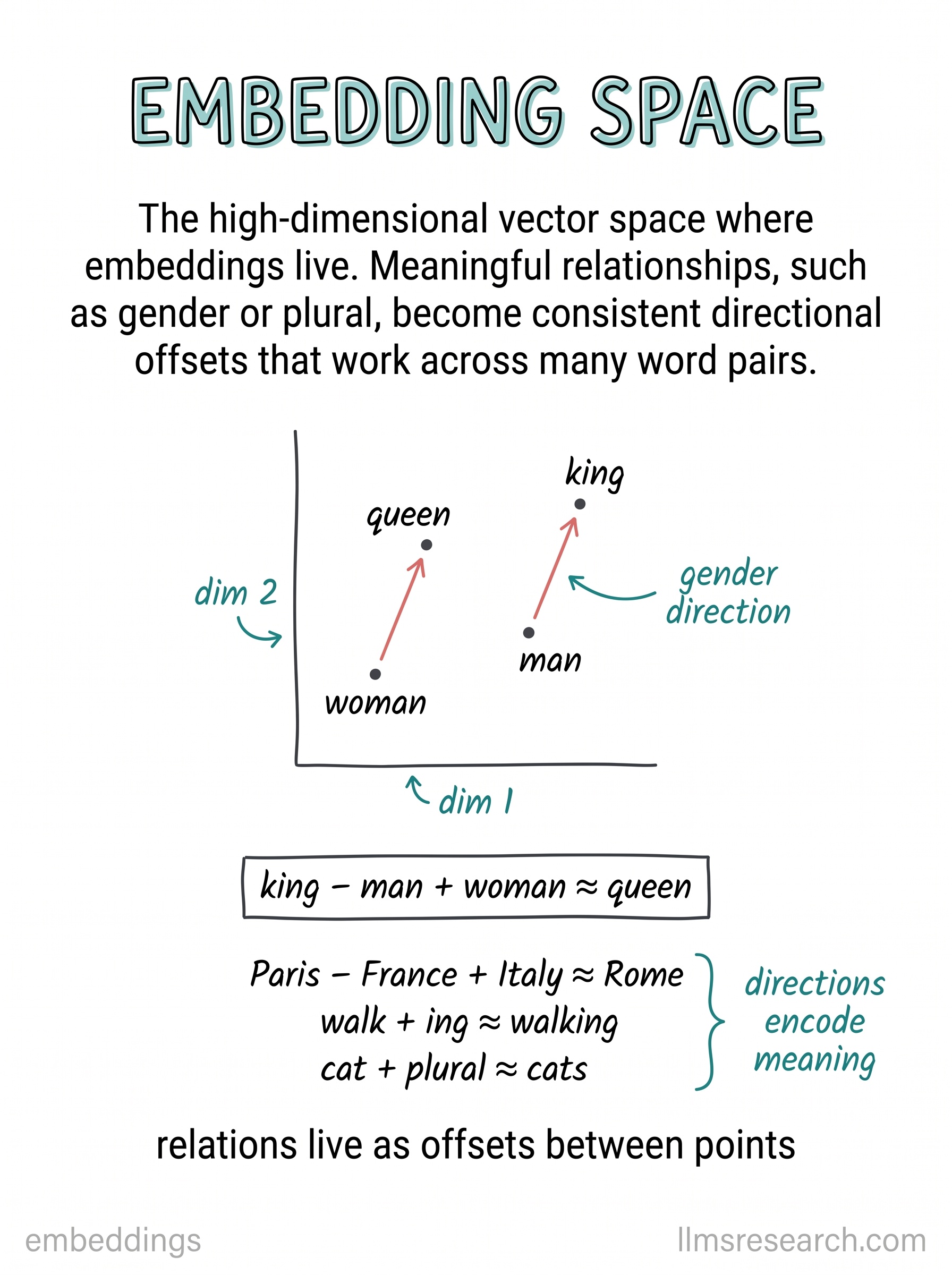
The previous card showed that similar words sit near each other. This one is about something subtler and more striking: the directions between words carry meaning too, not just the clusters they fall into.
The classic example is on the card. Look at the arrow from woman to queen and the arrow from man to king. They point roughly the same way and have roughly the same length. Whatever change turns woman into queen is the same change, as a direction in the space, that turns man into king. That shared direction is what the card labels the gender direction. It is not a coordinate anyone assigned; it fell out of training, and it is consistent enough that you can do arithmetic with it.
That arithmetic is the famous line: king minus man plus woman lands near queen. Read as vectors, you start at king, subtract the male direction, add the female direction, and arrive close to queen. The card lists more of these. Paris minus France plus Italy points at Rome, a capital-of relationship. walk plus an ing direction reaches walking. cat plus a plural direction reaches cats. Different relationships, same trick: each is a direction that generalizes across many pairs.
The reason this can happen is dimensionality. With hundreds of dimensions there is room for many independent directions to coexist, so one axis of variation can track gender while another tracks number and another tracks country, without colliding. The two-dimensional drawing flattens all of that, but the intuition survives: meaning is encoded in position and in direction.
Worth a caveat. These analogies are cleaner in the older static embeddings than in real models, and they are illustrative rather than exact. The durable idea is that the space has structure, and that structure is what makes embeddings more than a lookup. Measuring closeness in it is the next card.