The last two cards kept saying vectors are near or point the same way. Cosine similarity is how you actually put a number on that, and it is the measure most embedding systems use.
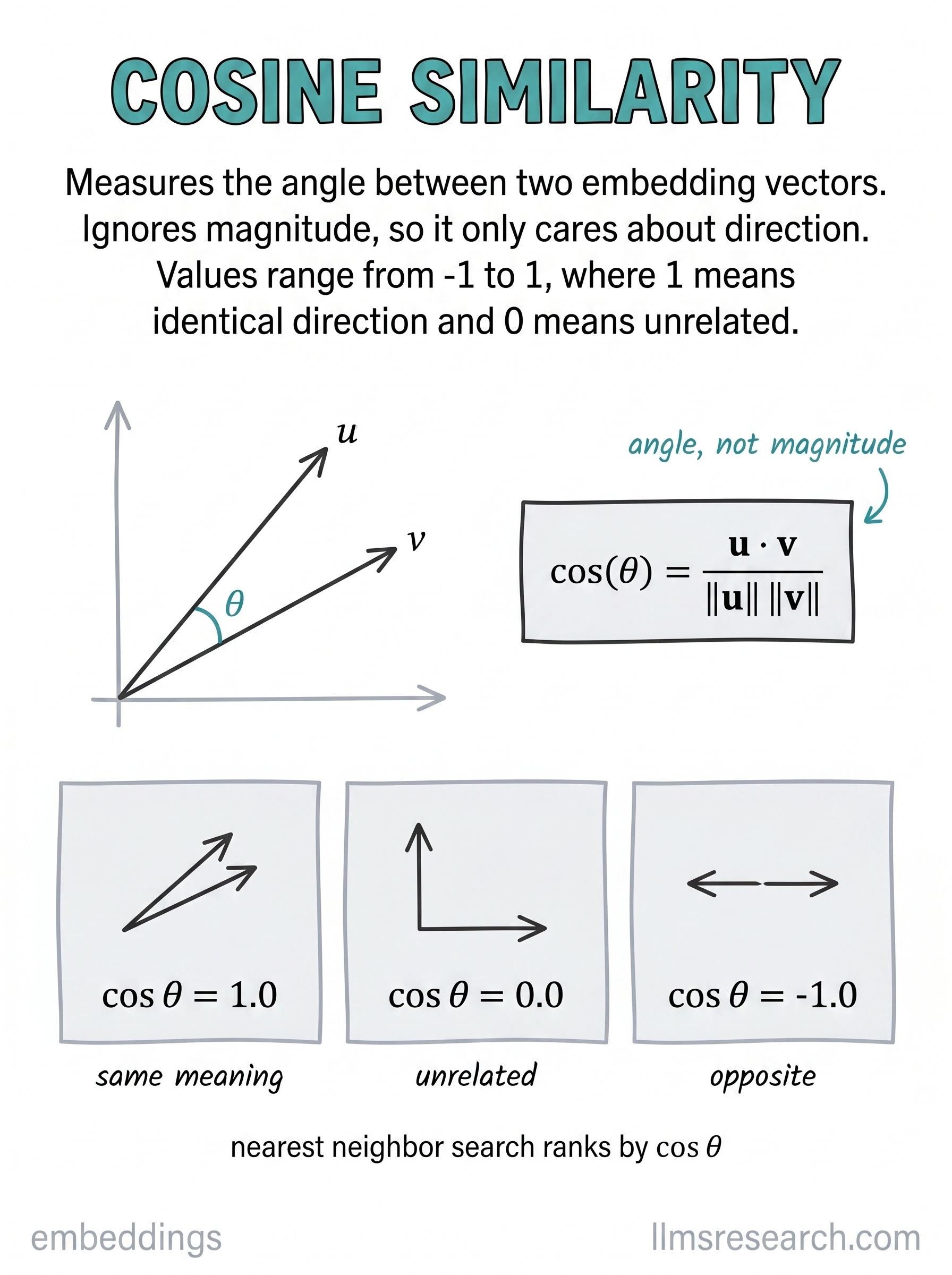
The idea is to compare direction and ignore length. The card draws two vectors, u and v, with an angle between them. Cosine similarity is the cosine of that angle, which the formula computes as the dot product of the two vectors divided by the product of their lengths. Dividing by the lengths is the important part: it cancels out magnitude, so only the angle is left. Two vectors that point the same way score high whether one is short and the other long.
The three panels give the whole range. When the vectors point in the same direction the angle is zero and the cosine is 1, read as same meaning. When they sit at a right angle the cosine is 0, meaning unrelated. When they point opposite ways the cosine is -1. So the score lives on a fixed scale from -1 to 1, which makes it easy to compare and threshold.
Why angle rather than plain distance? Because in these spaces the useful signal is usually which way a vector points, not how far out it sits. A word that appears very often can end up with a longer vector without being more similar to anything, and cosine similarity refuses to be fooled by that. It asks only about orientation.
The practical use is on the last line: nearest-neighbor search ranks candidates by cosine similarity. This is the engine under semantic search and retrieval. You embed a query, embed a pile of documents, and return the ones whose vectors point most nearly the same way. Later cards on retrieval lean directly on this measure.