A language model answers from what it learned during training. That knowledge is fixed at deployment time and has no access to your private documents, this week’s data, or facts that changed after the model was built. Retrieval-Augmented Generation, RAG, is the pattern for bringing external text into the answer at query time.
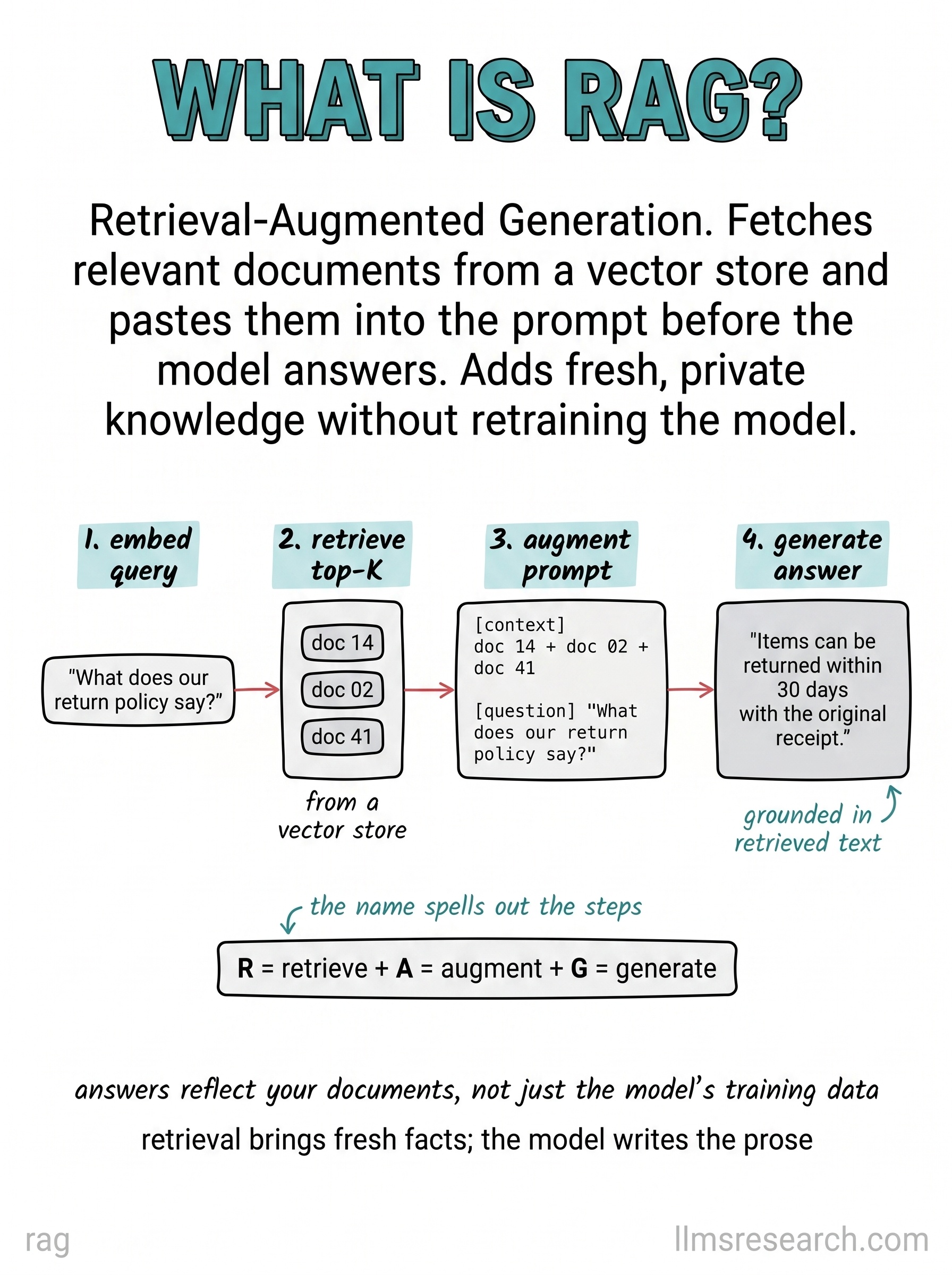
The card lays out four stages in a horizontal pipeline. First, the query is embedded. Second, the system retrieves the top-K similar documents from a vector store. Third, those documents are pasted into the prompt as context, wrapping the user’s question. Fourth, the model generates an answer conditioned on that context. The example uses a return-policy question and shows the model quoting a thirty-day window grounded in retrieved text rather than inventing a policy from memory.
The acronym spells out the steps: Retrieval, Augment, Generate. Retrieval fetches facts. Augmentation places them in the prompt. Generation writes the prose. A vector database handles the retrieval stage, but RAG is the larger idea that connects search to language model output. The model still does the writing. Retrieval supplies the evidence.
This matters because it separates knowledge storage from language ability. You can update the document index without retraining weights. You can point the same model at different corpora for different customers. Answers can reflect your sources rather than the model’s parametric memory, which reduces fabricated details on domain-specific questions.
The practical takeaway is that RAG is a system architecture, not a single model feature. It requires an indexed corpus, an embedding and search stack, a prompt template that accepts retrieved context, and eval to confirm the model uses that context faithfully. The cards that follow in this chapter each zoom into one stage of the pipeline.