RAG indexes documents, but it rarely retrieves a full document at once. A policy PDF, a wiki page, or a codebase file may run to thousands of tokens. Embedding the whole thing produces one vector that averages over many topics, and returning the entire file would waste most of the context window. Chunking is the preprocessing step that splits source material into smaller passages before indexing.
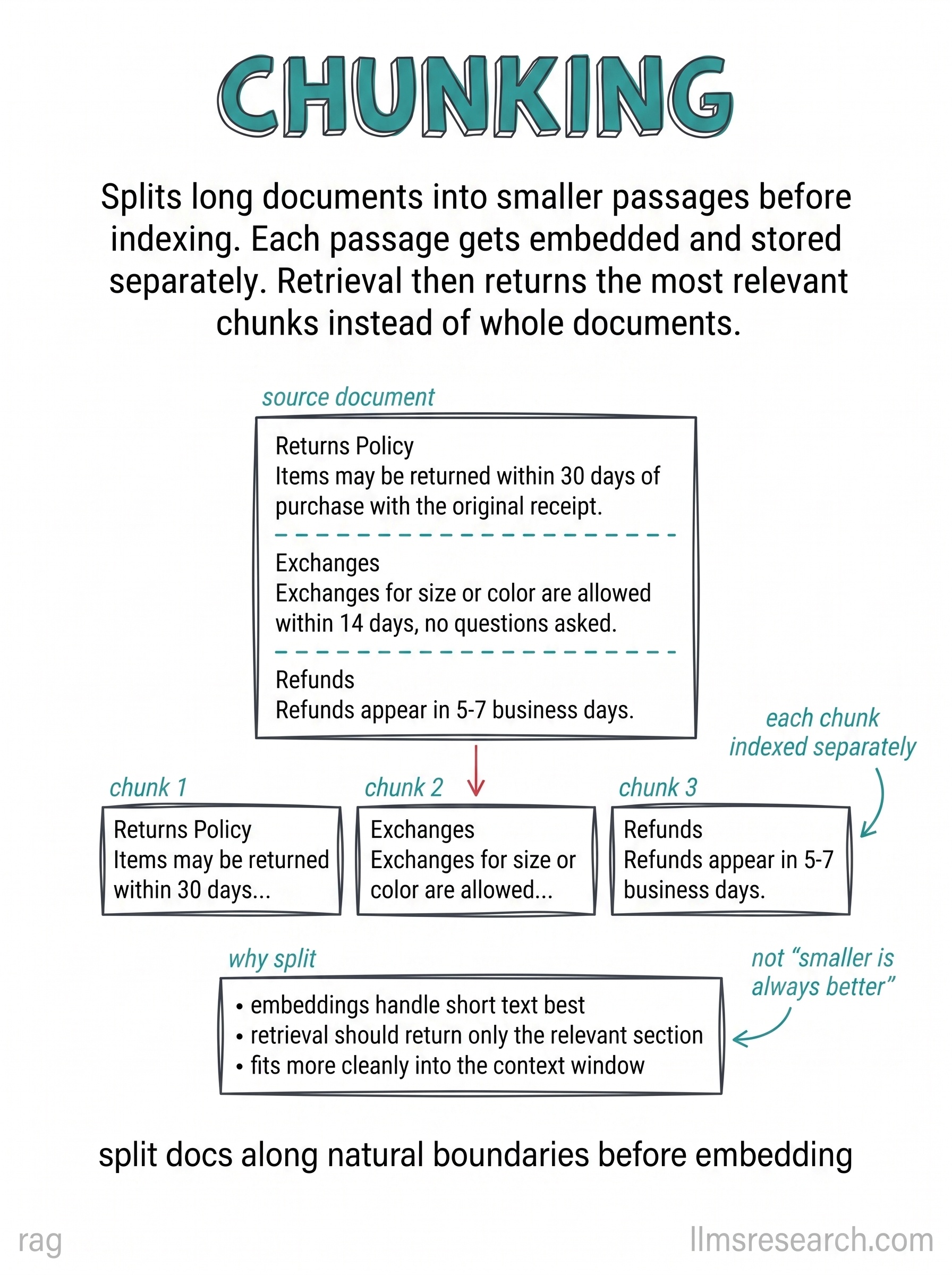
The card shows one source document at the top, a returns policy with sections on returns, exchanges, and refunds. Horizontal dashed lines mark chunk boundaries at natural section breaks. Below, three separate chunk rectangles each carry its own id and a subset of the original text. Each chunk is embedded and stored independently, so a query about refunds can retrieve the refunds section without pulling in unrelated exchange rules.
The reasons box lists why splitting helps. Embedding models handle short text more reliably than very long inputs. Retrieval should return only the section that answers the question, not an entire manual. Smaller chunks also fit more cleanly into the context window alongside instructions and the user question. The annotation notes that smaller is not always better, which is the subject of the next card on chunk size and overlap.
Boundary choice affects recall. Splitting on headings and paragraphs preserves semantic units. Splitting on fixed token counts is simpler but may cut sentences in half. Either way, the goal is units that are small enough to be specific and large enough to carry a complete thought.
The practical takeaway is to chunk along natural boundaries when the document structure allows it, and to treat chunking as part of index design rather than an afterthought. Every chunk becomes one row in the vector store, so the granularity you choose at index time determines what retrieval can return at query time.