A trained model stores billions of weights as floating-point numbers. Each value can land anywhere on a continuous number line. Quantization replaces that smooth range with a fixed set of discrete buckets.
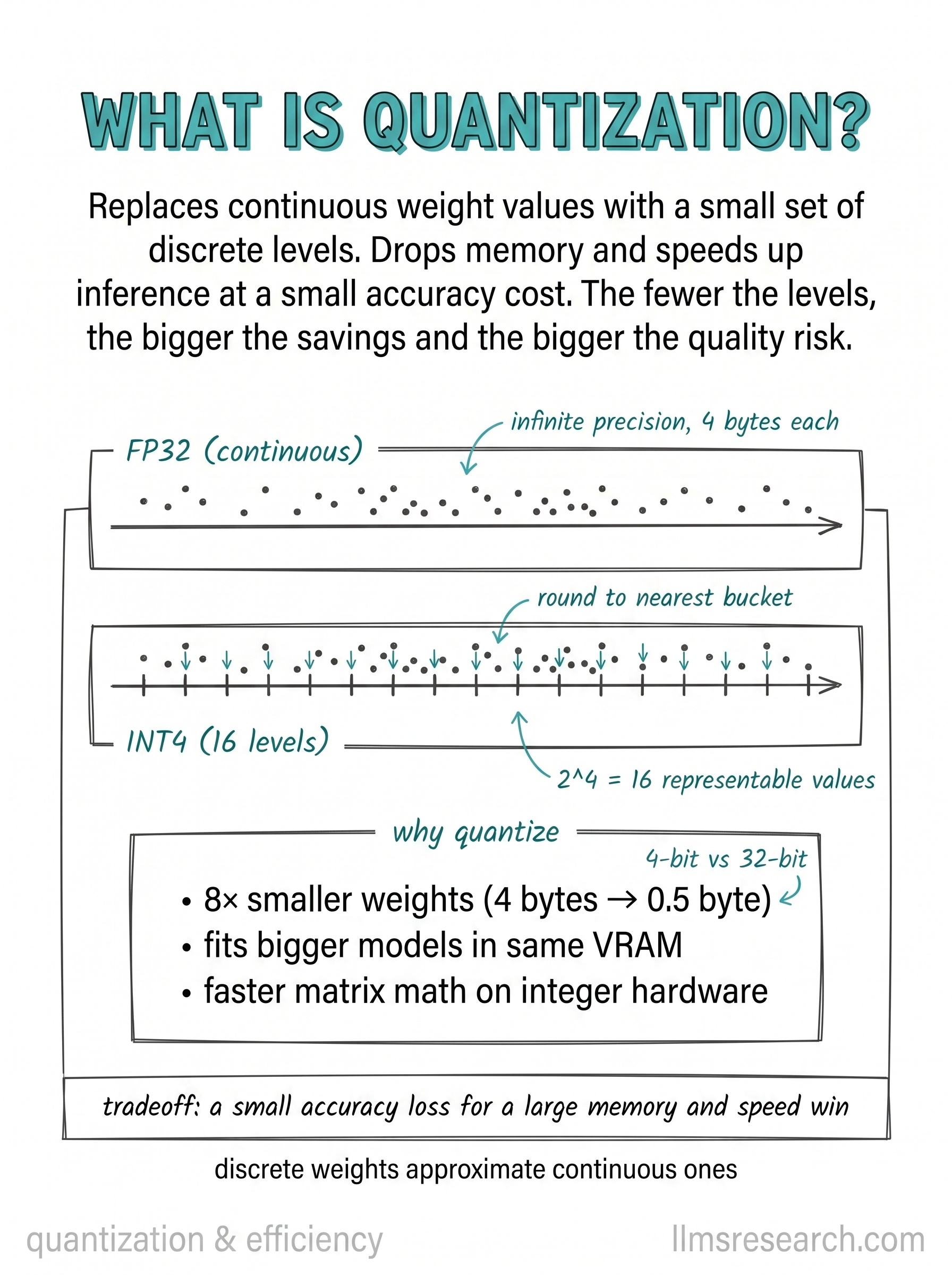
The card draws that change on two horizontal number lines. The top line is FP32: many scattered dots at irregular positions, each weight free to sit anywhere on the axis. The bottom line is INT4: the same dots mapped onto 16 evenly spaced ticks, with short arrows showing each weight rounded to its nearest bucket. The label notes that 2^4 gives only 16 representable values.
The middle panel lists why this tradeoff is worth making. Four-bit weights need roughly eight times less storage than 32-bit weights, which lets larger models fit in the same VRAM and can speed up matrix math on integer-friendly hardware. The cost is approximation error: a weight that sat between two buckets gets snapped to one of them, and the network output shifts slightly.
Quantization is inference-time compression. Training may still use full precision; deployment often cannot afford to keep every weight at 32 bits. The card’s closing line states the core idea plainly: discrete weights approximate continuous ones, with savings that grow as the number of levels shrinks.